A charge-engineered wood-derived binder could help battery makers replace fluorinated PVDF systems while improving electrode strength, ion transport, and high-loading performance.
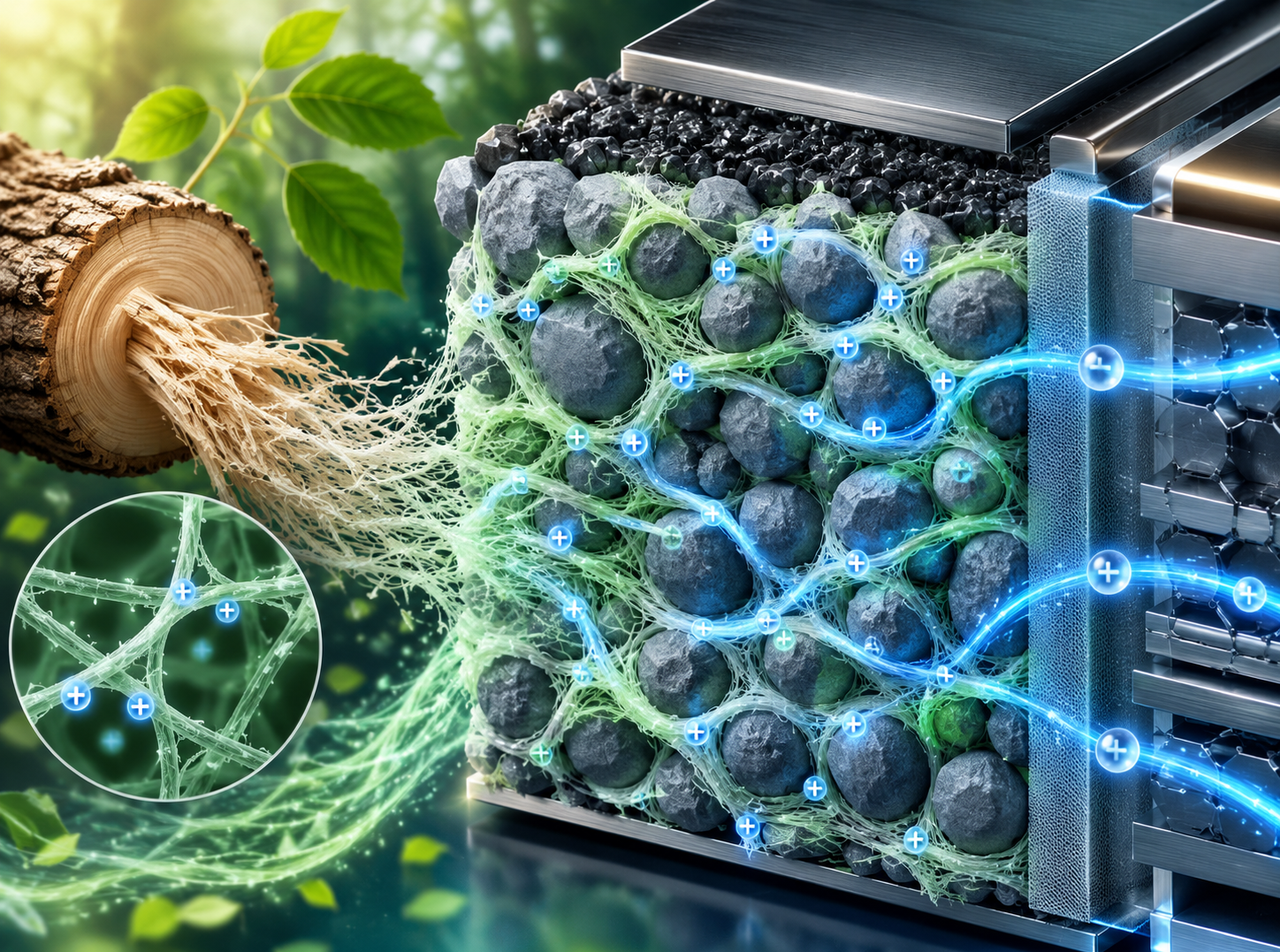
Charge-engineered cellulose nanofibril binders for PFAS-free, high-loading lithium battery positive electrodes. Image Credit: AI-generated image / OpenAI
In a recent research article published as an Article in Press in the journal Nature Communications, researchers developed charge-engineered cellulose nanofibril binders with tailored nanoscale structures to enable PFAS-free, high-loading lithium battery positive electrodes with enhanced ion transport and structural integrity.
Sustainable Nanofibril Binder Design
The increasing demand for sustainable, high-performance lithium-ion batteries has raised growing concerns regarding the environmental persistence and potential health impacts of per- and polyfluoroalkyl substances (PFAS) used in various battery components.
Polyvinylidene fluoride (PVDF), the dominant electrode binder, relies heavily on fluorinated chemicals and toxic solvents such as N-methyl-2-pyrrolidone (NMP), raising environmental and processing concerns. Additionally, PVDF exhibits limitations in supporting structural integrity under high mass-loading conditions, which is crucial for maximizing battery energy density.
This study introduces a novel binder based on charge-engineered cellulose nanofibrils (c-CNFs), designed to address both environmental and performance challenges by enabling PFAS-free battery electrodes with enhanced mechanical and electrochemical properties.
Charge-Engineered Binder Fabrication
The authors developed a charge-engineered variant of cellulose nanofibrils by functionalizing CNFs with quaternary ammonium groups, rendering them cationic (c-CNF). This functionalization induces electrostatic repulsion among slurry components, thereby improving the dispersion stability of active materials and conductive additives and reducing aggregation.
After drying, the c-CNF forms strong hydrogen bonds with electrode components, enhancing interfacial adhesion and structural cohesion. The nanofibrous morphology of c-CNF creates an interconnected network that reinforces mechanical integrity through physical entanglement and facilitates electrolyte infiltration and lithium-ion transport.
The binder and electrode slurries were prepared using environmentally benign ethylene glycol (EG) as the solvent rather than hazardous NMP. The electrochemical characterization focused on high-loading positive electrodes comprising LiNi0.8Co0.1Mn0.1O2 (NCM811) active material combined with carbon black additives and, in high-loading configurations, single-walled carbon nanotubes (SWCNTs) as conductive additives.
Various advanced microscopy, spectroscopy, and mechanical testing techniques were used to evaluate the morphology, elemental distribution, bonding interactions, mechanical strength, and cycling stability of the electrodes at the nanoscale.
Electrode Performance and Mechanisms
The charge-engineered c-CNF binder exhibited superior performance in stabilizing high-mass-loading electrodes compared to conventional PVDF binders. The quaternary ammonium moieties imparted cationic surface charge, promoting electrostatic repulsion and uniform particle dispersion in slurries, as confirmed by rheological studies and microscopy.
The nanofibrous structure of c-CNF developed a porous network that not only mechanically reinforced the electrode but also enhanced ionic pathways, enabling efficient electrolyte penetration. These nanoscale network architectures enabled the fabrication of electrodes with exceptionally high mass loading of 113 mg cm-² and a high density of 3.65 g cm-³ via standard slurry casting and roll-to-roll-compatible processes, supporting manufacturing scalability.
Electrochemical tests demonstrated that c-CNF-based electrodes achieved an areal capacity of 22.5 mAh cm-² and volumetric energy density of 1781.5 Wh L-¹ at 0.05 C, showing competitive performance relative to PVDF-based electrodes and superior performance in several high-loading, structural, and cycling tests. Mechanically, c-CNF binder suppressed crack initiation and propagation, preserving electrode crystallinity and structural integrity even after cycling tests.
The binder's nanofibrous networks mitigated stress concentrations at nanoscale grain boundaries and particle interfaces, as evidenced by microscopy showing reduced particle fragmentation and enhanced cohesion.
Pouch cell tests further validated these findings, indicating that c-CNF binders maintain uniform electrode microstructures and approach theoretical capacity even in small pouch-cell configurations used to evaluate scalability, in contrast to PVDF binders, which showed substantial capacity fading.
Additionally, the c-CNF binder facilitated NMP-free slurry processing using green solvents, reducing the environmental burden associated with fluorinated binders and NMP-based slurry processing. The nanostructured binder promoted the dispersion of SWCNT conductive additives, a known challenge due to their tendency to aggregate, enabling enhanced electronic conductivity.
The open, porous framework of c-CNF networks enhanced lithium-ion transport (tLi+), as confirmed by nuclear magnetic resonance (NMR) and electrochemical impedance spectroscopy (EIS) studies.
After prolonged cycling, full cells with c-CNF-based positive electrodes and commercial graphite negative electrodes retained approximately 88% of initial capacity after 300 cycles, exceeding PVDF-based control cells, indicating enhanced durability conferred by nanoscale charge-engineered cellulose networks.
The binder design successfully harmonizes molecular-level surface charge engineering with nanoscale fibrous architecture to overcome longstanding trade-offs between sustainability and battery performance.
Implications for Battery Sustainability
This study presents charge-engineered cellulose nanofibrils as a promising renewable binder alternative to fluorinated PVDF-based systems associated with PFAS chemistry for high-loading lithium battery positive electrodes. Through quaternary ammonium functionalization, the c-CNF binder effectively uses electrostatic repulsion to stabilize slurry dispersions and forms strong hydrogen-bonding interactions upon drying, resulting in a mechanically resilient nanofibrous network.
This architecture facilitates electrolyte infiltration and ion transport, enabling scalable electrode fabrication with high areal capacity and volumetric energy density. Unlike conventional PVDF binders, the c-CNF binder supports NMP-free, environmentally friendly processing and enhances cycle life by preserving electrode integrity at the nanoscale.
Overall, integrating precision nanomaterial design with green manufacturing strategies offers a promising pathway to overcoming sustainability-performance trade-offs in lithium-ion battery electrodes, providing a versatile binder platform for next-generation high-energy batteries.
Download your PDF copy by clicking here.
Source:
- Kim SW., Kim NY., et al. (2026). Charge-engineered cellulose nanofibril binders for PFAS-free, high-loading lithium battery positive electrodes. Nature Communications Article in Press. DOI: 10.1038/s41467-026-73909-0, https://www.nature.com/articles/s41467-026-73909-0