A magnetic, gold-containing nanomaterial combines bacterial capture, targeted heating, and rapid recovery in a single platform, pointing toward a new approach to controlling pathogens in complex food and water environments.
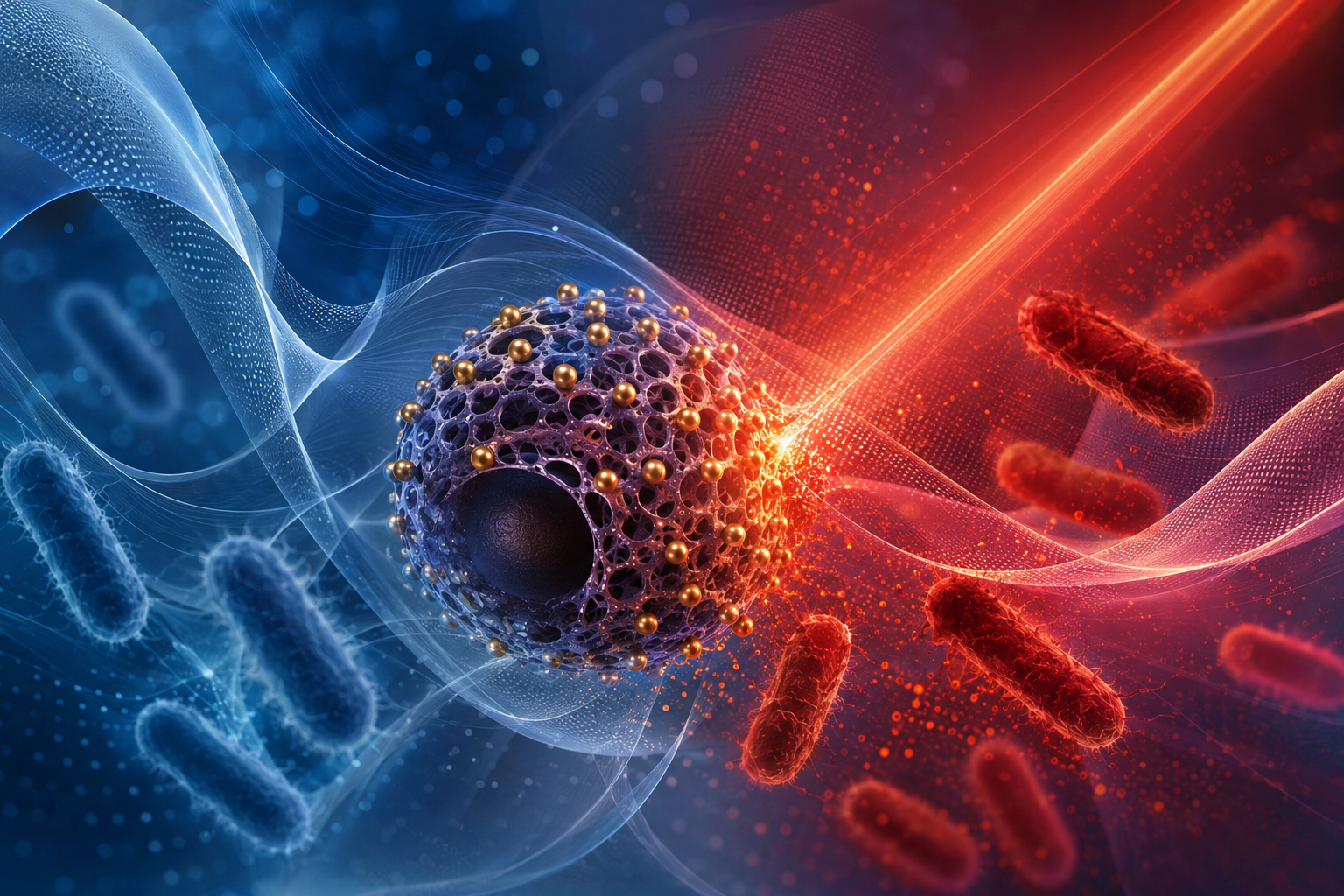
Paper: Composite multilayer nanomaterials for photothermal sterilization of pathogenic bacteria in milk and water. AI-generated conceptual image created using ChatGPT/OpenAI
In a recent research article published in the journal npj Science of Food, researchers designed a composite multilayer nanomaterial (nanoparticles">MCOF@Au@PEI NPs) that integrates capture, photothermal sterilization, and separation/recycling functions to rapidly and efficiently eliminate pathogenic bacteria in milk and water.
Novel Sterilization Imperative
The pervasive global consumption of dairy products and the critical need for safe drinking water underscore the pressing issues of microbial contamination. Traditional sterilization techniques, particularly for food, often face limitations, including the introduction of chemical residues, substantial energy demands, and potential degradation of nutritional content.
These methods can be energy-intensive, and concerns about antibiotic residues and antimicrobial resistance further motivate the development of advanced, sustainable alternatives. Nanotechnology has emerged as a promising frontier, offering recyclable, potentially lower-residue approaches using materials capable of bacterial capture and photothermal conversion.
MCOF@Au@PEI Synthesis and Testing
The foundational aspect of this investigation involved the systematic synthesis and comprehensive characterization of the composite multilayer photothermal nanomaterial, MCOF@Au@PEI NPs.
The fabrication commenced with the preparation of magnetic Fe3O4 nanoparticles (magnetic nanoparticles">MNPs), which are integral to subsequent magnetic separation and recovery. These MNPs were then encapsulated within a covalent organic framework (COF), forming MCOFs, which provided a stable scaffold and enhanced structural integrity.
Gold nanoparticles (AuNPs) were subsequently loaded onto the MCOFs, yielding MCOF@Au NPs, which are critical for their exceptional near-infrared (NIR) light-to-heat conversion efficacy. The final layer consisted of polyethyleneimine (PEI), which provided a positively charged surface that promoted non-specific bacterial capture and contributed to the material's stability.
The nanomaterial's photothermal conversion efficiency was rigorously quantified by exposing MCOF@Au@PEI NPs at varying concentrations to an 808 nm NIR laser, with real-time temperature monitoring via thermal imaging.
This facilitated the identification of optimal concentrations and power densities. Photothermal stability was assessed over five heating-cooling cycles, while reuse was evaluated separately through repeated sterilization, magnetic recovery, washing, and recapture.
Antibacterial efficacy was evaluated against Escherichia coli, Staphylococcus aureus, and Salmonella typhimurium. Experiments involved incubating the nanomaterial with bacterial suspensions under NIR irradiation, with bacterial capture efficiency quantified by supernatant plate counts following magnetic separation.
Sterilization efficiency was determined by viable plate counts post-treatment. Furthermore, the material's capacity to disrupt bacterial biofilms, a significant contributor to antimicrobial resistance, was investigated using crystal violet staining to measure biofilm biomass reduction. The material alone did not significantly inhibit bacterial growth or biofilm formation; biofilm disruption occurred only after photothermal treatment.
Laboratory-scale efficacy was tested in experimentally contaminated milk and drinking water samples, extending the assessment to food and water matrices containing the three bacterial species. Comprehensive analysis using ICP-MS detected no leakage of Fe or Au from the treated samples. Cytotoxicity assays on human and animal cell lines provided preliminary evidence of good biocompatibility, supporting further investigation of the approach for food and water processing.
Efficient Bacterial Elimination
MCOF@Au@PEI nanoparticles provide an effective, broad-spectrum bacterial sterilization method, primarily utilizing photothermal conversion. This composite material integrates a magnetic core (Fe3O4) for easy separation, gold nanoparticles (AuNPs) loaded on a covalent organic framework (COF) for efficient and stable light-to-heat conversion, and a polyethyleneimine (PEI) coating for non-specific bacterial capture.
The sterilization mechanism is predominantly due to thermal effects generated by photothermal conversion, rather than bacterial growth inhibition. The nanoparticles achieved a rapid 100% sterilization rate against E. coli, S. aureus, and S. typhimurium within 435 seconds under 808 nm NIR irradiation at 2.5 W/cm².
A key advantage is its high recyclability; the material maintains over 99% sterilization efficacy for five cycles, thanks to its stable structure and magnetic recovery capabilities. Beyond free bacteria, MCOF@Au@PEI NPs also exhibit the ability to destroy bacterial biofilms after NIR irradiation, offering a possible strategy for disrupting established biofilms.
In the experimentally contaminated milk and drinking water samples, the material maintained its sterilization performance while mitigating the loss of photothermal efficiency caused by turbidity-induced light shielding in colored solutions.
Safety evaluations showed low cytotoxicity in the tested MODE-K, H9c2, and BEAS-2B cells, with cell viability remaining around 100% after 24 hours. Furthermore, ICP-MS analysis indicated no detectable Fe or Au leakage following photothermal treatment, supporting continued safety assessment for future food processing applications. This integrated "capture-sterilization-recovery and separation" system offers a rapid, simple approach that could also inform future integrated platforms for food safety and water pollution monitoring.
Challenges Before Practical Application
This research has introduced a multilayer photothermal nanomaterial, MCOF@Au@PEI NPs, that achieved photothermal sterilization of three tested pathogenic bacterial species in milk and drinking water. This material combines several functions: it first captures bacteria, then uses light to heat and kill them, and finally, it can be separated and reused. This makes it a fast, effective, and recyclable experimental approach for reducing bacterial contamination.
Importantly, tests on experimentally contaminated milk and water samples showed that the material maintained strong bactericidal performance without detectable leakage of Fe or Au. However, practical deployment remains uncertain because the system currently depends on a professional NIR laser; a xenon lamp produced only a small temperature increase. The broad-spectrum, non-specific approach may also affect beneficial microorganisms in food, an issue the researchers said remains unresolved. Future studies will need to address light-source practicality, selective bacterial targeting, long-term environmental effects, and broader safety before food-processing applications can be established.
Source:
- Shi, X., Zhang, H., Zheng, J., Wang, J., & Zhao, C. (2026). Composite multilayer nanomaterials for photothermal sterilization of pathogenic bacteria in milk and water. Npj Science of Food. DOI: 10.1038/s41538-026-01104-y, https://www.nature.com/articles/s41538-026-01104-y