By pairing terahertz interferometry with optical frequency-comb accuracy, researchers measured battery electrode thickness in seconds without destructive sample preparation, pointing to sharper quality control for next-generation lithium-ion manufacturing.
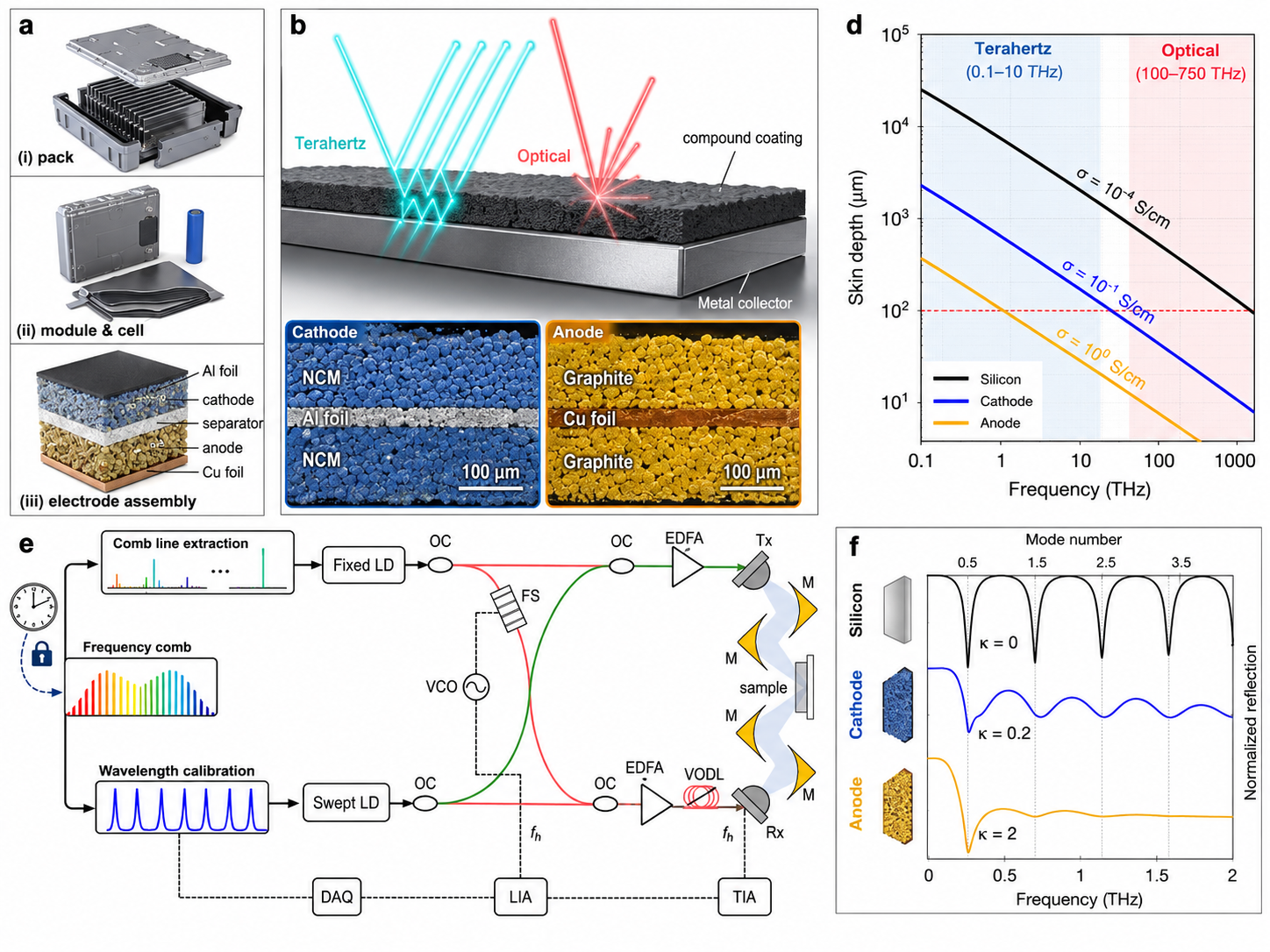
THz metrology for precision thickness measurements of LIB electrodes. a Structural hierarchy of a LIB system, showing the configuration from packs to the electrode assembly. b Schematic comparison of THz and optical beam behaviour during electrode inspection. THz waves exhibit deep penetration and low scattering, enabling multiple internal reflections within the electrode. In contrast, optical waves experience strong surface scattering and shallow penetration due to high absorption, limiting their ability to probe subsurface structures. c Cross-sectional SEM images of double-side-coated LIB cathode (left) and anode (right). d Calculated skin depth as a function of frequency for three different conductivities (silicon: ~10-4 S/cm; LIB cathode: ~10-1 S/cm; LIB anode: ~100 S/cm). Sample transparency (solid line: transparent, dotted line: opaque) is determined by comparing skin depth with sample thickness of 100 μm (horizontal red line). e System configuration of comb-based THz FP interferometry. f Simulated THz reflection spectra for three different conductivities. Each conductivity ?? is scaled into the extinction coefficient ??, assuming refractive index n = 3.416 and sample thickness t = 100 μm. Normalized reflection signals are offset for clarity. LD: laser diode, OC: optical coupler, FS: frequency shifter, VCO: voltage-controlled oscillator, EDFA: erbium-doped fibre amplifier, VODL: variable optical delay line, Tx: THz emitter, Rx: THz receiver, M: off-axis parabolic mirror, TIA: trans-impedance amplifier, LIA: lock-in amplifier, DAQ: data acquisition. Image Credit: Adapted from Kang, G., Kim, J., Kim, M.-R. et al. “Nanometre-precision terahertz interferometry for battery electrode metrology.” Nature Communications (2026). doi: 10.1038/s41467-026-74193-8. Redrawn using OpenAI ChatGPT.
A recent study published in the journal Nature Communications introduces a frequency-comb-referenced terahertz (THz) Fabry–Pérot interferometry platform for high-precision battery electrode metrology. The technique combines THz radiation with an optical frequency comb to measure the thickness of battery electrodes with nanometer-level precision. The system also estimates material properties such as the complex refractive index, providing structural measurements and material-property information that may reflect composition, porosity, and process variation.
Closing the Metrology Gap
The rapid growth of electric vehicles, energy storage systems, and portable electronics has increased the need for tighter control over battery manufacturing processes. Electrode thickness is a key determinant of battery performance. It influences energy density, ion transport, thermal stability, and cycle life. Even small variations can reduce performance consistency and increase the risk of safety failures such as thermal runaway.
Several non-destructive inspection methods are available for battery electrodes, including X-ray computed tomography, scanning acoustic microscopy, and laser displacement sensors. X-ray systems provide detailed structural information but suffer from low throughput and high cost. Acoustic techniques can detect subsurface features but offer limited spatial resolution. Optical methods support rapid measurements, but strong scattering and absorption in conductive, porous electrodes restrict their effectiveness.
Terahertz (THz) radiation offers several advantages for battery electrode inspection because it can partially penetrate conductive and porous materials, especially at lower frequencies, while remaining less sensitive to micrometer-scale surface roughness. Building on these capabilities, the researchers developed a frequency-comb-referenced THz Fabry–Pérot interferometry platform. The system combines THz spectroscopy with SI-traceable frequency referencing to achieve nanometer-scale thickness measurements.
Building the THz Platform
The researchers use an erbium-doped fiber optical frequency comb stabilized to a rubidium atomic clock, providing an SI-traceable frequency reference. Two lasers generate a continuously swept THz signal via optical heterodyning and photomixing, enabling rapid, highly accurate spectral measurements.
The measurement principle relies on Fabry–Pérot interference within the electrode. As THz waves propagate through the material, reflections from the front and back surfaces generate interference modes. The frequencies of these modes depend on the electrode thickness and refractive index. By tracking the precise positions of the resonance modes, the system directly determines thickness without requiring prior thickness calibration or periodic recalibration.
Researchers fabricated lithium-ion battery cathodes and anodes with different coating thicknesses using a doctor-blade process to evaluate the approach. They collected THz reflection spectra over a broad frequency range and analyzed the resonance modes of the electrode structure. Cross-sectional scanning electron microscopy (SEM) provided independent validation measurements.
The team also implemented frequency-comb calibration to correct nonlinearities in laser frequency sweeping and maintain absolute frequency accuracy. The platform enabled three-dimensional thickness mapping of a THz-absorbing test structure and real-time effective-thickness monitoring, demonstrating its potential suitability for industrial battery manufacturing environments.
Precision Beyond Conventional Methods
The results confirmed that THz radiation can probe battery electrodes under suitable low-frequency conditions, despite their conductive and porous structures. Unlike visible and near-infrared light, THz waves experience less scattering and, at suitable low frequencies, sufficient penetration to generate clear Fabry–Pérot interference signals. This capability enabled highly precise thickness measurements across a range of electrode architectures.
Frequency-comb calibration played a critical role in improving measurement accuracy and stability. By correcting nonlinearities in the frequency sweep, the calibration process eliminated frequency offsets and enhanced long-term reproducibility. The system achieved frequency precision at the sub-10-megahertz level, supporting nanometer-scale thickness measurements.
The researchers measured cathodes with various thicknesses ranging from approximately 50 to 90 μm and achieved sub-micrometer precision in single-shot measurements. The platform delivered even higher precision for anodes. A 103 μm-thick anode achieved a measurement precision of 70.1 nm within 0.2 s, which improved to 7.8 nm after 25.6 s of averaging.
The THz measurements showed strong agreement with thickness values obtained from cross-sectional SEM analysis. The technique also delivered significantly lower estimated measurement uncertainty and eliminated the need for destructive sample preparation. However, the authors note that SEM validation was affected by sample-preparation artifacts, spatial nonuniformity, and a mismatch in sampling between the THz and SEM measurement regions. Beyond thickness metrology, the platform simultaneously extracted material properties from the measured spectra.
The researchers determined complex refractive indices of approximately 2.9 + 0.5i for cathodes and 6.0 + 3.4i for anodes. The system also generated three-dimensional thickness maps in a 3D-printed polylactic acid test structure and tracked dynamic effective-thickness variations in real time using a tilted quartz-wafer setup. Stable operation under sample tilts of up to 45° and successful monitoring of micrometer-scale effective-thickness changes at frequencies up to 5 Hz further demonstrated its potential for future integration into industrial manufacturing environments.
Toward Smart Battery Manufacturing
This study advances non-destructive battery metrology by combining optical frequency comb technology with THz Fabry–Pérot interferometry. The technology addresses several limitations of existing inspection methods. THz radiation can probe conductive and rough electrode surfaces more effectively than optical techniques, particularly through low-frequency components that are less affected by scattering and absorption.
The platform extends beyond thickness metrology by simultaneously providing material characterization. Extracting complex refractive index information from THz spectra could help monitor changes in electrode composition, porosity, and processing conditions. However, independently separating refractive index from thickness and thereby extracting porosity would require additional measurement constraints. These capabilities could support process optimization and improve manufacturing consistency.
Overall, the research demonstrates the potential of frequency-comb-referenced THz interferometry for advanced industrial metrology. The platform could support accurate battery inspection, process optimization, and real-time quality control, while offering opportunities for broader applications in semiconductor manufacturing and materials characterization.
Download your PDF copy by clicking here.
Disclaimer: The views expressed here are those of the author expressed in their private capacity and do not necessarily represent the views of AZoM.com Limited T/A AZoNetwork the owner and operator of this website. This disclaimer forms part of the Terms and conditions of use of this website.