A new roll-based printing method could help turn fragile nanowire forests into dense, aligned, flexible electronic layers for wearable sensors, UV photodetectors, and next-generation device platforms.
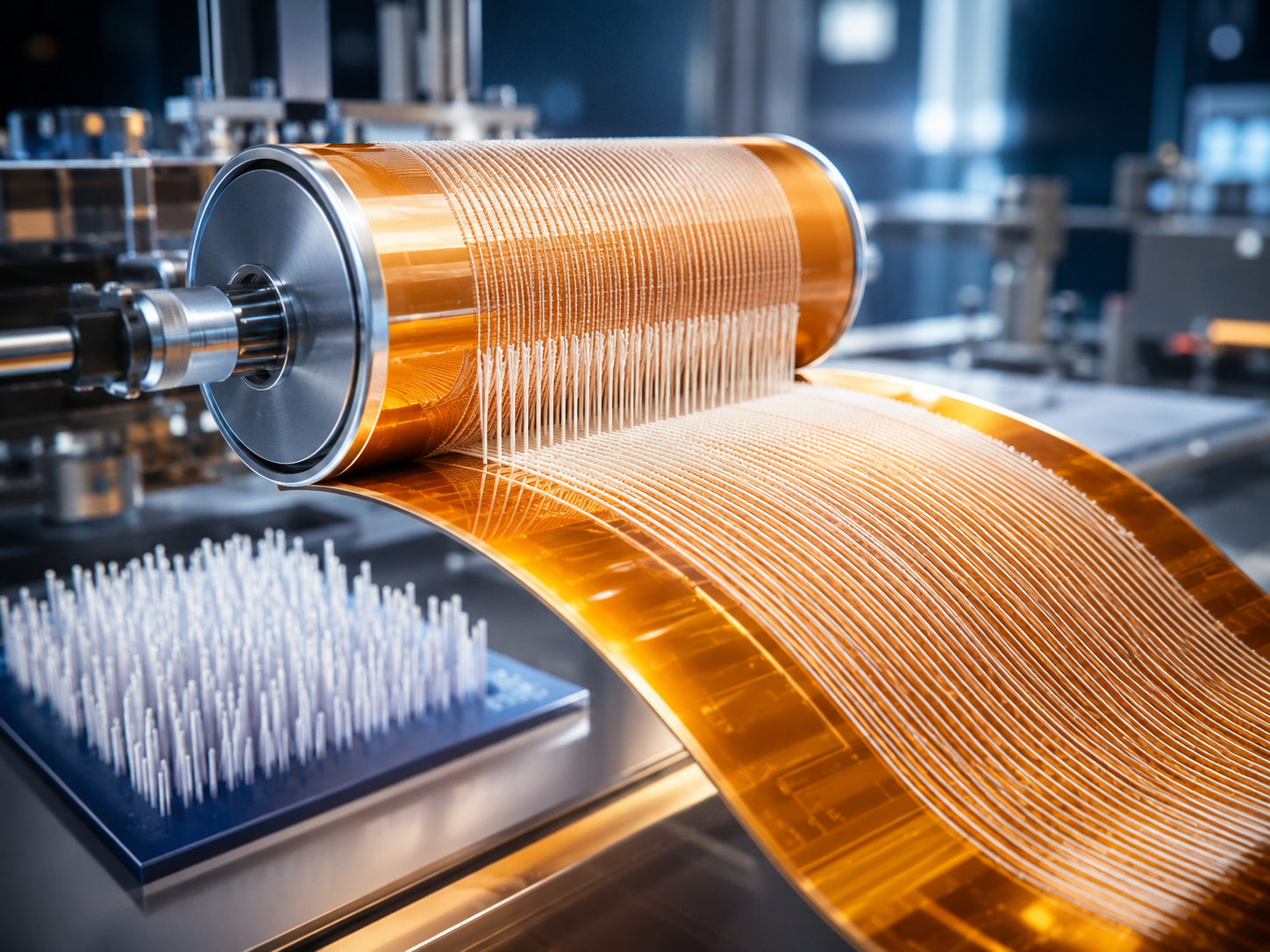 Image credit: AI-generated with ChatGPT/OpenAI, adapted from Christou et al., npj Flexible Electronics (2026), CC BY 4.0.
A paper recently published as an 'Article in Press' in the journal npj Flexible Electronics proposed a roll-contact printing methodology for the deterministic assembly of ultradense, aligned nanowire (NW) arrays for large-area, high-performance flexible electronics.
The Need for Deterministic Assembly
Semiconductor NWs are advancing several research domains simultaneously. The combination of mechanical flexibility and high carrier mobility makes inorganic NWs suitable for advanced flexible electronics.
In specific engineered architectures, such as strained structures, their charge-carrier mobility exceeds that of their bulk equivalents, as band-structure modifications induced by strain reduce the effective mass of electrons.
This characteristic allows the synthesis of high-performance devices. These devices can integrate with dynamic environments and curved surfaces, thereby expanding the application possibilities of neuromorphic computing and wearable systems.
Despite significant advances in NW fabrication, a ‘deterministic’ NW assembly method has yet to be developed to enable their widespread adoption in flexible high-performance electronics.
In the nanoscale electronic layer, reproducible control over critical parameters, such as NW density, alignment uniformity, average transferred length, and material purity, can be realized through a deterministic assembly technique.
Although the majority of growth processes produce disordered, dense NW forests, current assembly methods have failed to meet the requirements of high density, minimal contamination, and uniform orientation, which are crucial for scalable device integration and electronic-grade layers.
For instance, contactless dielectrophoresis suffers from complex equipment needs and limited throughput, while the Langmuir-Blodgett approach lacks precision control and introduces substantial contamination. Similarly, bubble-blown assembly and capillary force methods fail to provide reproducibility, contamination control, and uniformity.
The Proposed Deterministic Approach
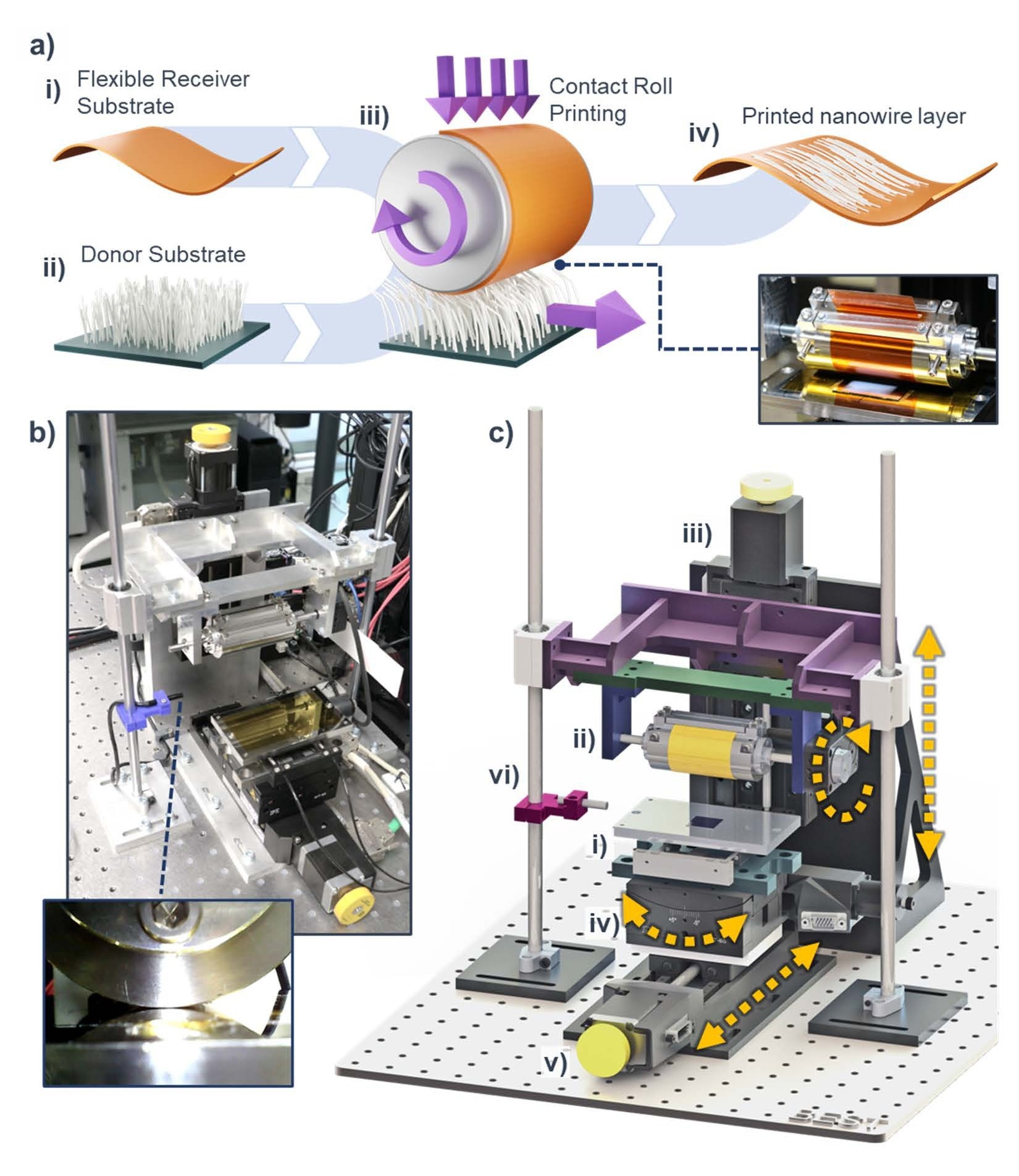
In this work, researchers introduced a roll-based contact printing approach that addresses existing issues through geometric innovation, using cylindrical configurations to replace planar contact interfaces and transforming area-based interactions into line-based contact mechanisms.
Development of Contact Roll Printing Equipment: The hardware comprised independently actuated rotational, horizontal, and vertical platforms offering accurate control over receiver and donor substrate velocity, displacement, and loading force.
The rotating platform controlled the cylindrical receiver, while the horizontal platform controlled donor substrate motion, allowing the researchers to tune shear forces and printing area ratios during NW transfer.
Accurate motor control enabled sufficient adjustment of every printing parameter. The dual-platform architecture enabled active control over the printing area for both substrates, allowing systematic variation in their area ratio. Platform configuration allowed precise control of normal and shear force during NW transfer.
Rotational and horizontal platforms controlled shear forces between the receiver and donor substrates. Additionally, a vertical platform applied normal forces by moving the rotating platform assembly along the Z-axis.
Closed-loop control and force monitoring were realized by positioning the load cells below the donor substrate platform. Two load cells were strategically positioned on opposing sides of the donor platform for alignment monitoring between the cylindrical and planar platforms.
An integrated camera system enabled real-time process monitoring and laid the foundation for future automated quality control. Automated printing and comprehensive system control were achieved using custom software.
Real-time alignment monitoring and automated correction were achieved through a dual-load-cell configuration for conformal contact. Integrated goniometer control enabled automated alignment correction, while the specialized roller design enabled effective, flexible substrate handling during the printing of nano-to-chip-scale electronic layers.
Fabrication of Flexible UV Photodetectors: Zinc oxide (ZnO) NW ultraviolet photodetectors were fabricated using conventional microfabrication techniques to evaluate NW assembly precision. Conventional fabrication was chosen to ensure accurate assessment of NW assembly quality and performance.
Standard photolithography and electron-beam evaporation were employed to deposit titanium/gold source and drain contacts, followed by lift-off processing.
The Viability of the Approach
Researchers successfully demonstrated a roll-contact printing platform that reproducibly controlled NW density, alignment, transfer length, and material purity, producing highly aligned ZnO NW arrays on flexible substrates and achieving record densities of up to 14 NWs µm-¹.
No-rotation area-compression printing reached densities above 14 NWs µm-¹ with about 70% area coverage, while velocity-ratio experiments demonstrated tunable density control, reaching about 6.5 NWs µm-¹ at a 0.2 ratio.
This improvement was attributed to a distinct “comb effect,” which simultaneously removed contaminating debris and promoted NW alignment, resulting in electronic-grade, highly uniform films.
The use of traveling line contact instead of conventional area contact reduced mechanical stress on individual NWs while enabling continuous large-area transfer. Parametric studies established the roles of applied force and velocity ratio in governing transfer length, alignment uniformity, density, and suppression of donor contamination.
Flexible UV photodetectors fabricated across controlled NW densities displayed systematic performance scaling, with the highest-density tested group (8 NWs µm-¹) achieving responsivity up to 4000 A W-¹ but showing greater device-to-device variability than intermediate-density devices.
Devices retained functionality after 5000 bending cycles at 10 mm radius and 5000 twisting cycles at ±25°, although photocurrent decreased by 18.8% after bending and 20.9% after twisting.
Importantly, the study did not demonstrate NW printing at predefined spatial locations, which the authors identified as a key metric of deterministic assembly. The authors noted that such location-specific integration could be achieved in future work by combining roll printing with patterned receiver substrates or predefined NW growth sites.
In conclusion, the findings of this study demonstrated the feasibility of the proposed deterministic roll-contact printing as a resource-efficient, potentially manufacturable route to high-performance large-area flexible electronics, while noting that wider-area scale-up will require improved control of line contact, roller and platform tolerances, substrate bowing, roller runout, and donor growth uniformity.
Download your PDF copy by clicking here.
Disclaimer: The views expressed here are those of the author expressed in their private capacity and do not necessarily represent the views of AZoM.com Limited T/A AZoNetwork the owner and operator of this website. This disclaimer forms part of the Terms and conditions of use of this website.
Source:
- Christou, A., Dahiya, A. S., Zumeit, A., & Dahiya, R. (2026). Deterministic roll-contact printing of ultradense aligned nanowire arrays for high-performance flexible electronics. npj Flexible Electronics. DOI: 10.1038/s41528-026-00605-w. https://www.nature.com/articles/s41528-026-00605-w