A gold-enhanced nanowire photodetector embedded in a soft contact lens may bring continuous eyelid oxygen monitoring closer, while keeping the technology firmly in the preclinical stage.
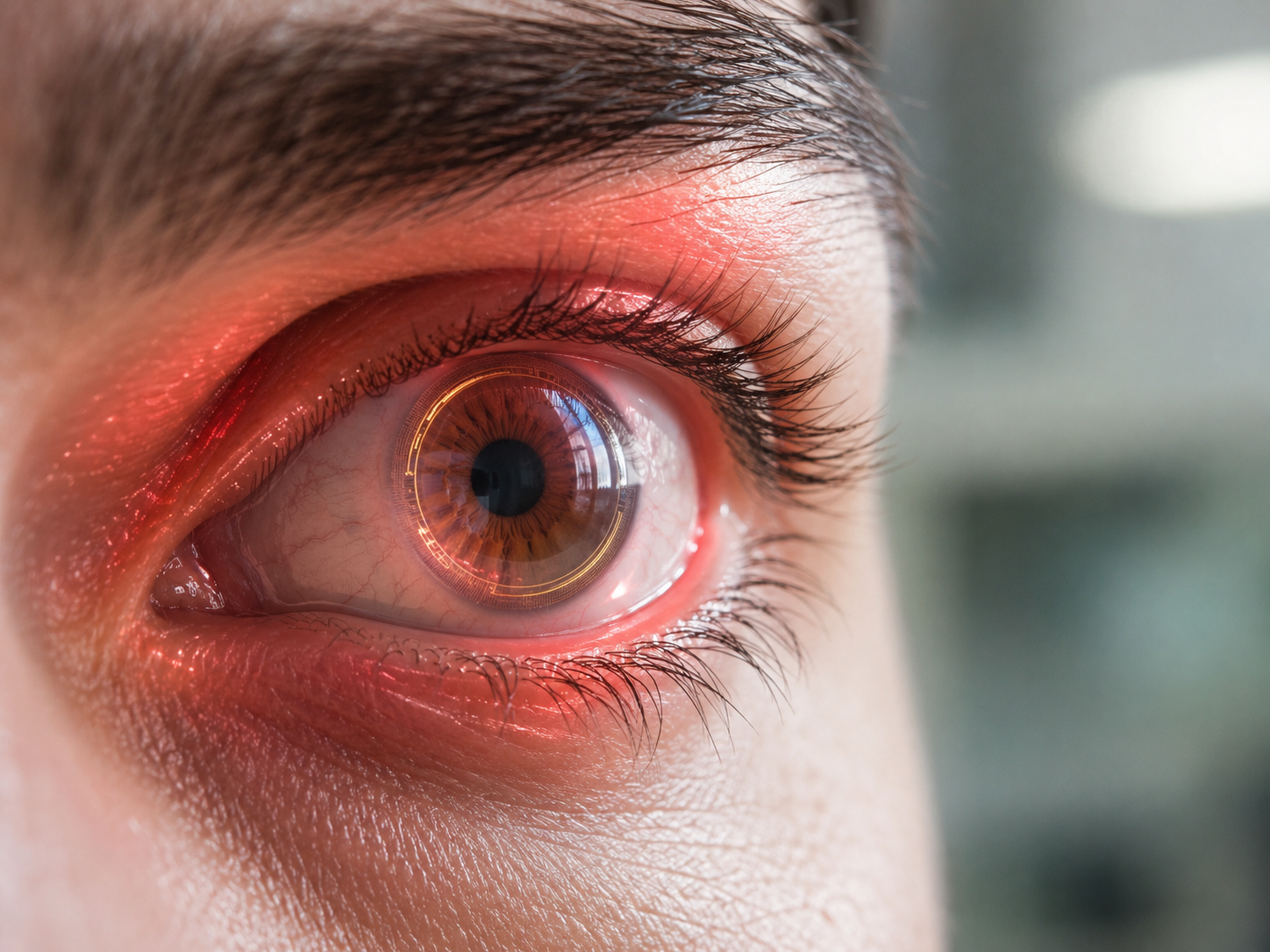
Study: A smart contact lens with plasmonic nano-confinement nanowire array for non-invasive ocular blood oxygen saturation monitoring. Image credit: AI-generated image created using ChatGPT/OpenAI
In a recent 'Article in Press' published in the journal npj Flexible Electronics, researchers developed a smart contact lens incorporating a plasmonic nano-confinement nanowire array embedded with gold nanoparticles to enable high-sensitivity, non-invasive eyelid-capillary blood oxygen saturation monitoring.
Nano-Enabled Ocular SpO2 Sensing
Blood oxygen saturation (SpO2) is a vital physiological parameter widely used in clinical diagnostics to evaluate respiratory and cardiovascular health. Conventional wearable oxygen sensors generally measure SpO2 at peripheral sites, such as the fingers; however, these are unsuitable for ocular applications due to their bulky, rigid nature.
Localized surface plasmon resonance (LSPR) in metallic nanoparticles, such as gold (Au), can concentrate electromagnetic fields at the nanoscale, thereby improving photodetector sensitivity.
Conductive polymer nanowires can offer enhanced charge transport due to their geometry and ordering. Integrating plasmonic nanoparticles into highly aligned conductive polymer nanowires, creating a plasmonic nano-confinement (PNC) nanowire array, presents a novel approach to improving the performance of photodetectors.
Fabrication and Integration Techniques
This study introduces a flexible organic photodetector in which a plasmonic nano-confinement nanowire array serves as an anode interfacial modification layer within the sensing device embedded within a smart contact lens for non-invasive eyelid-region SpO2 monitoring. The core nanomaterial innovation lies in a composite array of highly aligned poly(3,4-ethylenedioxythiophene):poly(styrene sulfonate) (PEDOT:PSS) nanowires, uniformly embedded with optimized-diameter gold nanoparticles (Au NPs).
The PNC nanowire array is fabricated through nanoimprint lithography combined with infusion processes, enabling uniform embedding of 20 nm Au NPs within the conductive polymer nanowires, arranged with precise 1 μm spacing.
PEDOT:PSS serves as the hole-transport material, while embedded Au NPs induce localized surface plasmon resonance, thereby enhancing electromagnetic field confinement. Finite-difference time-domain (FDTD) simulations were conducted to model the local electric-field enhancement and optimize nanoparticle size for maximal plasmonic effects with minimal radiative damping. The optimal Au NP diameter was found to be 20 nm, balancing field enhancement with scattering effects. The authors noted that enhancement at 630 nm and 850 nm should not be interpreted as a direct plasmonic resonance at 850 nm, but as a combined optical and charge-extraction effect within the multilayer detector.
The photodetector structure constitutes the PNC nanowire array as an anode interfacial modification layer within a multilayer organic photodetector based on a PDTP-DFBT:PC71BM photoactive layer, sandwiched between polydimethylsiloxane (PDMS) films, integrated onto flexible transparent polyethylene naphthalate (PEN)/indium tin oxide (ITO) substrates, and finally mounted inside a silicone hydrogel contact lens.
To enhance signal quality and suppress noise inherent in photoplethysmography (PPG), a miniaturized backend circuit employing wavelet threshold denoising processes the raw photodetector signals in real time.
The device measures transmitted light intensities under dual-wavelength illumination and, through Lambert-Beer’s law, calculates SpO2 values from the red/NIR intensity ratio. The system was tested first on human fingers to establish baseline accuracy and subsequently in vivo on anesthetized rabbits for ocular surface monitoring validation.
Enhanced Performance and Validation
Structural characterization confirmed the successful fabrication of the PNC nanowire array with embedded Au NPs uniformly dispersed within aligned PEDOT:PSS nanowires. Atomic force microscopy (AFM), scanning electron microscopy (SEM), transmission electron microscopy (TEM), and elemental mapping confirmed the regular 1 μm nanowire pattern and the nanoscale distribution of Au NPs, without large-scale aggregation. The composite films retained excellent film-forming properties and optical transparency (>90%), suitable for contact lens integration with minimal optical obstruction.
Electrical characterization revealed notably enhanced hole conductivity in the PEDOT:PSS nanowires doped with Au NPs compared to pristine polymer films. Ultraviolet photoelectron spectroscopy (UPS) displayed a reduced hole injection barrier attributable to the nano-confinement structure and plasmonic effects, facilitating improved charge extraction and suppressing interfacial recombination losses. These improvements translated into increased photocurrent density and external quantum efficiency (EQE) at target wavelengths, which is paramount to achieving sensitive and selective oxygen saturation detection.
When integrated into a contact lens, the photodetector maintained a high optical transmittance (up to 91%) ensuring minimal interference with vision. Stability tests demonstrated the device’s robustness in artificial tear fluid, retaining approximately 99.0% and 98.9% of its photocurrent response under 630 nm and 850 nm illumination, respectively, after a two-hour immersion, indicating suitability for short-term ocular-surface environments.
Initial benchmarking on human fingers showed close agreement between SpO2 readings and those of commercial pulse oximeters, with approximately 99% average agreement within the tested range. The PNC nanowire sensor outperformed versions without nanowires by about 35% in measurement accuracy. Wavelet-based denoising significantly improved signal clarity in raw PPG data, filtering out noise sources such as ambient light and electronic interference while preserving physiological information.
In vivo rabbit experiments supported the feasibility of continuous eyelid-capillary SpO2 measurement. The PPG signals from the eyelid region displayed pulsatile waveforms matching physiological conditions. Under varying environmental oxygen concentrations (hypoxic, normoxic, hyperoxic), the lens-monitored SpO2 in the eyelid showed a strong, consistent correlation with peripheral SpO2 measured by standard leg-attached commercial sensors.
The sensor effectively detected decreases in eyelid oxygenation under 10% oxygen and responsive increases at high oxygen levels, illustrating both sensitivity and dynamic range under controlled preclinical conditions.
Clinical Potential and Future Work
This work demonstrates a preclinical proof-of-concept flexible plasmonic nano-confinement nanowire photodetector integrated into a silicone hydrogel contact lens capable of non-invasive, continuous monitoring of eyelid-capillary blood oxygen saturation.
Future efforts will focus on enhancing device integration, wireless capability, long-term stability, motion-artifact rejection, awake-state testing, lens-fitting stability, and clinical validation across broader oxygen saturation ranges to enable practical healthcare applications.
The authors also noted that current validation was limited to short-term animal experiments and a tested SpO2 range of approximately 84% to 100%, with no human ocular trials reported. These limitations indicate that the system remains at an early translational stage despite its promising materials and device-level performance. The incorporation of plasmonic nanostructures into conductive polymer nanowires offers a powerful nanoscale strategy to improve wearable optoelectronic biosensors, marking a significant advance in flexible, transparent bioelectronics.
Source:
- Kan X., Fan Q., et al. (2026). A smart contact lens with plasmonic nano-confinement nanowire array for non-invasive ocular blood oxygen saturation monitoring. npj Flexible Electronics. DOI: 10.1038/s41528-026-00614-9, https://www.nature.com/articles/s41528-026-00614-9