In one of Earth’s most remote and pristine regions, researchers found nanoplastics in Antarctic soil, raising new questions about how far plastic pollution can travel and what it means for fragile polar ecosystems.
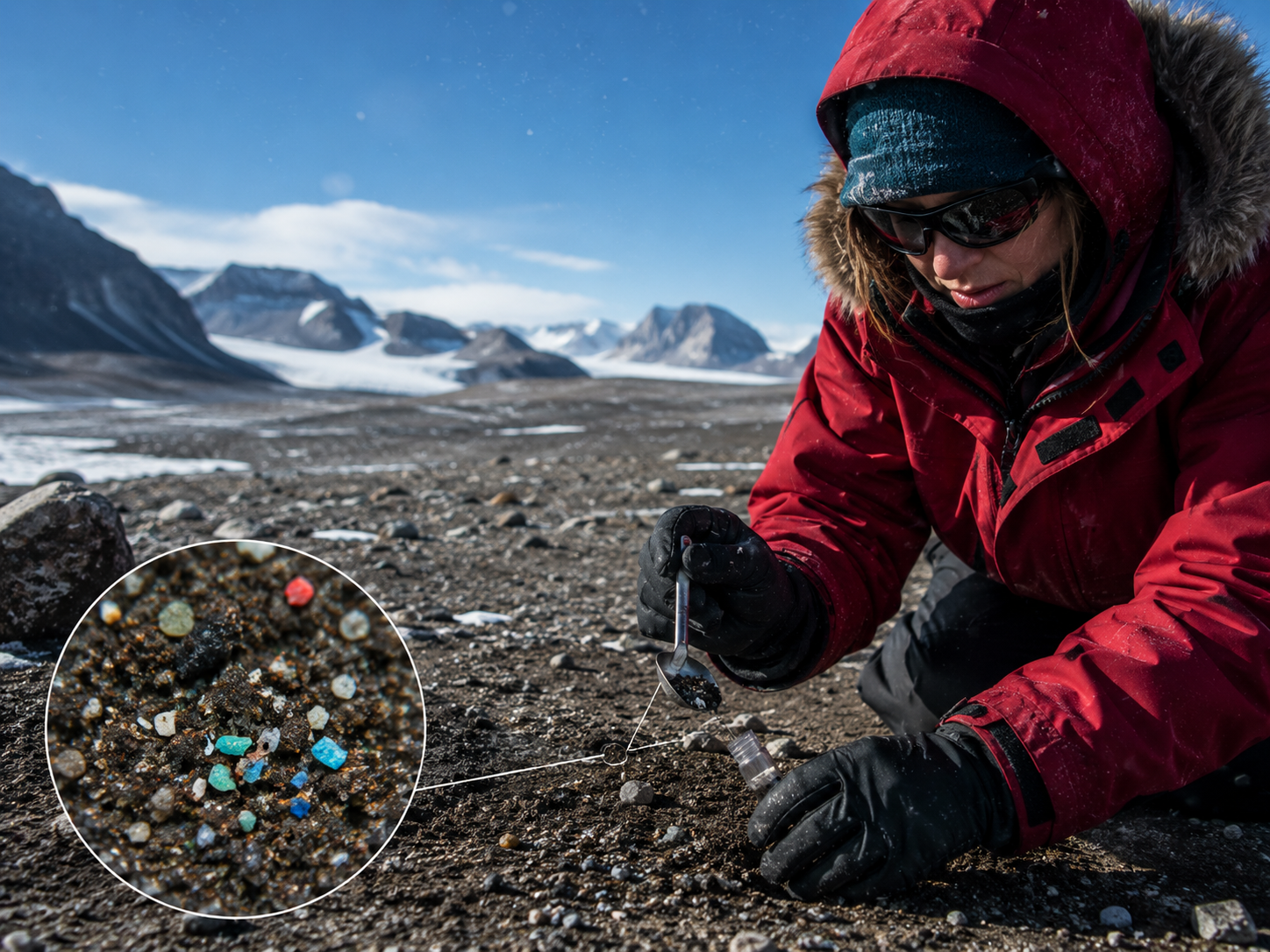
Research: First evidence of nanoplastics in Antarctica soil. Image credit: AI-generated image created using ChatGPT/OpenAI
A paper recently published as an Article in Press in the journal Scientific Reports reported the first detection of nanoplastics (NPs) in Antarctic soil.
Plastic Pollution in Antarctica
Plastic contamination has reached Antarctica, one of the last pristine regions of the planet. Local activities, including tourism and scientific stations, as well as plastics from sea vessels and lower-latitude sources, are among the proposed contributors to this contamination. Plastics are also carried through air masses to that region.
Plastic debris like microplastics (1 μm–5 mm) and macroplastics (≥ 5 mm) were detected in diverse Antarctic environments, including deep-sea sediments, shallow waters, island coastlines, freshwater systems, sea ice, and glaciers.
Plastic contamination may threaten the Antarctic ecosystem and biodiversity, with studies reporting harmful effects of microplastics on marine species. Other pollutants transported by plastic particles, like persistent organic pollutants, also cause adverse effects.
While studies have investigated plastic contamination extensively, most have focused on larger microplastics and macroplastics. Smaller plastics, such as NPs (<1 μm), which are more environmentally relevant and a greater concern than larger particles, remain largely underexplored.
Smaller plastics have a strong adsorption affinity for pollutants, improved colloidal mobility, and a high surface area-to-volume ratio, which increase their ecological risk and biological uptake by facilitating the transport of pollutants and the leaching of additives.
Thus, in biologically active yet low-biomass systems such as Antarctic ecosystems, particle size is a critical environmental factor. Insufficient research on smaller plastics is primarily attributed to analytical challenges, including inadequate sensitivity of current detection techniques and matrix interference.
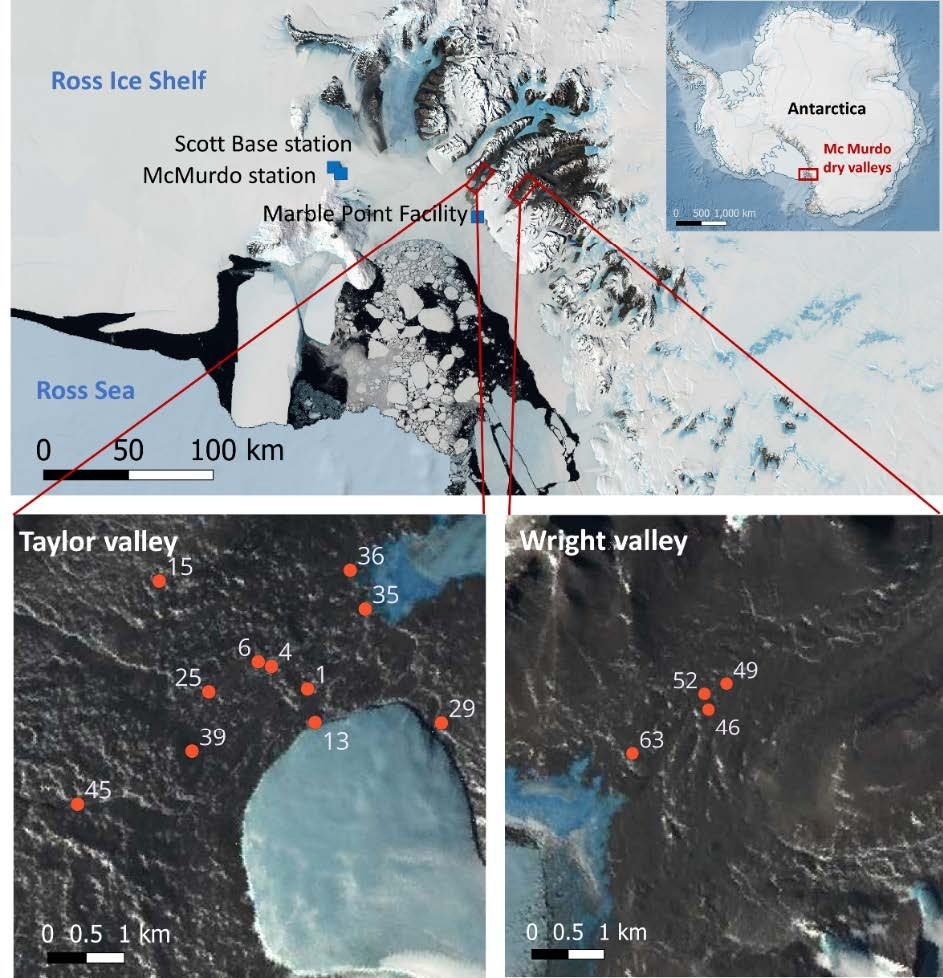
Sampling locations in the MDV, Antarctica. The main map shows the proximity of Taylor Valley and Wright Valley to the Ross Ice Shelf, Ross Sea and some research stations, with detailed views of sampling points (red dots) in both valleys. The inset map provides the broader geographical context of the MDV within Antarctica. Maps with satellite imagery were created using Quantarctica v3 (Norwegian Polar Institute; https://www.quantarctica.org/) and QGIS v3.16 (https://qgis.org/).
Investigating NPs in Antarctica
In this study, researchers investigated NPs and microplastics in mainland soils of Antarctica to address the research gap regarding the occurrence of smaller plastics in the polar region. NPs were investigated for the first time in mainland Antarctica.
They selected Antarctica's largest ice-free region, the McMurdo Dry Valleys (MDV), as the investigation site owing to its inland location in the trans-Antarctic Mountains in southern Victoria Land near McMurdo Sound, which minimized the impact of marine sources.
These features made the region suitable for studying plastic contamination due to atmospheric deposition. Additionally, minimal human activity and isolation made the MDV a good location for establishing baseline NP and microplastic data.
Such data are crucial for assessing the global impacts of contamination in Antarctica and making future comparisons. Soil samples collected from January 8 to 28, 2023, from the MDV were analyzed in this study.
In the MDV region, the samples were collected across Taylor and Wright Valleys. Overall, four topsoil samples (0–10 cm) were collected from the Wright Valley, and four deep and subsurface soil samples (≥20 cm to ≥40 cm) and nine topsoil samples (0–10 cm) were collected from the Taylor Valley.
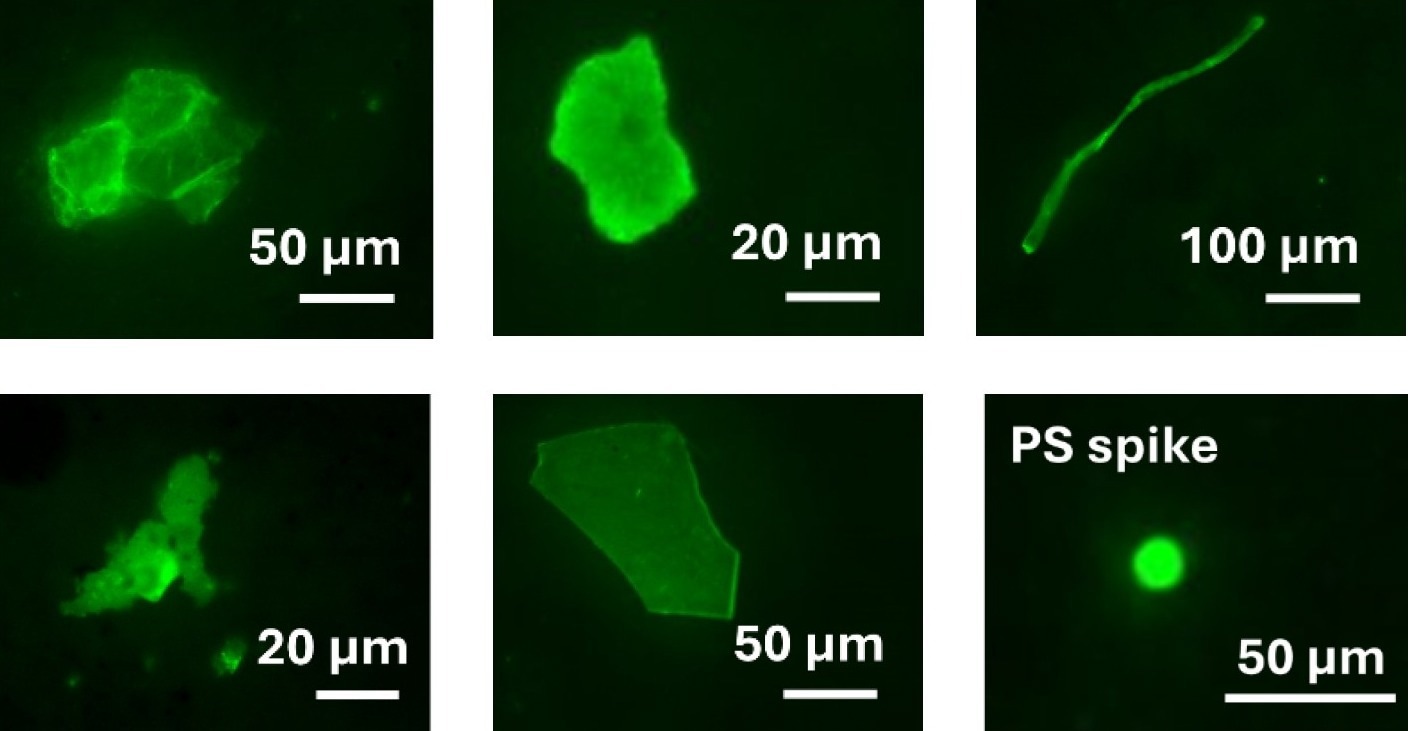
Morphological diversity of MPs visualized using fluorescence microscopy (Zeiss Axio Zoom.V16) equipped with a green fluorescent protein (GFP) filter (excitation/emission: 470/520 nm) following staining with Nile Red (5 mg L-¹ in hexane). Microscopy image of the sample acquired at 50× magnification (pixel size: 2.48 μm) Observed morphologies include fragments, films, and fibres, ranging from approximately 10 μm to 100 μm in size. “PS spike” denotes a control polystyrene sphere used in the recovery test.
Researchers hypothesized that plastics in such remote regions primarily originate from long-range atmospheric transport (LRAT), with additional contributions from human activities such as tourism and scientific expeditions.
They also proposed a novel extraction protocol to isolate NPs from Antarctic soil. For the first time, the protocol was applied along with thermal desorption–proton transfer reaction time-of-flight mass spectrometry (TD-PTR-TOF-MS).
Results from the Study
The researchers separately assessed microplastics and nanoplastics using different analytical methods. The study, using the novel TD-PTR-TOF-MS protocol for NPs and Nile Red-stained fluorescence microscopy for microplastics, provided evidence for the presence of NPs and microplastics in mainland Antarctic soil.
Researchers detected plastics in both Wright and Taylor Valleys. NPs were detected in deep soils and topsoils across several locations, with concentrations reaching up to 295 ng g-¹ and a 26.6 ng g-¹ median concentration for topsoil.
NPs were identified in 50% of the four deep soil samples and 54% of the 13 topsoil samples. In deeper soil layers, NPs were detected at a lower median concentration of 1.95 ng g-¹, although this inference was constrained by the small number of paired topsoil and deeper-soil samples, and one deeper sample showed a relatively high concentration.
MP concentrations above the method detection limit for particles larger than 10 μm were detected at only one site. The polymers identified using TD-PTR-TOF-MS included tire wear particles, polyvinyl chloride, polystyrene, polyethylene terephthalate, polyethylene, and polypropylene.
Seasonal deposition patterns were inferred from the Lagrangian particle dispersion model FLEXPART, with inputs from LRAT and local sources such as research stations. However, the authors emphasized that source attribution remains uncertain without systematic atmospheric, deposition, and soil measurements.
Limitations of this Research
This work employed density separation using the overflow method, which may lead to inadequate separation and loss of small (<10 μm) particles during overflow. The MP recovery rate was estimated at 23.0 ± 8.9%, and the study did not include the 1–10 μm microplastic fraction.
Although fluorescence microscopy is a suitable method, it cannot chemically identify polymer types, thereby reducing its specificity. Certain particles, including black particles or particles that stain poorly with Nile Red, may also be under-detected. Additionally, the persistence of residual organic matter after extraction may lead to a small number of false-positive results.
The authors also noted that NP concentrations were semi-quantitative because recovery during extraction, thermal desorption, and ionization was incomplete. Therefore, the reported concentrations should be interpreted as lower-threshold estimates, and actual environmental concentrations may be higher.
In conclusion, this study found evidence of plastic contamination in the soils of Antarctica, one of the last pristine regions of Earth, with reported NP and microplastic concentrations providing a critical baseline for global pollution assessments.
Disclaimer: The views expressed here are those of the author expressed in their private capacity and do not necessarily represent the views of AZoM.com Limited T/A AZoNetwork the owner and operator of this website. This disclaimer forms part of the Terms and conditions of use of this website.