From bacteria-fighting coatings to patient-specific implant designs, nanoscale titanium systems show promise, but the review warns that clinical proof must catch up with laboratory performance.
Paper: Nanostructured titanium composites in dental implantology: Design, structure-property relationships, biological safety and clinical translation
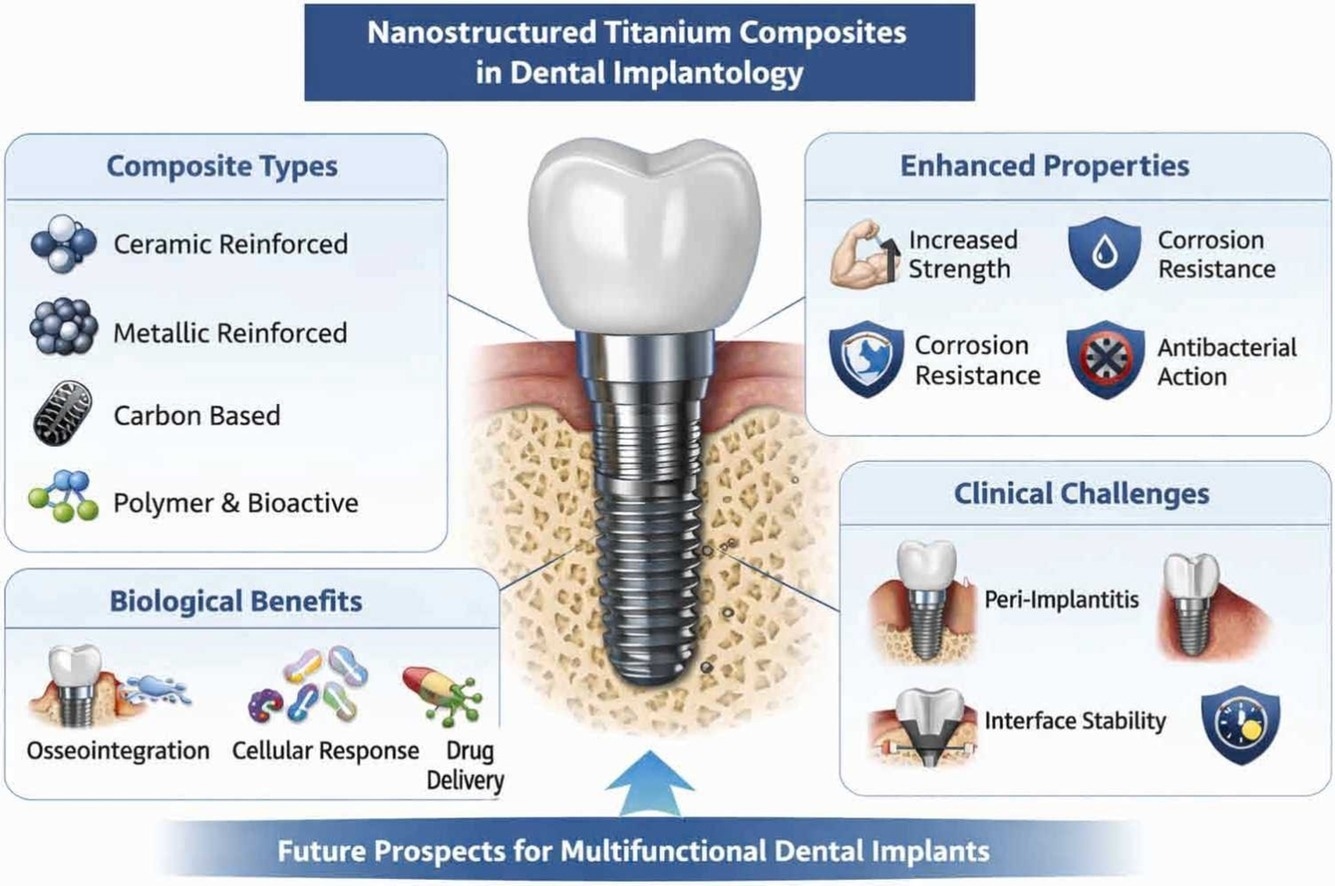
A recent narrative review published in the journal Next Nanotechnology critically examined how nanoscale surface modifications can address clinical challenges in dental implantology. The authors compared representative laboratory and preclinical improvements, including a 97.8% reduction in specific oral bacterial species, with the established survival rates of conventional dental implants.
By linking nanoscale reinforcement strategies to biological safety, the review found that evidence supports enhanced bioactivity, corrosion resistance, and antibacterial properties in selected nanostructured titanium composites. However, the authors emphasized that rigorous clinical validation is essential before these materials can be adopted alongside or beyond conventional micro-rough titanium implants.
Limitations of Conventional Titanium Implants
Commercially pure titanium and titanium alloys are the gold standard for dental implants due to their high mechanical strength, corrosion resistance, and osseointegration with surrounding bone. Despite their strong clinical performance, conventional micro-rough titanium surfaces have significant limitations. They lack intrinsic antimicrobial properties, making implants susceptible to bacterial colonization and peri-implant diseases.
Additionally, many commonly used titanium alloys have an elastic modulus higher than that of cortical bone, increasing the risk of stress shielding and subsequent bone resorption. Their protective oxide layer can degrade after prolonged exposure to fluoride and acidic foods, highlighting the need for advanced nanoscale surface engineering.
Classifying Nanocomposite Innovations
To evaluate how nanostructure design addresses biomechanical limitations, the authors used a systematic framework to classify titanium nanocomposites into ceramic-reinforced, metallic or ion-reinforced, carbon-based, polymer-titanium, bioactive drug-delivery, and functionally graded additive-manufactured systems. Each category incorporates distinct materials, including hydroxyapatite, zirconia, silver, zinc, and graphene oxide derivatives, to enhance specific biological and mechanical properties.
The review emphasized that nanoscale design significantly influences biological performance. Maintaining particle sizes within the 1-100 nm range enhances protein adsorption and cell signaling, while particle detachment can trigger localized cytotoxicity and inflammation. Various reinforcement morphologies, including two-dimensional nanosheets and one-dimensional nanotubes, affect cell interactions and mechanical load distribution.
Another focus was on dispersion quality and interfacial bonding. Poorly dispersed nanomaterials can form agglomerates, creating structural defects and accelerating fatigue failure. To ensure long-term performance, nanocomposite coatings require strong bonding to withstand implant insertion, cyclic loading, and repeated sterilization without delaminating from the titanium substrate.
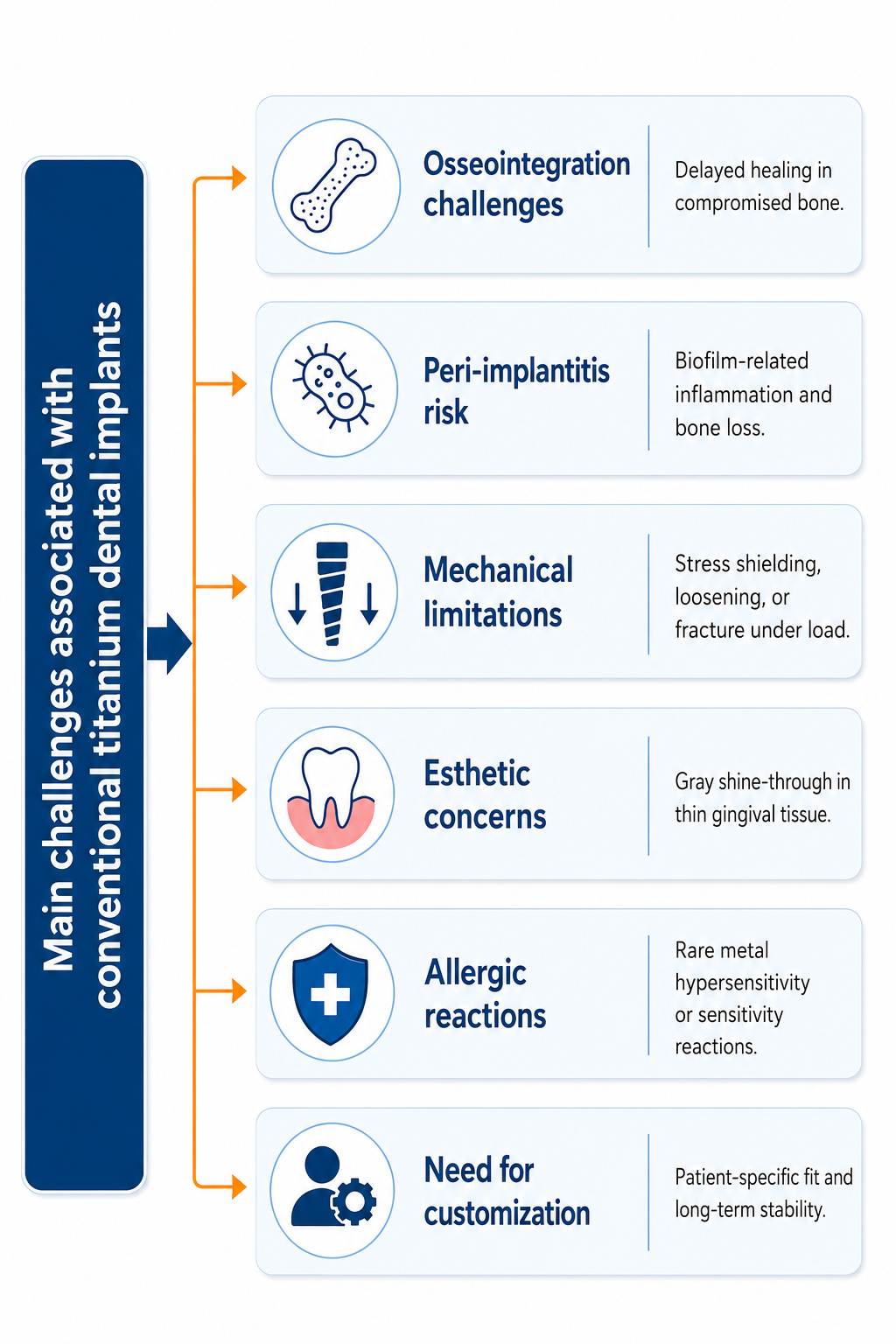
Main clinical and materials-related challenges associated with conventional titanium dental implants.
Laboratory Advances and Clinical Gaps
The reviewed evidence indicated substantial improvements across multiple functional outcomes following the integration of nanoreinforcements into titanium implants in representative laboratory and preclinical studies. In antimicrobial testing, graphene quantum dot-modified titania nanorods reduced Streptococcus mutans by 97.8%, while silver- and zinc-loaded plasma electrolytic oxidation coatings achieved a significant reduction in viable bacteria. Vacuum-assisted graphene nanocoatings on Grade 4 titanium also suppressed Candida albicans biofilm maturation.
Nano-reinforcements enhanced corrosion resistance and biological performance. Titanium-molybdenum composites reinforced with 5 wt.% zirconia provided superior corrosion protection in simulated physiological fluids while minimizing the release of toxic ions. Similarly, electrodeposited chitosan-hydroxyapatite nanocomposite coatings improved resistance to electrochemical degradation and promoted osteoblast proliferation.
Despite these promising laboratory results, the review identified a significant gap between experimental performance and clinical evidence. Conventional sandblasted and acid-etched titanium implants have demonstrated a 99.7% implant-level survival rate over 10 years, while standard acid-etched implants maintain a 92.9% survival rate after 17 years. In contrast, most nanocomposite studies were limited to short-term in vitro experiments or animal models. Although improved stability has been reported during the first 3-6 months of healing, long-term clinical superiority over conventional micro-rough titanium implants has not yet been demonstrated.
Targeting Specific Clinical Needs with Nanostructured Implants
Nanostructured titanium composites may offer specialized functionality in clinical situations where conventional implants are at higher risk of failure. Implant surfaces utilizing localized drug-delivery systems, such as drug-loaded titania nanotubes, are designed to enable the controlled release of antibiotics and growth factors directly into the surrounding bone tissue. These multifunctional platforms may be most relevant for patients with poor bone quality or an increased risk of peri-implant infection. Furthermore, additively manufactured, functionally graded titanium implants can be customized with porosity gradients that match local bone density.
Navigating Regulatory and Clinical Challenges
In summary, transitioning nanostructured titanium implants from laboratory to routine clinical practice requires addressing key biological and manufacturing challenges. Long-term safety remains a concern, with potential risks including nanoparticle detachment and oxidative stress ,twhichmust be evaluated through long-term studies rather than short-term aanalyses
Large-scale clinical adoption needs strict control over particle size, batch-to-batch reproducibility, and coating adhesion after standard sterilization procedures. Future work should move beyond isolated proof-of-concept studies toward standardized trials that directly compare nanocomposite implants with established titanium systems under realistic intraoral conditions. With proven long-term safety and strong clinical evidence, nanotechnology has the potential to support the next generation of patient-specific dental implants.
Disclaimer: The views expressed here are those of the author expressed in their private capacity and do not necessarily represent the views of AZoM.com Limited T/A AZoNetwork the owner and operator of this website. This disclaimer forms part of the Terms and conditions of use of this website.
Source:
- Panda, S. R., Mishra, P. C., & Kar, A. K. (2026). Nanostructured titanium composites in dental implantology: Design, structure-property relationships, biological safety and clinical translation. Next Nanotechnology, 10, 100589. DOI: 10.1016/j.nxnano.2026.100589, https://www.sciencedirect.com/science/article/pii/S2949829526002287