Researchers turn eggshell membrane into a zinc oxide scaffold to test its effects on frozen human sperm and reproductive health in rats.
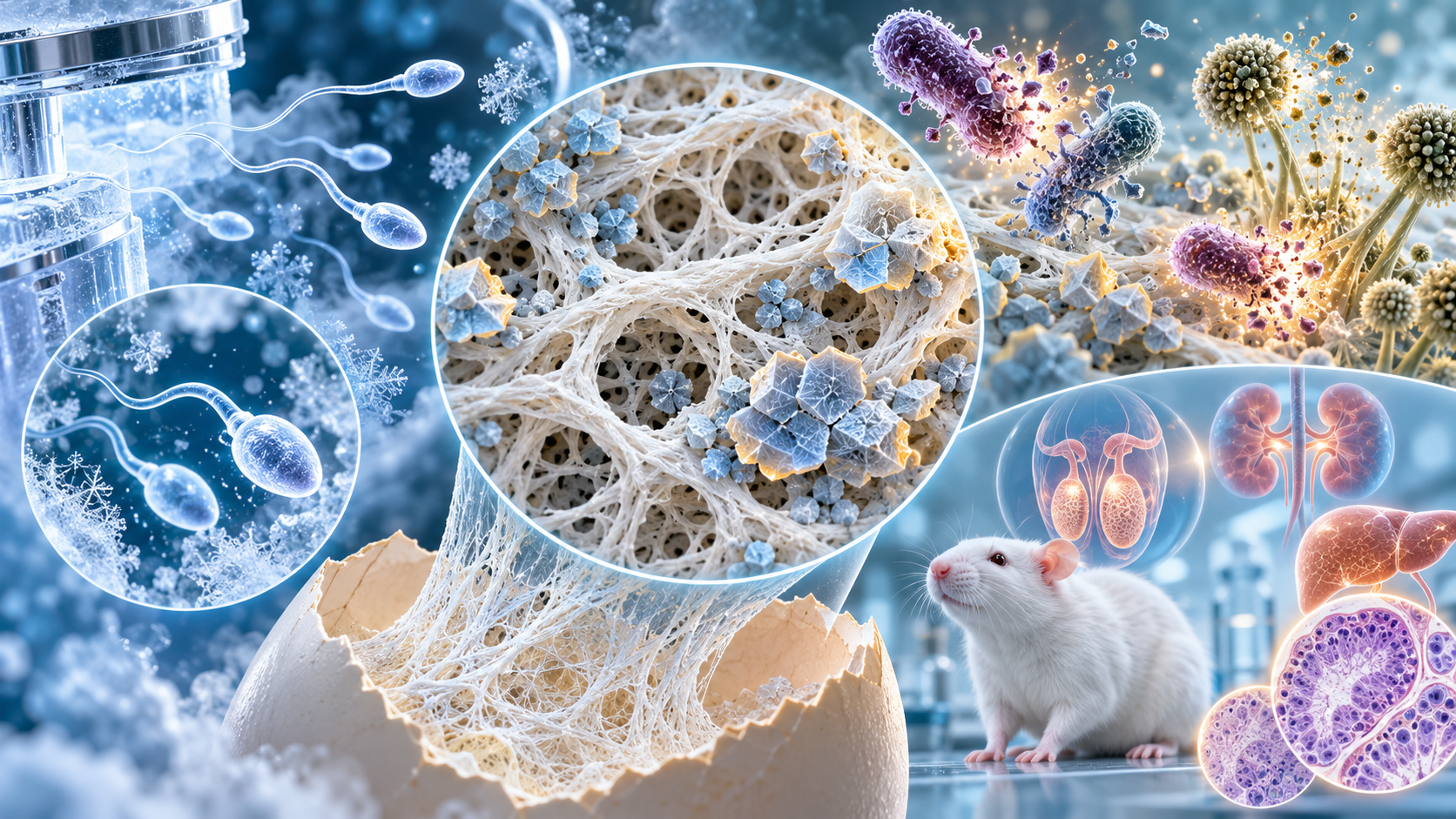
Paper: Protein-rich fibrous eggshell membrane derived ZnO 3D-nanohybrid for cryoprotectant, reproductive scavengers against Zn deficiency and hypokalemic effects in rats. AI-generated abstract conceptual image created using ChatGPT/OpenAI
In a recent Article in Press in Advanced Composites and Hybrid Materials, researchers developed a new eggshell membrane-supported ZnO nanohybrid that performed better in sperm cryopreservation tests, showed antimicrobial activity, and was associated with changes in reproductive measures and tissue histology in rats.
The work suggests possible reproductive-health applications but does not establish a treatment for zinc deficiency-induced male infertility or metabolic dysfunction.
Zinc Deficiency & Fertility
Zinc is a trace element that serves as a cofactor for more than 300 enzymes and plays major roles in protein synthesis, DNA integrity, antioxidant defense, and immune response.
In male reproductive physiology, zinc helps regulate sperm maturation and motility, supports DNA stability, and protects against reactive oxygen species (ROS). ZnO nanoparticles have attracted attention for fertility research because their high surface area and biological permeability may support antioxidant effects and sperm preservation.
Uncontrolled zinc ion release and nonspecific tissue distribution can limit their clinical application due to potential toxicity.
Natural polymer-based carriers like chitosan and gelatin have been explored to modulate nanoparticle delivery but can face problems such as immunogenicity or degradation instability.
The eggshell membrane, rich in collagen, keratin, and glycoproteins, provides a fibrous, porous matrix with a chemically active surface that can bind nanoparticles. Its biocompatibility and structure make it a candidate matrix for biomedical nanocomposites, yet no previous work has reported its use with ZnO for male reproductive health.
The authors fabricated and tested ESM-supported ZnO nanohybrids via chemical, thermal, and biogenic routes, with the thermal route yielding ZnO nanoflakes.
ESM-ZnO Nanocomposite Fabrication
Researchers used three fabrication methods to synthesize ESM-ZnO nanohybrids: a green route using neem leaf extract (ESM-ZnO-G), a chemical route with potassium hydroxide (ESM-ZnO-C), and a thermal route involving mechanical mixing of hydrolyzed ESM powder with zinc acetylacetonate followed by calcination at 410 °C to form ZnO-T nanoflakes, which were combined with ESM to form the ESM-ZnO-T nanocomposite.
Researchers used microscopy, spectroscopy, X-ray analysis, and elemental measurements to examine the materials' structure, composition, and zinc-release behavior.
Laboratory studies measured antimicrobial activity, sperm viability, motility, morphological integrity, DNA fragmentation, and ROS generation under heat-shock and freeze-thaw stress conditions. The authors then tested the ESM-ZnO-T formulation in rats. The methods identify Wistar rats, while the abstract and introduction refer to Sprague-Dawley rats, and the main paper does not clearly describe a zinc-deficiency induction protocol.
Assessments covered reproductive hormone profiles, sperm morphology, testicular histology, urinary minerals, kidney marker enzymes, and liver and kidney histology. Statistical analyses, including two-way ANOVA and receiver operating characteristic (ROC) curves, compared groups and ranked the cryopreservation formulations.
Sperm Protection and Bioactivity
Among the tested materials, ESM-ZnO-T performed best across several physical and biological comparisons. The synthesized ESM-ZnO nanohybrids had distinct physical and chemical properties depending on the fabrication method. Fresh ESM showed a natural 3D fibrous, porous architecture suitable for immobilizing nanoparticles.
The green and chemical routes produced relatively small (~40-85 nm), spherical ZnO nanoparticles uniformly decorating the ESM surface. The thermal synthesis produced ZnO nanoflakes averaging ~2 µm laterally and less than 20 nm thick, distributed across the fibrous ESM scaffold.
The ESM-ZnO-T nanocomposite remained better dispersed than the other tested formulations and released Zn²+ most gradually, consistent with controlled ion delivery.
Antimicrobial assays found concentration-dependent antibacterial and antifungal activity for ESM-ZnO-C and ESM-ZnO-T. Ciprofloxacin produced larger antibacterial inhibition zones overall, and the proposed antimicrobial mechanisms were inferred rather than directly tested.
Sperm exposed to ESM-ZnO-T during heat shock and freeze-thaw cycles maintained better viability, motility, normal morphology, and DNA integrity while producing less ROS, suggesting stronger cryoprotection. Tests used semen from 120 men and measured post-thaw sperm quality, not fertility outcomes.
In vivo administration of ESM-ZnO-T produced mixed hormone findings.
FSH did not differ significantly among groups, LH was higher than in the ESM-ZnO-C group, and testosterone was higher than in the unhydrolyzed ESM (u-ESM) group but similar to untreated controls.
Testicular histology was better preserved, though the lower testis-to-body-weight ratio led the authors to note possible delayed testicular development or gonadal hypoplasia.
The formulation also partly restored urinary markers associated with hyperoxaluria, but oxalate remained raised, and calcium remained low. Liver and kidney histology appeared closer to normal in the ESM-ZnO-T group.
The main paper reports no potassium measurements showing correction of hypokalemia. These findings point to changes in selected renal and tissue measures, not proof of normalized electrolyte balance or organ function.
Research Implications of ESM-ZnO
This investigation reports the first use of an eggshell membrane-supported ZnO nanohybrid in this male reproductive-health context, with the thermal formulation performing best in laboratory cryopreservation tests and several rat measures.
The animal work did not assess reproductive success through mating, while the human semen experiments measured laboratory sperm outcomes rather than pregnancy or live-birth outcomes.
The work does not constitute a clinical trial, and claims about treating infertility or metabolic disorders remain preclinical.
It also lacks a free-ZnO comparator; the authors did not directly test several proposed mechanisms. Some rat results are difficult to interpret because the paper labels certain comparisons statistically significant while reporting P values greater than 0.05.
This work supports further study of ESM-ZnO-T for sperm preservation and reproductive health applications, while claims about treating hypokalemia or metabolic dysfunction go beyond the reported evidence.
Source:
- Mayakrishnan G., Ranganathan P., et al. (2026). Protein-rich fibrous eggshell membrane derived ZnO 3D-nanohybrid for cryoprotectant, reproductive scavengers against Zn deficiency and hypokalemic effects in rats. Advanced Composites & Hybrid Materials. DOI: 10.1007/s42114-026-02090-1, https://link.springer.com/article/10.1007/s42114-026-02090-1