From manual SEM measurements to AI-powered multiparameter analysis, this review shows how smarter imaging tools could help researchers and manufacturers measure, monitor, and optimize nanofibers with greater speed, consistency, and precision.
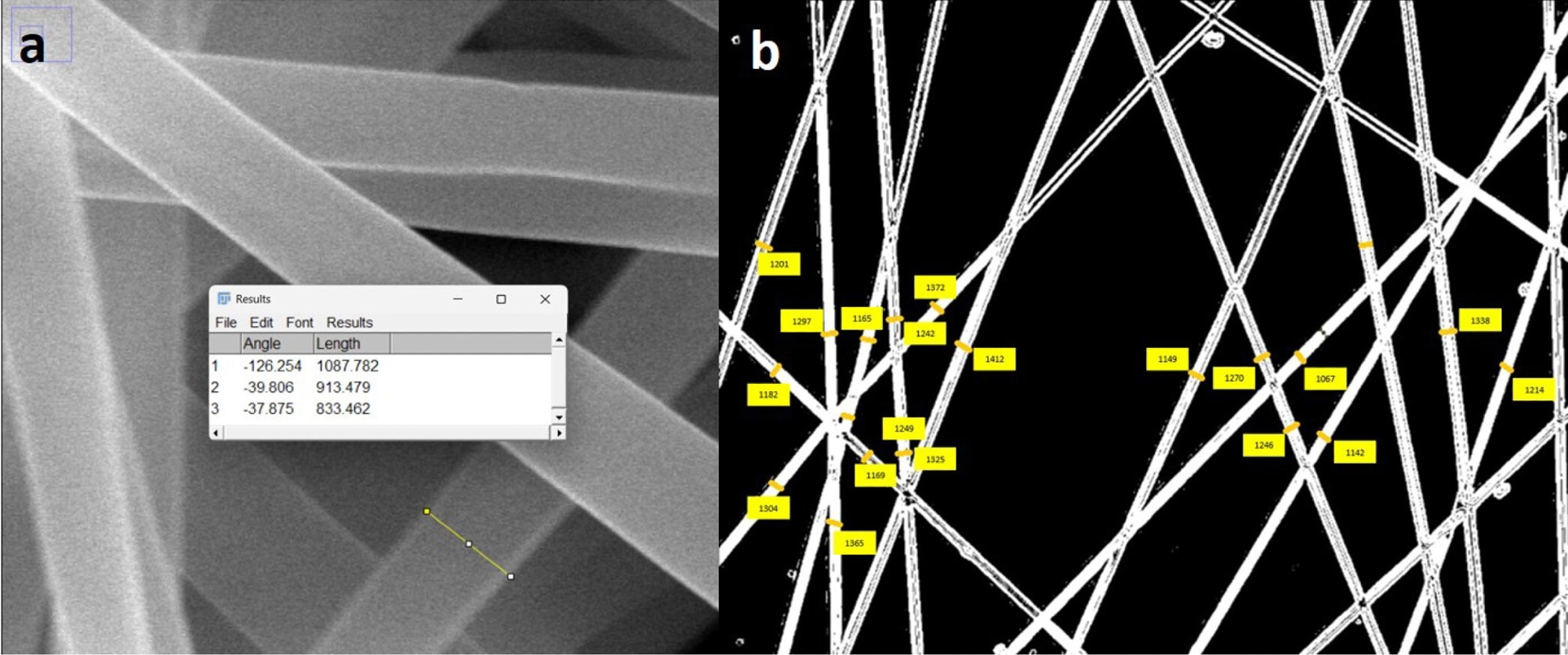
Manual fiber diameter measurement workflow using ImageJ software. Measurement lines (yellow) drawn by the operator and measurement values obtained relative to the reference scale (a) on the SEM image and (b) on the optical microscope image of the electrospun nanofiber mat.
In a recent review article published in the journal ACS Omega, researchers systematically explored Artificial Intelligence">AI-driven image analysis techniques for precise characterization and multiparameter assessment of nanofibers, highlighting advancements that enhance nanoscale measurement accuracy and support smart nanofiber manufacturing.
Nanofiber Production Fundamentals
Nanofibers, known for their high surface area and porous structure, have emerged as critical materials across diverse fields, including biomedical engineering, filtration, energy storage, and environmental remediation.
Electrospinning creates nanofibers by applying high electric fields to polymer solutions. The process generates charged jets that elongate and thin until solid nanofibers form on collectors. Several factors influence the nanoscale structure of the resulting fibers.
Polymer solution characteristics, such as concentration and viscosity, affect chain entanglements and often correlate with fiber thickness. Process variables, such as applied voltage, solution flow rate, and collector distance, control the jet's stretching and solvent evaporation, thereby directly determining fiber diameter and uniformity.
Environmental conditions like humidity and temperature further modulate solvent evaporation rates, affecting nanofiber morphology. Traditionally, measuring fiber diameter has relied on manual techniques or semi-automated tools such as DiameterJ and GIFT, which use image thresholding and segmentation but face challenges with overlapping fibers and noisy images at the nanoscale.
AI Techniques for Nanofibers
The review outlines a spectrum of methodologies for nanofiber diameter analysis. Initial approaches included manual measurements from scanning electron microscopy (SEM) images, limited by subjectivity and throughput. Open-source tools such as DiameterJ automate aspects of fiber segmentation but depend heavily on ideal image conditions and require parameter tuning.
For routine analysis of clear SEM images, however, the review notes that conventional automated tools may remain preferable because they are accessible, validated, and require no training.
Conventional machine learning techniques, including random forests and support vector machines, improved object detection and classification accuracy but are constrained by hand-crafted feature reliance and sensitivity to image variability.
More recent advances leverage deep learning architectures such as convolutional neural networks (CNNs), which automatically learn hierarchical image features, thereby handling noise, overlaps, and complex fiber networks with high accuracy when trained and validated on sufficiently diverse datasets. Models such as U-Net and Mask R-CNN provide pixel-level segmentation of nanofibers, enabling precise diameter and pore-size measurements. Studies have demonstrated deep learning's ability to robustly segment fibers even when image contrast varies or fibers intersect, overcoming limitations of threshold-based methods.
Additionally, the review highlights generative AI frameworks, including generative adversarial networks (GANs) and diffusion models, that generate synthetic fiber images to augment training datasets, thereby addressing the challenges posed by limited labeled data in nanoscale imaging. It also notes emerging transformer-based and foundation-model approaches that may support more flexible segmentation of complex microscopy images.
The review also discusses practical applications in industry where AI enables real-time quality control during electrospinning. Automated vision systems capture continuous images of fiber mats as they form and apply AI models to detect defects such as beads, diameter variations, or fiber misalignment.
These systems can potentially adjust operational parameters in a feedback loop to maintain nanoscale consistency, demonstrating a shift toward smart manufacturing. Furthermore, AI-powered inspection systems in post-production settings assess uniformity, pore distribution, and structural defects across entire fiber rolls, supporting nanoscale quality standards in high-throughput environments.
Industrial Applications and Challenges
The integration of AI-based image analysis represents a major advance over traditional characterization methodologies for nanofibers. Deep learning-based segmentation methods enable rapid, high-throughput, and consistent measurement of fiber diameter and pore characteristics, delivering accuracy and detail that are difficult to achieve manually or with traditional image processing.
AI models can improve robustness to imaging conditions, handle complex fiber overlays, and compensate for noise when trained on representative data, thereby supporting broader applications across diverse nanofiber types and production environments. Scalability is a key advantage of optimized AI workflows, particularly for large image datasets, although models may still require retraining, validation, or domain adaptation when applied to new materials or imaging conditions.
Despite these strengths, challenges remain, particularly concerning data availability for training robust models, computational costs, and ensuring AI models generalize well beyond their training domains. The review notes the value of synthetic data generation and transfer learning to overcome data scarcity. Additionally, the adoption of explainable AI techniques is anticipated to improve interpretability and trust in automated assessments.
The marriage of AI with electrospinning technology holds promise for real-time, closed-loop control of nanoscale fiber properties, improving product consistency and reducing waste. Industry examples illustrate benefits such as reduced manual intervention and higher throughput, although widespread fully autonomous deployment still requires further validation and integration.
Future Perspectives and Recommendations
AI-driven methodologies have markedly advanced nanofiber characterization by delivering fast, accurate, and comprehensive analyses of nanoscale features, including fiber diameter, morphology, and spatial distribution.
Future research is encouraged to focus on improving model generalization, expanding open datasets and benchmarks, and integrating domain knowledge into AI frameworks. The authors also emphasize that AI-derived measurements should be cross-validated against manual or conventional measurements to ensure consistency and trustworthiness. The ongoing development of lightweight, accessible AI models will further democratize nanofiber analysis, driving innovation in both academic research and smart manufacturing.
The synergy between AI and nanofiber science points to a more integrated future for nanoscale materials characterization, enabling greater clarity in understanding and controlling electrospun fibers. Harnessing AI’s capabilities promises accelerated advancement of nanofiber technologies across biomedical, environmental, and industrial domains.
Download your PDF copy by clicking here.