Nature-built proteins may offer a cleaner way to capture toxic metals, recover valuable resources, and reshape the future of environmental remediation.
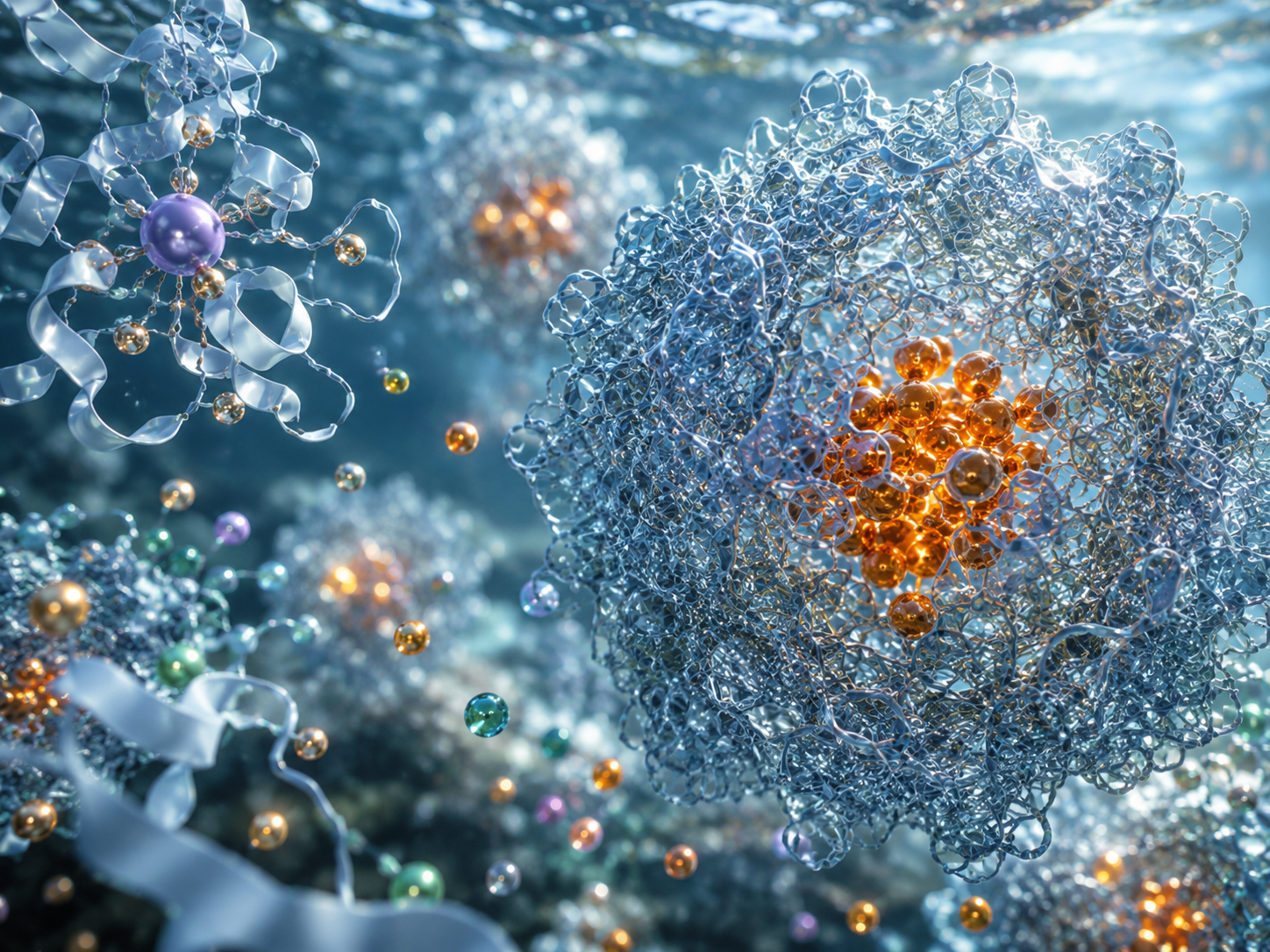
Paper: Nature's Nanotech Warriors: The Role of Metalloproteins and Protein Cages for Environmental Remediation. Image Credit: AI-generated image / OpenAI
In a recent review article in the journal Advanced Sustainable Systems, researchers explore the nanoscale potential of metalloproteins and protein cages as protein-based biological nanosystems for efficient heavy-metal sequestration and environmental remediation.
Heavy Metal Pollution Challenges
Heavy metals and metalloids such as cadmium, lead, mercury, arsenic, chromium, zinc, and uranium persist in the environment due to industrialization, mining, industrial wastewater, agricultural runoff, and electronic waste disposal, posing long-term threats to ecosystems and human health. These metals bioaccumulate and disrupt natural biogeochemical cycles, causing severe toxic effects, including neurological disorders, cancer, and organ damage, particularly kidney injury.
Conventional physical and chemical remediation methods involve substantial energy consumption and often generate secondary pollutants, highlighting the urgent need for sustainable alternatives. Biological approaches leveraging natural protein-based nanostructures have emerged as environmentally friendly and efficient tools for selective heavy metal capture and detoxification.
The core of this biological strategy lies in metalloproteins and protein cages, many of which evolved in microbes and other organisms over millions of years to manage metal stress by high-affinity binding, sequestration, transformation, or encapsulation of toxic ions. Metalloproteins interact with metal ions through specific binding motifs, while protein cages self-assemble into nanoscale hollow structures, providing confined environments for metal immobilization.
Protein-Based Remediation Strategies
The review underscores detailed mechanistic insights and diverse experimental innovations involving metalloproteins and protein cages at the nanoscale. Metallothioneins and phytochelatins, cysteine-rich metal-binding proteins and peptides, use precision binding to chelate heavy metals intracellularly, often in coordination with metal-regulatory proteins and transmembrane P-type ATPases that maintain metal homeostasis and efflux toxic ions from cells.
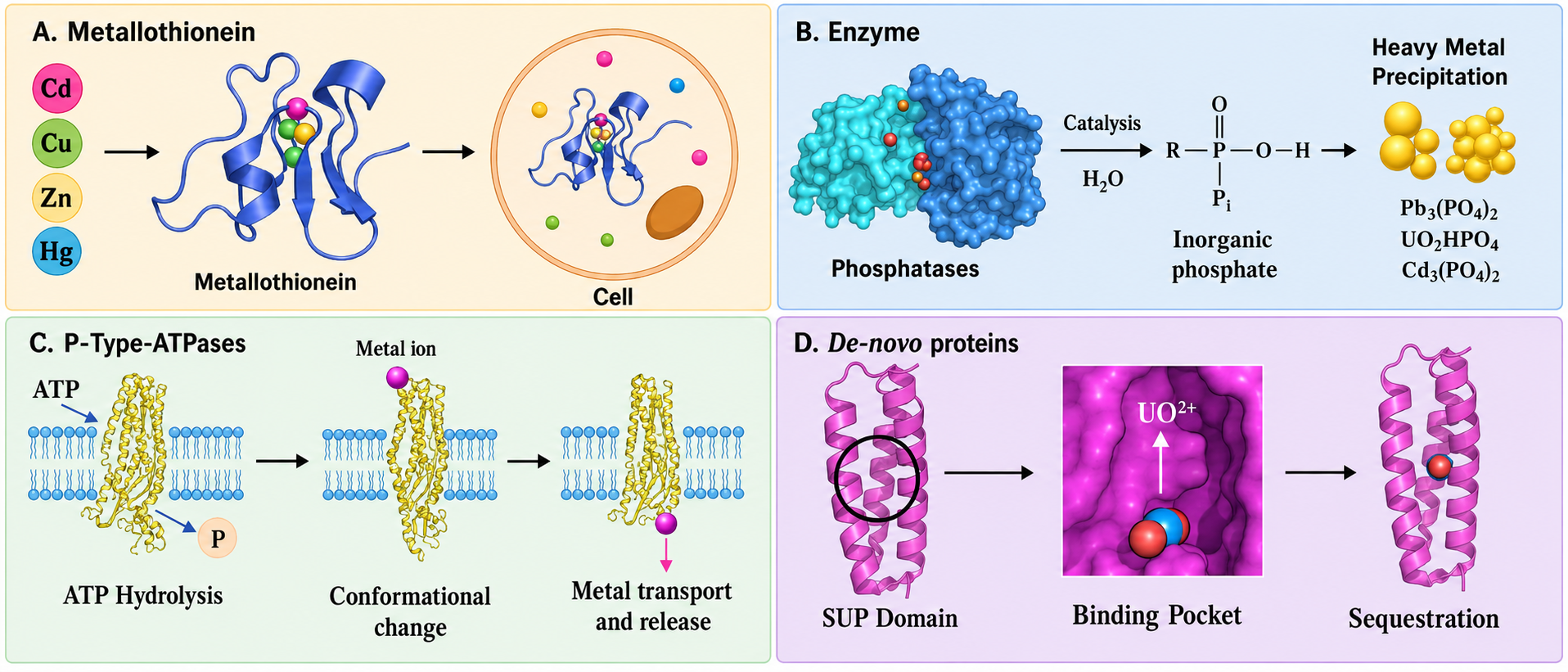
Protein-based strategies for heavy metal sequestration. (A) Metallothioneins bind Cd, Cu, Zn, and Hg via cysteine thiols for intracellular detoxification. (B) The schematic shows phosphatase-mediated catalysis for the formation of insoluble phosphate complexes of different heavy metals (Pb, UO2+, Cd). Phosphatases catalyzed heavy metal (Pb, UO2+, Cd) precipitation through the generation of inorganic phosphate. (C) The schematic shows P-type ATPases mediated ATP hydrolysis, which facilitates active transport of metal ions across membranes. (D) Schematic illustrating the de novo-designed protein Super Uranyl-binding Proteins (SUPs), which carry selective binding pockets for high-affinity UO2+ sequestration. Image Credit: Adapted from D’Silva S., Acharya C., Chakraborti S. (2026). Nature’s nanotech warriors: The role of metalloproteins and protein cages for environmental remediation. Advanced Sustainable Systems, 10, e70495. DOI: 10.1002/adsu.70495. Licensed under CC BY 4.0. Redrawn using ChatGPT.
Protein cages, such as ferritins, are highlighted as remarkable natural nanostructures formed by the self-assembly of 12 or 24 subunits into spherical shells roughly 8–12 nm in diameter. These cages have internal cavities that accommodate thousands of metal ions, facilitating sequestration via electrostatic forces, oxidation at ferroxidase sites, and nucleation into inert mineral forms such as oxides or phosphates.
Experimental studies show ferritin’s capability not only to store iron but also to sequester a range of non-iron metals and metalloids, including cadmium, mercury, chromium, lead, and arsenic, in specific ferritin systems. Engineered bacterioferritins expressed in bacteria demonstrated increased tolerance to cadmium, highlighting practical bioremediation applications.
VLPs, another class of protein nanocages, have been employed experimentally to detoxify toxic metals, metalloids, and industrially relevant ions, including Pb, Hg, Cd, Ni, Co, Li, and As, albeit less extensively than ferritins. The hollow architecture and charged residues lining the pores and internal surfaces of these cages dictate metal-ion selectivity and uptake kinetics, a property exploited by rational protein engineering, Artificial Intelligence">AI-guided protein design, and site-directed mutagenesis to create improved sequestration scaffolds.
Studies on archaeal ferritins, like that from Archaeoglobus fulgidus, illustrate high cobalt and nickel sequestration capacity, with one system enabling almost pure cobalt carbonate recovery from a Co/Ni/Li mixture, an example of next-generation nanobiotechnological applications for critical metal recovery.
Additionally, de novo-designed artificial protein nanocages reveal extraordinary metal selectivity and assembly triggered by alkaline earth metals, underscoring the convergence of computational protein design and biotechnology at the nanoscale.
Protein Cages and Engineering
This review highlights the unique capabilities of nanoscale protein systems as biological “nanotech warriors” combating heavy metal pollution. Their self-assembled cage architecture and precise metal-binding sites form an efficient multistep sequestration pathway, with metal-ion attraction via charged pore residues, nucleation deep within the cavity, and conversion into stable, inert mineralized nanoparticles.
Protein engineering, synthetic biology, and AI have advanced the de novo design and enhancement of natural metalloproteins and protein cages. These approaches increase metal-binding affinity and specificity, tailor cage pore sizes, and introduce novel metal-coordination chemistries, thereby helping address the limitations of natural proteins, which may exhibit limited selectivity under complex environmental conditions.
For instance, metalloregulatory proteins like MerR have been engineered to develop metal-responsive “sense-and-respond” circuits that regulate detoxification, integrating synthetic feedback loops and CRISPR-based transcriptional regulation to optimize metabolic burden and remediation efficacy.
Despite their promise, challenges remain in translating these nanoscale biomaterials from laboratory prototypes to field-deployable technologies. Issues of scalability, protein stability, reusability, cost, environmental robustness, public acceptance, and regulatory approval for genetically engineered organisms must be addressed.
Moreover, the selectivity dilemma, distinguishing and sequestering specific toxic metals within complex environmental mixtures, requires further improvement through expanded metalloproteomic data and advanced AI-driven computational design to create fine-tuned metal-binding sites.
Prospects and Barriers
Protein-based nanosystems encompassing metalloproteins and self-assembling protein cages represent a rapidly advancing frontier in environmental nanobiotechnology for heavy metal remediation. Natural nanocages, especially ferritins and engineered variants, provide structurally tunable platforms capable of high-capacity sequestration, mineralization, and recovery of a diverse array of metals under environmentally benign conditions.
As research advances, protein nanocages and metalloproteins could move beyond biological curiosities to become practical nanotechnological tools in critical metal recovery, environmental monitoring, resource recovery, and circular economy applications. This interdisciplinary field is thus gaining momentum, although field deployment will depend on improved selectivity, stability, scalability, cost-effectiveness, and regulatory pathways for nature-inspired nanotech solutions against the age-old challenge of heavy metal pollution.
Download your PDF copy by clicking here.