A PEI-coated magnetic carbon nanomaterial removed 98.33% of water from heavy-oil emulsions in lab tests, suggesting a reusable route to faster, more efficient oil-water separation.
Paper: Functionalized Magnetic Carbon Nanoparticles Efficiently Break Water-in-Heavy Oil Emulsions
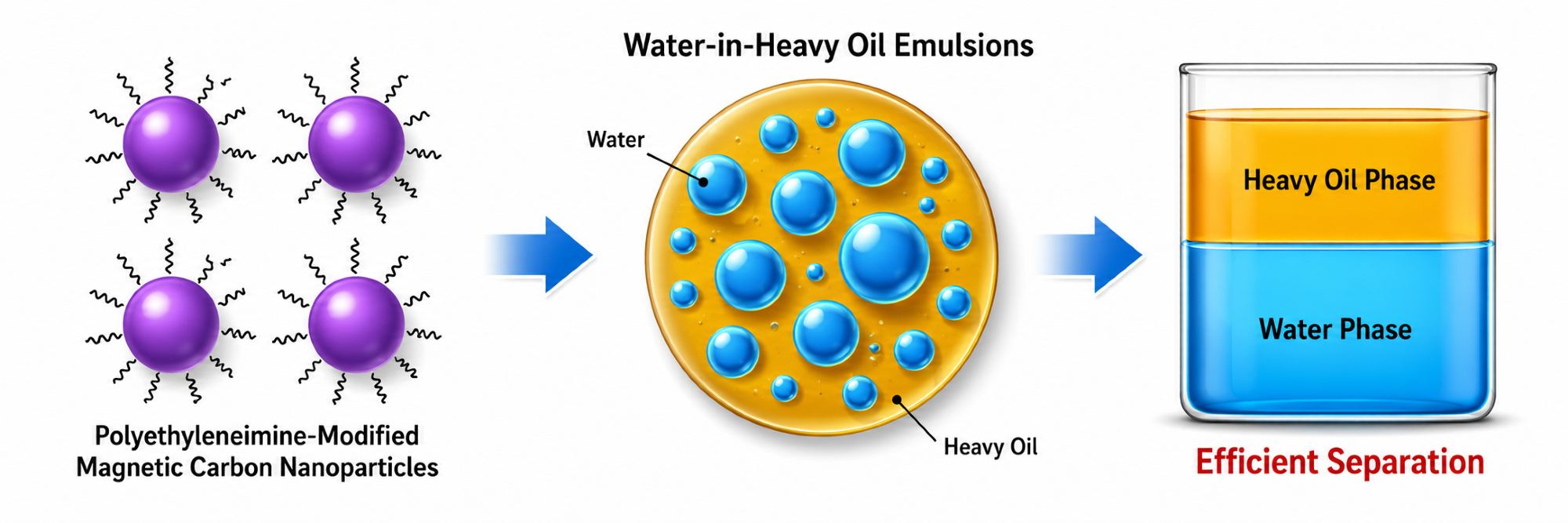
A recent study published in the journal Materials reports the development of polyethyleneimine-functionalized magnetic carbon nanoparticles for the efficient separation of water-in-heavy-oil emulsions. The researchers engineered a multifunctional nanomaterial that combines magnetic recovery and enhanced interfacial activity to disrupt stable emulsions. The work demonstrates the potential of engineered nanomaterials to support future development of more efficient oil-water separation processes, although field-scale performance and environmental safety remain to be established.
Engineering Multifunctional Magnetic Nanoparticles
Heavy oil remains an important global energy resource, but its production and processing are often complicated by the formation of highly stable water-in-heavy oil emulsions. Natural surface-active components accumulate at the oil-water interface, forming rigid protective films around water droplets. These interfacial layers hinder droplet coalescence, increase emulsion stability, and make water removal both energy-intensive and costly.
Conventional demulsification technologies include biological, physical, and chemical approaches. While effective in certain applications, many require high energy input, specialized equipment, or large quantities of chemical additives. Chemical demulsifiers remain the industry standard, but concerns over environmental impact, recovery, and reusability continue to drive the search for more sustainable alternatives.
Nanotechnology offers new opportunities to address these challenges. Magnetic nanoparticles have attracted considerable interest due to their high surface area, strong adsorption capacity, and ease of recovery using external magnetic fields. However, particle aggregation and limited interfacial activity often restrict their performance in complex heavy-oil systems.
In this work, the researchers developed polyethyleneimine (PEI)-functionalized magnetic carbon nanoparticles (P-MCNs). By integrating magnetic Fe3O4 cores, carbon nanostructures, and amine-rich polymer coatings, they engineered a multifunctional nanomaterial with enhanced interfacial activity.
Nanomaterial Synthesis and Characterization
The researchers synthesized polyethyleneimine-functionalized magnetic carbon nanoparticles (P-MCNs) through a two-stage preparation route. They first produced carbon nanospheres using hydrothermal carbonization of glucose. The researchers then formed and anchored Fe3O4 on the carbon framework during hydrothermal synthesis to impart magnetic functionality to the carbon nanospheres. PEI was included in the same synthesis step to provide surface functionalization and improve interfacial activity.
PEI played a key role in the nanoparticle design. Its amine-rich structure introduced positive surface charges, enhancing interactions with negatively charged species at the oil-water interface. The resulting P-MCNs combined a magnetic Fe3O4 core, a carbon-based framework, and a functional polymer coating within a single nanostructured material.
The team utilized various characterization techniques to verify successful synthesis and evaluate material properties. Fourier-transform infrared spectroscopy, XRD, and X-ray Photoelectron Spectroscopy">XPS confirmed the presence of Fe3O4 and PEI functional groups, and demonstrated strong interactions between the polymer coating and magnetic nanoparticles. Electron microscopy revealed rough, coated particles with a distinct core-shell architecture, and thermogravimetric analysis showed excellent thermal stability.
The researchers conducted bottle tests using model water-in-heavy-oil emulsions to assess demulsification performance. They systematically investigated the effects of nanoparticle concentration, temperature, and settling time on water separation efficiency.
Exceptional Demulsification Performance Through Surface Functionalization
The results showed that surface functionalization significantly improved nanoparticle performance. Compared with unmodified carbon nanoparticles and polyethyleneimine alone, P-MCNs delivered consistently higher dehydration efficiencies across all operating conditions.
Nanoparticle concentration strongly influenced separation performance. Dehydration efficiency increased rapidly with increasing dosage, reaching nearly complete dehydration at concentrations above 400 ppm. The optimal concentration was 500 ppm, beyond which further additions provided little improvement. Increasing the operating temperature from 35°C to 50°C significantly enhanced water separation by increasing molecular mobility and weakening the interfacial films surrounding water droplets.
P-MCNs achieved a dehydration efficiency of 98.33%, compared with 90% for unmodified carbon nanoparticles under optimized conditions. The fabricated nanoparticles exhibited rapid demulsification kinetics. The P-MCNs removed about 80% of the water within ten minutes and reached maximum dehydration efficiency after one hour.
Contact angle measurements showed that functionalization enhanced particle wettability after surface engineering. P-MCNs produced the greatest reductions in surface tension and oil-water interfacial tension, facilitating water droplet coalescence and separation. Zeta potential analysis further revealed stronger electrostatic interactions with negatively charged bitumen species, thereby disrupting the stabilizing interfacial film and accelerating emulsion breakdown.
Advancing Nanomaterial-Based Separation Technologies
This study demonstrates how surface engineering can significantly enhance the performance of magnetic nanoparticles for oil-water separation. By integrating magnetic Fe3O4 nanoparticles, carbon nanostructures, and polyethyleneimine functional groups, the researchers developed a multifunctional nanomaterial that efficiently destabilizes water-in-heavy-oil emulsions.
The resulting P-MCN material achieved a dehydration efficiency of 98.33% under optimized conditions while maintaining high thermal stability and rapid separation kinetics. The material retained more than 92% demulsification efficiency after six consecutive cycles, supporting its potential as a reusable demulsifier; however, long-term structural stability, potential leaching, field performance, and cost impacts still require further study.
Beyond heavy oil processing, the findings suggest that similar surface-engineering strategies could eventually be explored in interfacial engineering. Precise control over nanoparticle surface chemistry enables the design of materials that selectively interact with complex fluid interfaces. Similar strategies could support future work in wastewater treatment, environmental remediation, enhanced oil recovery, and other separation technologies.
Overall, the work establishes polyethyleneimine-functionalized magnetic carbon nanoparticles as a promising class of recyclable demulsifiers and highlights the growing role of engineered nanomaterials in advancing sustainable separation technologies.
Download your PDF copy by clicking here.
Disclaimer: The views expressed here are those of the author expressed in their private capacity and do not necessarily represent the views of AZoM.com Limited T/A AZoNetwork the owner and operator of this website. This disclaimer forms part of the Terms and conditions of use of this website.
Source:
- Gao, J., Yan, L., & Ma, J. (2026). Functionalized Magnetic Carbon Nanoparticles Efficiently Break Water-in-Heavy Oil Emulsions. Materials, 19(12), 2584. DOI: 10.3390/ma19122584, https://www.mdpi.com/1996-1944/19/12/2584