A carefully tuned mix of copper microparticles, silver nanoflakes, and ultrafine nanoparticles formed conductive pathways that improved heat transfer in a model LED package.
Paper: Silver-copper hybrid nanocomposite thermal interface materials for power electronic device packaging. Image credit: AI-generated image created using ChatGPT/OpenAI
In a recent 'Article in Press' published in the journal Scientific Reports, researchers developed silver-copper micro-nano hybrid composite thermal interface materials with high thermal and electrical conductivities for high-power electronic device packaging, and found that they produced lower effective die-attach thermal resistance than one commercial sintered-silver paste in a model LED package.
Challenges for Power-Electronics TIMs
Thermal interface materials (TIMs) are critical in managing heat in power electronic device packaging, especially as wide-bandgap devices such as SiC can operate at temperatures reaching 250 to 300 °C, compared with about 180 °C for silicon devices.
Conventional solders, such as Sn-Pb and lead-free solders (e.g., Sn-Ag-Cu alloys), face limitations related to toxicity, temperature-dependent mechanical degradation, and long-term reliability at elevated temperatures. Silver nanoparticle (AgNP) pastes offer advantages due to their size-dependent low-temperature sintering, while the resulting sintered silver network has a melting point near bulk silver, 961.78 °C.
However, pure silver TIM pastes are costly and exhibit issues like high ion mobility, which can contribute to silver migration and reliability concerns. To address these challenges, hybrid micro-nano composites combining silver and copper particles with tailored size and shape characteristics have been investigated to improve thermal performance while reducing costs.
This study specifically develops silver-copper micro-nano hybrid composites (AgCuMNHs) that utilize copper microparticles (CuMPs), silver nanoflakes (AgNFs), and nanoparticles">AgNPs to create interconnected sintered networks designed to improve thermal and electrical properties in die-attach TIMs for power device packaging.
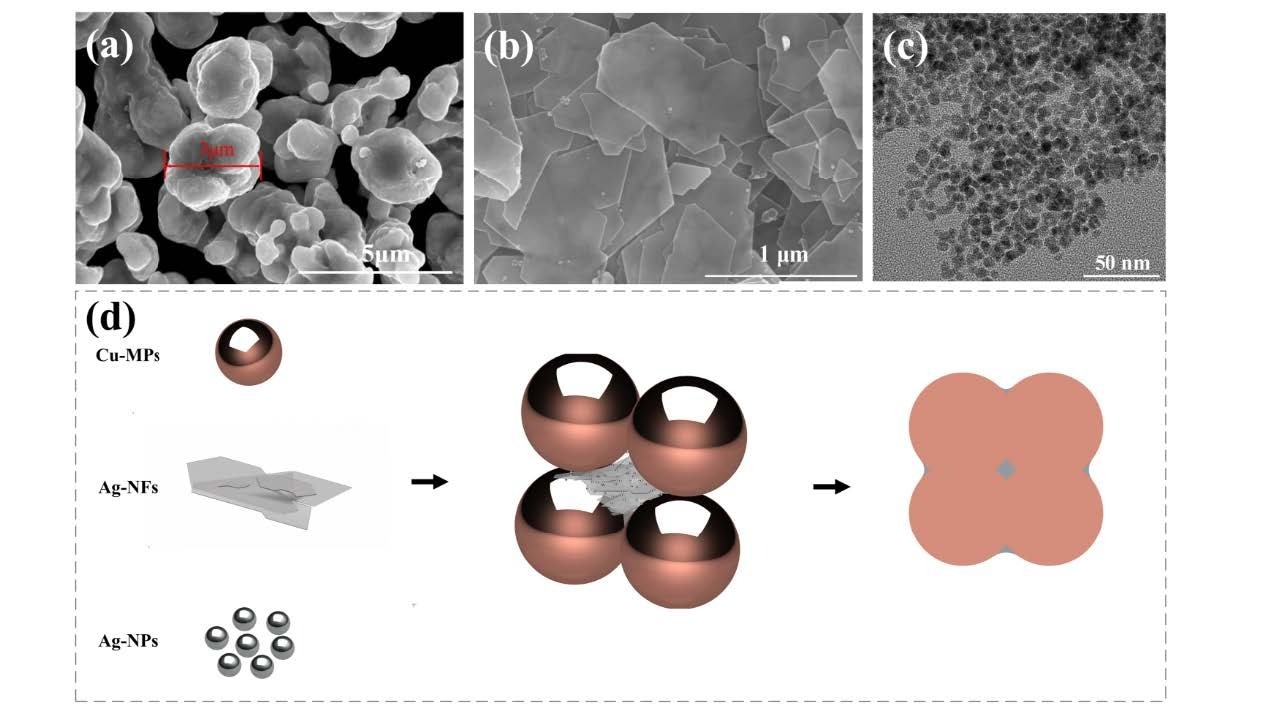
Microstructures of AgCuMNH components: a,b) SEM images of CuMPs and AgNFs; c) TEM image of AgNPs; d) Schematic of the sintering process of AgNFs, AgNPs and CuMPs to form AgCuMNH composites as TIMs.
AgCuMNH Paste Fabrication
The research utilized a multi-scale hybrid particle system composed of 55 wt% CuMPs (approximately 3 μm), 25 wt% AgNFs (0.3–0.5 μm flakes, ≤50 nm thick), and 10 wt% ultrafine AgNPs (8–10 nm), dispersed in 10 wt% organic solvents.
Characterization methods included scanning electron microscopy (SEM), transmission electron microscopy (TEM), energy-dispersive X-ray spectroscopy (EDS) mapping, laser flash analysis for thermal diffusivity, four-probe electrical conductivity measurements, and bulk density measurement by the Archimedes method, from which porosity was calculated. The specific heat capacity was measured via differential scanning calorimetry.
Finally, AgCuMNH and commercial benchmark silver paste, Kyocera CT2700R7S, were applied as die-attach TIMs on LED chips to evaluate their device-level thermal resistance and mechanical shear strength under identical packaging conditions. Both LED groups underwent pressureless sintering at 260 °C for 30 minutes, rather than the 220 °C and 0.7 MPa hot-press conditions used in the material tests.
Performance Evaluation and Analysis
The study indicated that solvent polarity influenced the dispersion of AgNPs and AgNFs within the paste, which in turn affected sintering uniformity and final microstructure integrity. The low-polarity solvent terpineol produced poor AgNF dispersion, uneven silver distribution, and less complete sintering, resulting in fewer effective conductive pathways and a thermal conductivity of 105.1 W/(m·K).
Conversely, the authors proposed that 1,2-propanediol delivered the best balance of dispersibility among the four solvents tested due to compatibility with polyvinylpyrrolidone (PVP) capping agents on AgNFs and greater compatibility than the more polar glycol with the hydrophobic surfactants coating AgNPs, enabling more uniform distribution and enhanced formation of sintering necks, or fused contact points between neighboring particles.
The 1,2-propanediol formulation exhibited higher thermal conductivity (247.4 W/(m·K)) and electrical conductivity (27 mS/m) than the other solvents tested. SEM images showed more complete sintering, while EDS mapping indicated more uniform silver distribution when 1,2-propanediol was used. For the solvent comparison, thermal conductivity was based on single third-party measurements with a reported relative uncertainty of ±4.5%, while electrical conductivity was measured in triplicate.
Sintering temperature and pressure were found to have optimal ranges; above 0.7 MPa, further pressure increases had limited or adverse effects, while the authors attributed the performance decline at 240 °C to surface oxidation of the CuMPs. The best-performing conditions among those tested were 220 °C and 0.7 MPa, which yielded interconnected micro-nano networks in which the ultrafine AgNPs served as bridges, facilitating neck formation between the micron-sized CuMPs and AgNFs and capitalizing on the size-dependent low-temperature sintering of AgNPs.
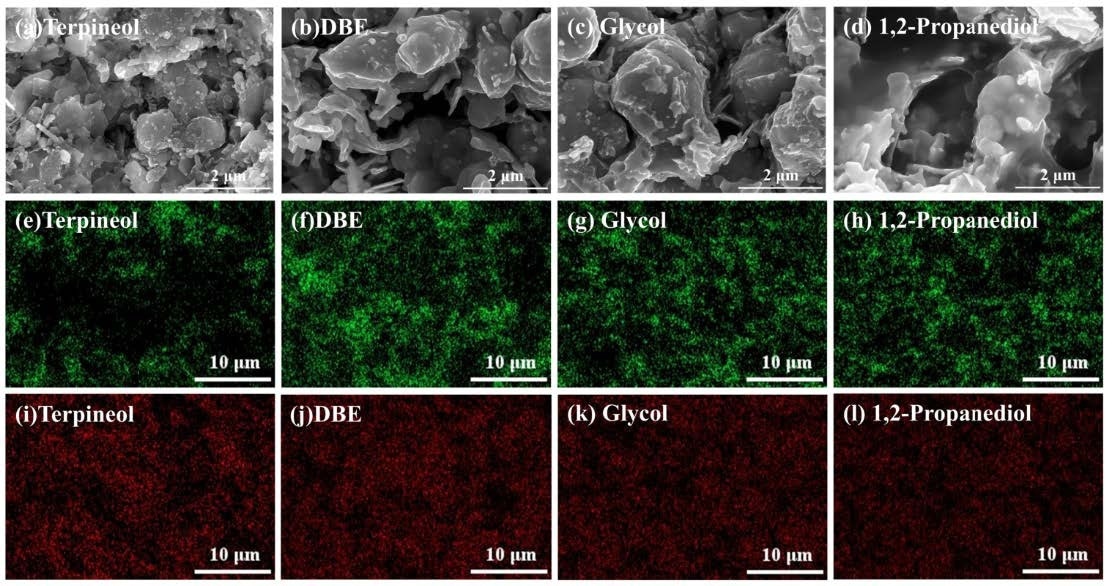
SEM micrographs of sintered samples prepared with four different solvents: a–d) SEM images; e– h) EDS mapping images of silver; i–l) EDS mapping images of copper.
Following further refinement of the formulation and sintering process, an optimized hybrid composite reached a thermal conductivity of 330.0 W/(m·K) and electrical conductivity of 5.6 × 10⁷ S/m. The authors described this as the highest thermal conductivity among reported AgCuMNH TIMs. The paper did not fully report the additional formulation changes used to obtain these peak values. Although the study did not conduct a formal cost-performance analysis, copper constituted approximately 61% of the metal solids, leaving silver at less than 40% of the metal content.
In device-level tests on LED chip packaging, the AgCuMNH TIMs demonstrated an average effective die-attach thermal resistance of 0.56 K/W, approximately 44% lower than the benchmark Kyocera CT2700R7S paste's 1.00 K/W. This effective value included the bulk TIM layer, bond-line thickness, and top and bottom interfacial contact resistances. The mechanical shear strength of the hybrid paste, 18.0 MPa, exceeded the 6.25 MPa minimum cited by the authors in MIL-STD-883K Method 2019.9, although it was lower than the benchmark value of 27.6 MPa.
The lower effective thermal resistance was attributed to a more uniform particle distribution and to well-sintered, interconnected metallic networks formed by nano-sized silver particles filling gaps between the larger copper particles and silver flakes. Porosity varied only modestly across the solvent groups and did not account for their large conductivity differences.
Implications for Power Packaging
This research provided laboratory and model-device evidence for the design and synthesis of silver-copper micro-nano hybrid composite pastes as high-performance TIMs with potential for use in power electronic device packaging. By strategically utilizing nanoscale silver particles to bridge micron-sized copper and silver flakes, the composites achieved high thermal conductivity and electrical performance via low-temperature sintering.
The selection of organic solvents with appropriate polarity was critical for promoting uniform nanoparticle dispersion and effective neck formation during sintering. These peak material values were obtained in near-room-temperature measurements after hot-press processing at 220 °C and 0.7 MPa.
These findings highlight the potential of hybrid micro-nano composites for further development as thermal management materials in power devices. However, performance during prolonged high-temperature operation, thermal and power cycling, long-term reliability, manufacturing scalability, and production costs were not assessed.
Source:
- He H., Zhang H., et al. (2026). Silver-copper hybrid nanocomposite thermal interface materials for power electronic device packaging. Scientific Reports. Article in Press. DOI: 10.1038/s41598-026-64292-3, https://www.nature.com/articles/s41598-026-64292-3