Tumbling MXene microrobots captured trapped plastic particles in laboratory water and soil samples, pointing to a promising cleanup method with important safety hurdles ahead.
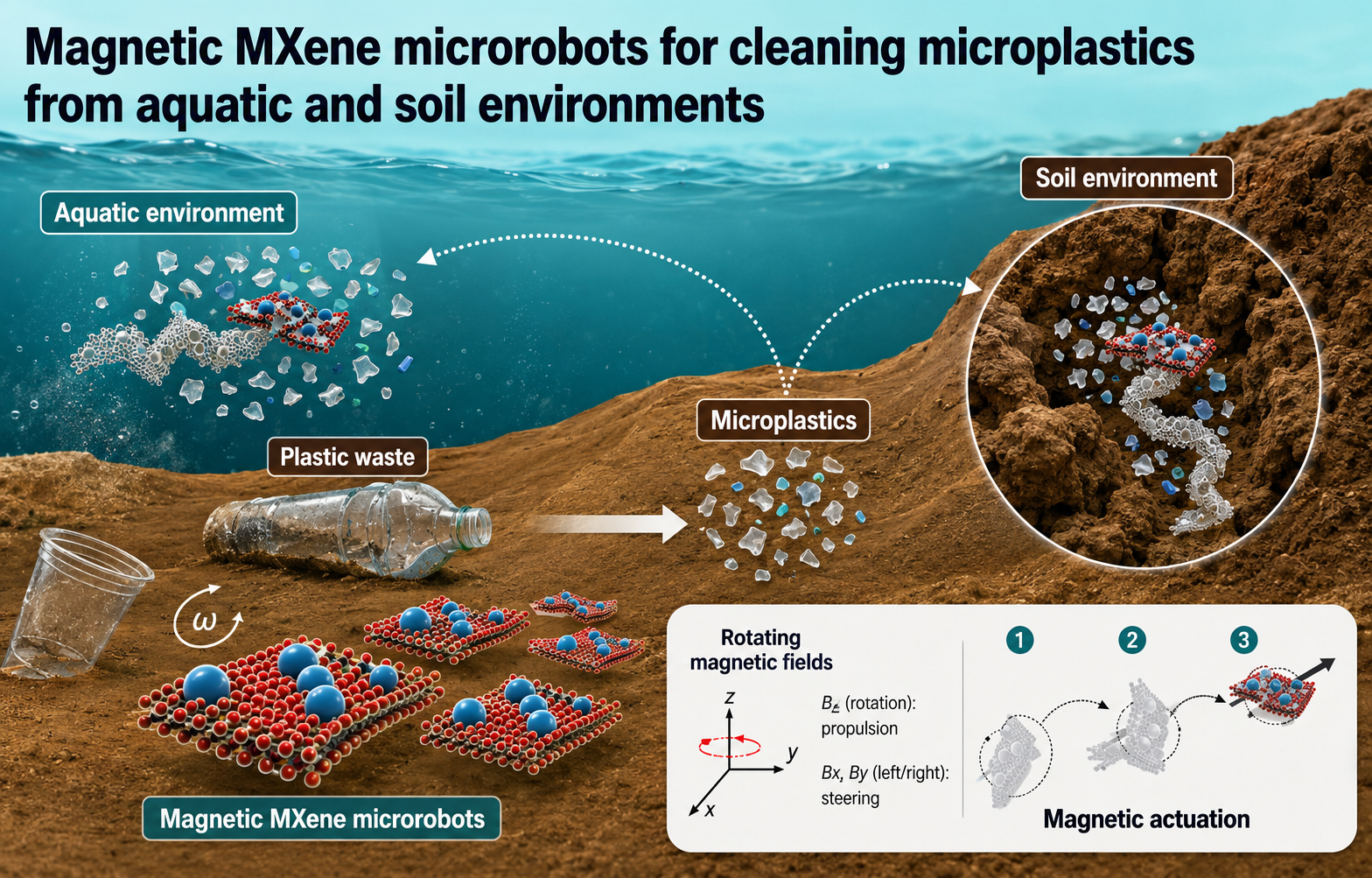
Schematic illustration of magnetic MXene (Ti3C2Tx@Ni) microrobots for microplastic removal from aquatic and soil environments, driven by rotating magnetic fields for propulsion and steering. Paper: Magnetic MXene-based microrobots for soil microplastics removal
A research paper, published online as an article in press in the journal NPG Asia Materials, proposed a magnetically actuated microrobotic platform based on two-dimensional (2D) MXene for the efficient removal of microplastics from soil and aquatic environments under laboratory conditions.
Microplastic Pollution in Terrestrial Environments
Microplastic pollution poses a major threat to human health and ecosystems. Microplastics are plastic particles less than 5 mm in diameter. These particles are produced through the disintegration of large plastics by biological degradation, mechanical abrasion, ultraviolet exposure, and thermal stress.
Microplastics can degrade soil fertility, interfere with nutrient cycling, and disrupt microbial communities in terrestrial ecosystems, resulting in potential risks to food security.
The accumulation of microplastics over long periods poses unknown risks to environmental and human health. Approaches like adsorbent-based separation, electrokinetic extraction, and bioremediation for removing microplastics suffer from limited practicality, high costs, potential environmental impacts, and inefficiency.
Potential of Nano- and Microrobots
Nano- and microrobots with precise navigation and active motion at micro- and nanoscales could support a range of applications. Specifically, their programmable, collective, adaptive, and dynamic behaviors make them suitable for environmental remediation.
Yet the primary focus of existing nano-/microrobot-based approaches is on aquatic environments. Their potential for challenging subsurface environments has remained largely unexplored.
Role of Transition Metal Carbides
Titanium carbide Ti3C2Tx MXenes display excellent physicochemical properties like tunable surface chemistry, large specific surface area, the reported environmental compatibility of the MXene component, and enhanced adsorption capacity.
Their numerous surface terminations enable multiple adsorption mechanisms, while their layered structure allows water and organic molecules to move into and out of the spaces between layers. These properties make MXenes suitable for advanced membranes and adsorbents in desalination and water purification applications.
Thus, integrating Ti3C2Tx MXenes with magnetic nickel nanoparticles and microrobotic systems can serve as an efficient design approach, combining enhanced adsorption capacity with accurate magnetic manipulation to address challenges in removing microplastics from soil.
The Proposed Magnetic MXene-Based Microrobots
In this work, researchers introduced magnetically active 2D MXene microrobots capable of agile, wireless, and precise maneuverability. These microrobots were engineered for dynamic transport, retrieval, and capture of microplastics in aqueous suspensions and water-permeated soil samples.
The robots consisted of multi-layered Ti3C2Tx MXene microparticles integrated with approximately 500 nm nickel (Ni) nanoparticles (Ti3C2Tx@Ni hybrids), forming mobile adsorbent particles in which the Ni nanoparticles acted as magnetic engines. Rotational magnetic fields induced synchronized tumbling motion with a maximum velocity of 22.1 µm s-¹ at 5 mT and 3 Hz, enabling propulsion along pre-programmed or manually steered trajectories.
Additionally, collective magnetic swarming enhanced localized fluid convection and continuous physical interactions, increasing contact between the MXene surfaces and dispersed microplastics.
Fabrication of Magnetic MXene Microrobots
Ti3C2Tx MXene, amine-modified fluorescent-labeled polystyrene particles, ethylene glycol, hydrazine hydrate, sodium hydroxide, and nickel (II) chloride hexahydrate were used as starting materials.
A chemical reduction method was used to synthesize the Ti3C2Tx@Ni hybrids/magnetic MXene microrobots. Nickel (II) chloride hexahydrate was dissolved in a 20 mL solution containing deionized water and ethylene glycol at a 1:1 volume ratio under sonication for 10 min.
Then, Ti3C2Tx MXene microparticles were added to the as-obtained Ni precursor solution and vigorously stirred for 30 min. Subsequently, 4 mL of 80% hydrazine hydrate and 4 mL of 2.5 M sodium hydroxide were added to the mixture.
The as-prepared mixture was heated at 70 °C for 60 min under continuous sonication. Finally, the researchers separated the reaction product by centrifugation, washed it repeatedly using deionized water, and dried it in a vacuum oven.
Researchers used spectroscopic, diffraction, microscopic, surface-area, and zeta-potential analyses to characterize the synthesized magnetic MXene microrobots.
Researchers also conducted microplastic transport, retrieval, and capture experiments, as well as magnetically driven multimodal motion studies.
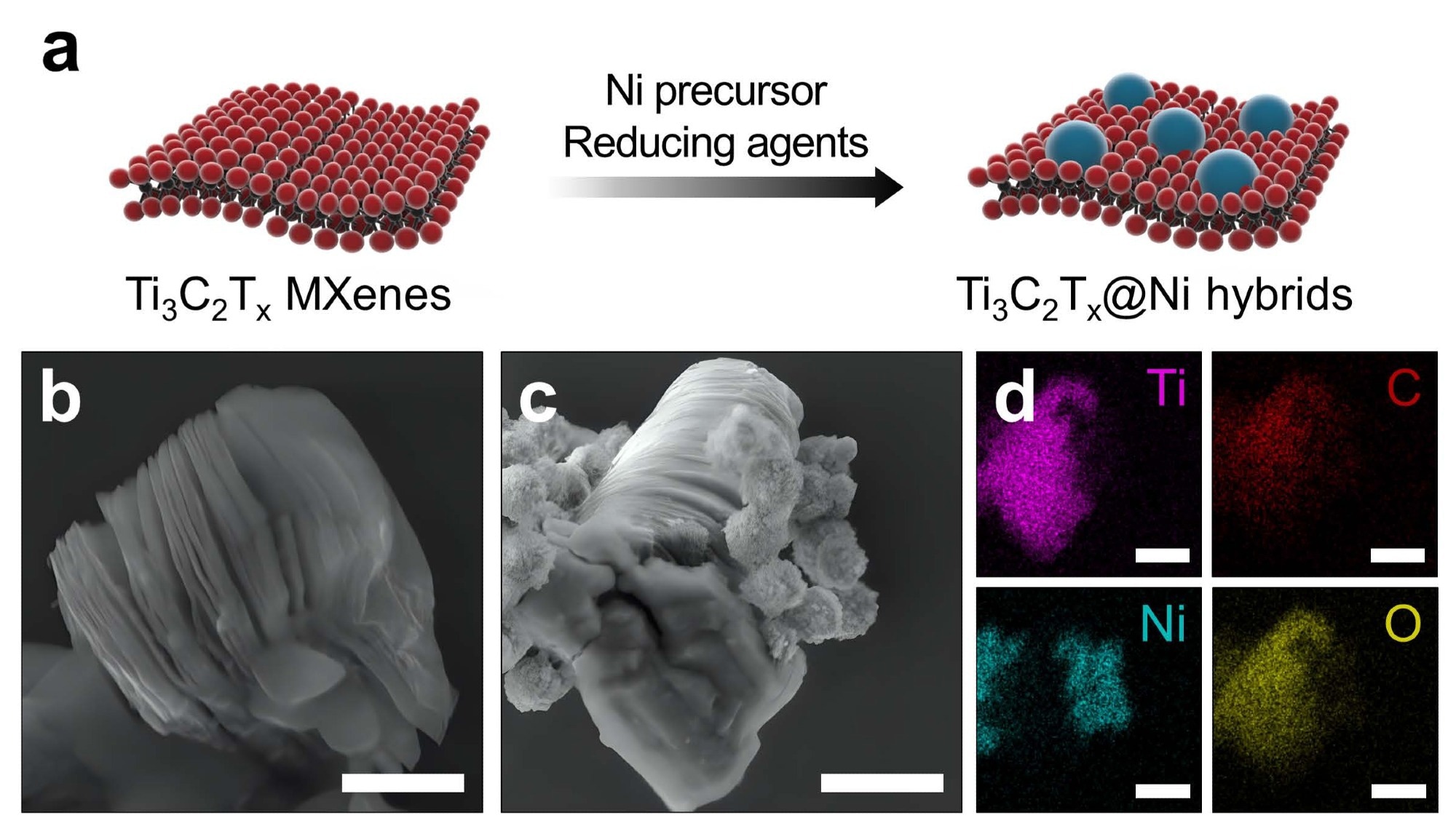
Fabrication and characterization of magnetic MXene microrobots. (a) The synthesis process of Ti3C2Tx@Ni hybrids by chemical reduction method. b-d Representative SEM images of Ti3C2Tx MXenes (b), Ti3C2Tx@Ni hybrids
Laboratory Performance of the Microrobots
Researchers demonstrated a laboratory-scale magnetically actuated 2D MXene-based microrobotic platform for microplastic removal in aqueous and soil test systems. The strategy was validated using 1 µm polystyrene (PS) microplastics and 1-150 µm polyethylene terephthalate (PET) microfragments.
The microrobots showed cooperative and individual transport and capture capabilities across different microplastic sizes. In aqueous laboratory suspensions after 60 min of treatment, they achieved removal efficiencies of 89.2% for PET and 94.0% for PS, compared with 74.4% and 81.1%, respectively, for static microrobots. In water-permeated soil samples prepared in Petri dishes, the microrobots navigated through soil microenvironments, binding microplastics actively and generating mechanical forces that detached trapped particles.
This dynamic strategy improved extraction efficiency, reaching 72.2% for PET and 80.6% for PS after 60 min of treatment, compared with 52.5% and 70.7%, respectively, for the same microrobots under static, non-actuated conditions. These triplicate laboratory experiments indicated that active motion could improve microplastic removal, supporting the role of magnetic actuation in environmental cleanup. Thus, the platform warrants further investigation for addressing complex microplastic contamination. However, it was not evaluated in field soil, natural water, mixed-pollutant systems, or over repeated use cycles.
In conclusion, this study's findings demonstrated the laboratory feasibility of magnetically driven 2D MXene microrobots as a potentially versatile platform for removing microplastics from contaminated water and soil. However, the authors cautioned that Ni nanoparticles could release metal ions and that complete magnetic retrieval could not always be guaranteed, posing potential ecological toxicity and secondary pollution risks. They therefore called for environmentally safer magnetic materials before practical deployment.
Disclaimer: The views expressed here are those of the author expressed in their private capacity and do not necessarily represent the views of AZoM.com Limited T/A AZoNetwork the owner and operator of this website. This disclaimer forms part of the Terms and conditions of use of this website.