The research paper has appeared in the latest edition of Nature Chemistry. The research was funded by the EU.
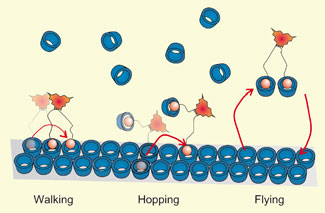 The mechanism of molecular motion changes as the environment changes; in this case, due to competition from free receptors (blue) in solution (c) Nature Chemistry. A. Perl, A.
Dr. Thompson says the team conducting clinical tests at Twente first developed two-legged molecules. A fluorescence microscope was utilized to analyze their movements over a surface that had nano-pores filled with water. The molecules do not like water. This makes the molecules stick to each other, causing the molecules to react to the surface.
This communication between the molecules and the surface had been discovered over ten years ago by a team led by George Whitesides at Harvard, but it had not been applied until now because not much was known about the route and the movement of the molecules.
The molecules have multiple limbs so they move faster and with greater energy over surfaces, indulging in activities that go beyond binding or separating themselves from each other. Dr. Thompson used a computer to trigger other activities that revealed the multiple forces, which compelled the molecules to walk, hop or jump, according to the change in the environment.
Dr. Thompson further says that using a computer helped the team create the molecular tracks and helped understand the microscopy results. Much of the simulations were done on computer clusters that were funded by the Science Foundation Ireland at Tyndall, while some larger calculations were done at the Irish Center for High End Computing. This discovery will help scientists to develop systems from millions of atoms.
Other authors of the paper include Gomez-Casado, D. Thompson, H. H. Dam, P. Jonkheijm, D. N. Reinhoudt and J. Huskens.
Source: http://www.tyndall.ie