A non-viral lipid nanoparticle system delivered three RNA editing components to liver cells, suggesting a preclinical path toward precise, repeat-dose correction of inherited metabolic diseases.
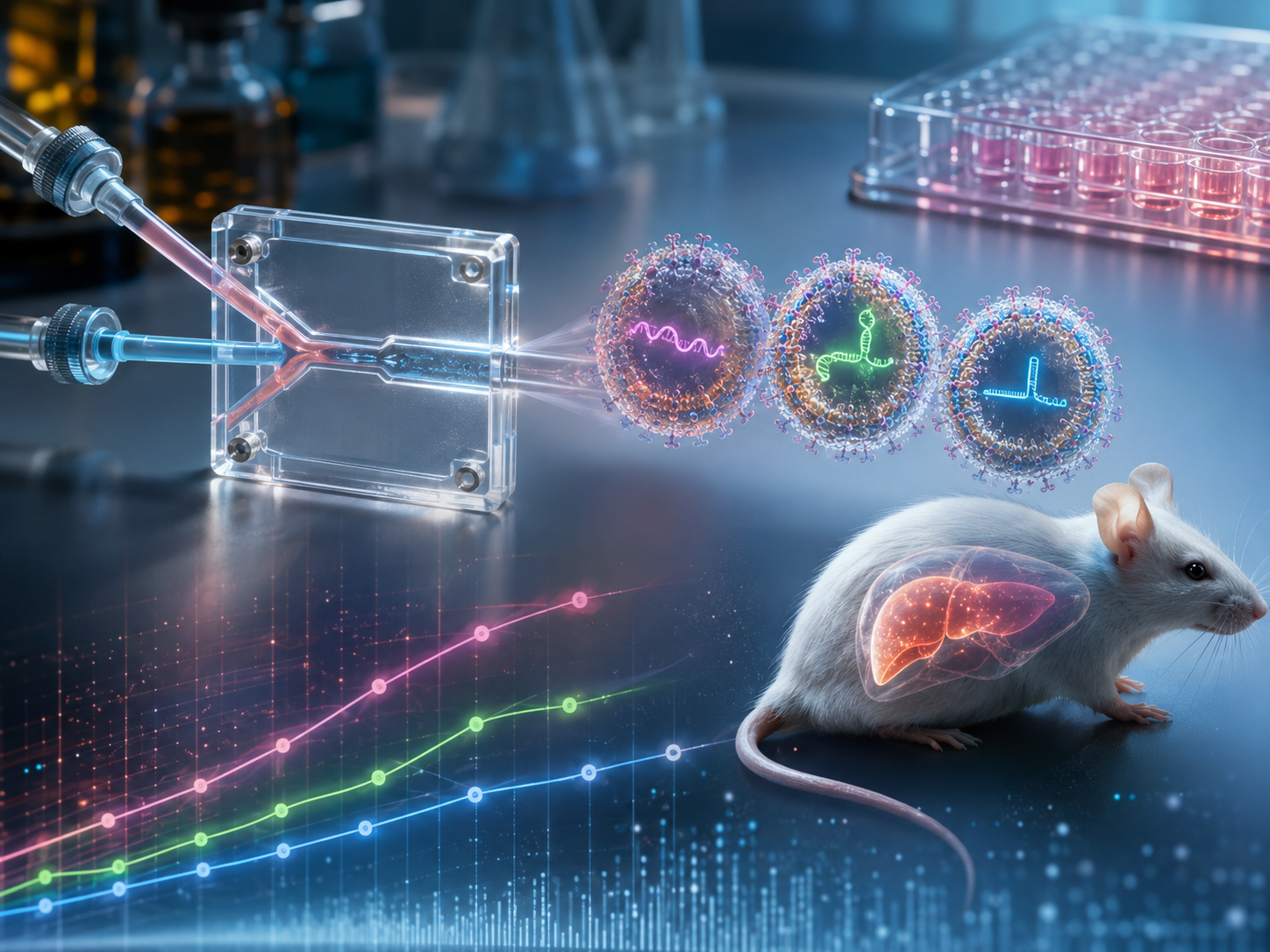
AI-generated illustration created using ChatGPT/OpenAI, inspired by the PE-LNP formulation and administration workflow described in Jiang et al. (2026). Original research: Jiang, A.Y., Cristian, A., Brooks, D.L., et al. “Efficient prime editing in vivo and in vitro using lipid nanoparticles.” Nature Nanotechnology (2026). DOI: 10.1038/s41565-026-02200-6.
A recent study published in the journal Nature Nanotechnology introduced an all-RNA delivery platform for precise in vivo genome editing, leveraging optimized lipid nanoparticles. This non-viral system effectively delivers multiple RNA components required for therapeutic genome correction in preclinical models.
The platform achieved high liver prime-editing efficiencies, including 49% average editing at Pcsk9 in bulk mouse liver, a level comparable to dual-AAV prime-editor delivery in the same study. This highlights the potential of synthetic lipids as a controllable alternative for treating hereditary genetic disorders while reducing prolonged editor exposure and associated off-target risks.
Challenges in Gene Editing Delivery Systems
Prime editing has emerged as a versatile genome-editing approach capable of modifying specific DNA sequences without generating double-strand breaks. However, delivering the necessary molecular components into target tissues remains a significant challenge.
Historically, adeno-associated viruses have been used for gene delivery due to their efficient tissue penetration. Despite this, they are limited by cargo capacity, immune responses, and prolonged editor activity that can increase the risk of unintended genetic modifications.
To address these limitations, researchers have turned to lipid nanoparticles, which protect nucleic acids from degradation, facilitate cellular uptake, and release their cargo after reaching target cells. Composed of ionizable lipids, helper phospholipids, cholesterol, and polyethylene glycol lipids, these nanoparticles self-assemble around genetic payloads and naturally accumulate in the liver after systemic administration. This behavior makes them well-suited for delivering gene-editing therapies for hepatic and metabolic disorders.
Multi-Cargo Nanoparticles for Prime Editing
The study focused on developing an all-RNA prime editing platform using lipid nanoparticles. A key challenge was the simultaneous delivery of three RNA molecules of different sizes: a large prime editor messenger RNA and two much smaller guide RNAs. To address this mismatch, researchers separately formulated nanoparticles for each cargo using the OF-02 lipid formulation and microfluidic mixing, then admixed them before administration.
The platform incorporated an advanced PE6c (Prime Editor 6c) editor and stabilized guide RNAs with the eSBRMV1-A 3′ pseudoknot motif to effectively enhance intracellular persistence. Physicochemical characterization demonstrated that guide RNA nanoparticles achieved encapsulation efficiencies of 87-92% with particle sizes below 105 nm. In contrast, messenger RNA nanoparticles exhibited an encapsulation efficiency of 63% and a larger diameter of 118 nm.
Structural analysis revealed distinct nanoparticle morphologies: guide RNA formed compact lamellar and hexagonal core structures, whereas messenger RNA formulations produced larger particles with multi-bleb cores. These nanoparticles were combined in an optimized ratio before administration to ensure balanced delivery of all editing components, although the study found that RNA stoichiometry had a more modest effect than editor choice, guide RNA stabilization, and RNA purification.
Efficacy and Safety of the System
When evaluated in vivo, the optimized lipid platform produced significant improvements in prime-editing efficiency. By combining the advanced editor variant, stabilized guide RNAs, and an optimized messenger RNA-to-guide RNA mass ratio, researchers achieved a 63-fold increase in editing performance compared to initial formulations. A single systemic administration resulted in 49% indel-free prime editing at the Pcsk9 target site in bulk liver tissue.
The therapeutic potential of the platform was demonstrated in a humanized phenylketonuria (PKU) model, in which treatment achieved 12-15% genomic correction in bulk liver after a single 4 mg kg−1 dose and significantly reduced disease-associated biomarkers. Circulating phenylalanine decreased by approximately 90%, falling below the 360 µM threshold used to guide therapeutic intervention. Safety analyses indicated that the lipid nanoparticles primarily targeted liver hepatocytes, with little or no detectable editing in the non-hepatic tissues and cell populations examined. Off-target screening detected very low levels of unintended genomic modification at candidate sites, although these assays do not exclude all possible genome-wide off-target effects. Toxicity assessments showed only mild, transient elevations in liver enzyme levels that returned to baseline within 3 days.
Implications for Treating Metabolic Disorders
The strong liver targeting and high editing efficiency of this lipid nanoparticle platform highlight its potential for treating a range of inherited metabolic disorders caused by genetic defects in hepatocytes. Conditions such as phenylketonuria and urea cycle disorders are particularly attractive targets because nanoparticles naturally accumulate in the liver.
A major advantage of this delivery system is its potential for repeat dosing. Unlike viral vectors, which can induce immune responses that limit treatments, lipid nanoparticles may permit multiple therapeutic doses over time, enabling progressive accumulation of corrected cells.
Future Directions for Genome-Editing Delivery
In summary, this study demonstrates that optimized multi-cargo lipid nanoparticles can efficiently deliver complex prime-editing systems in vivo, establishing a viable non-viral alternative for therapeutic genome correction in the liver. It indicates that delivery performance depends heavily on nanoparticle formulation and the stability and quality of the RNA cargo, including guide RNA stabilization and mRNA/epegRNA purification strategies that enhance editing efficiency and fidelity.
The results provide a foundation for developing safe, predictable, and scalable gene-editing therapies for liver diseases. Future advances will focus on expanding the tissue-targeting capabilities of lipid nanoparticles by modifying their composition and targeting features. This could enable treatments for a wider range of genetic disorders beyond the liver.
Download your PDF copy by clicking here.
Disclaimer: The views expressed here are those of the author expressed in their private capacity and do not necessarily represent the views of AZoM.com Limited T/A AZoNetwork the owner and operator of this website. This disclaimer forms part of the Terms and conditions of use of this website.