By detecting directional photothermal signals under ambient conditions, TFM-IR gives researchers a sharper view of how strain, stacking, and electronic structure shape light-matter interactions at the nanoscale.
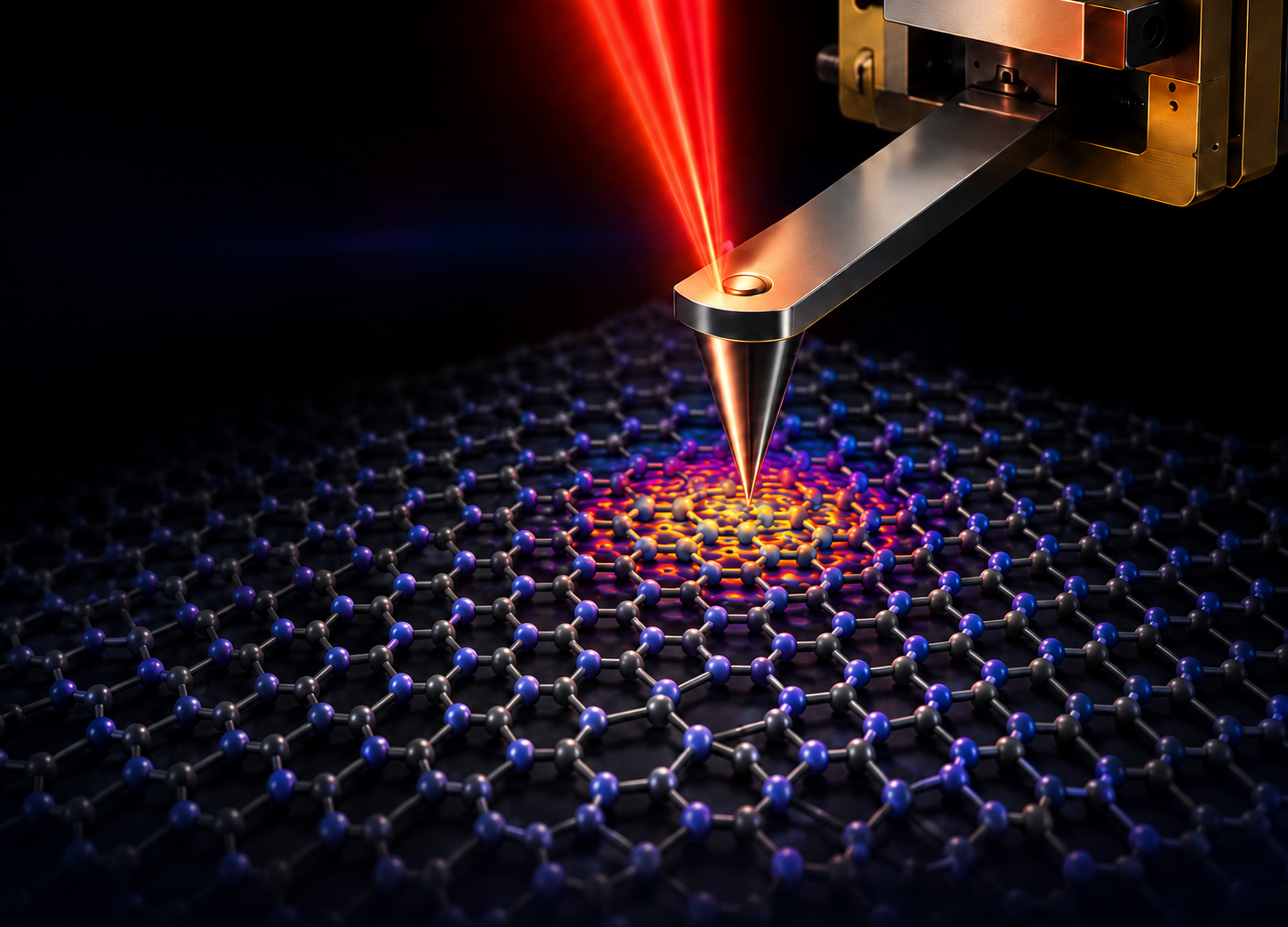
Paper: Direction-resolved nanoscale optical imaging with near-nanometer resolution by emerging infrared torsional force microscopy. Image credit: AI-generated image created using ChatGPT/OpenAI
An 'article in press' in the journal Nature Communications introduced infrared torsional force microscopy (TFM-IR) imaging as an ambient-condition, versatile platform for nanoscale optical characterization.
Limitations of Existing Optical Techniques
Nanoscale optical imaging is an effective tool for investigating light-matter interactions, as it resolves spatially localized optical responses that are inaccessible to traditional far-field methods.
The integration of atomic force microscopy (AFM) with optics, such as infrared nanospectroscopy (AFM-IR) and scattering-type scanning near-field optical microscopy (s-SNOM), enables the investigation of phenomena including nanoscale absorption heterogeneity, excitonic resonances, and phonon polaritons, with applications in materials science and biology.
Yet, current optical techniques based on AFM are primarily sensitive to the out-of-plane response of a sample, leaving complementary and distinct in-plane properties largely inaccessible. Their spatial resolutions are also limited by the tip apex of the AFM.
Thus, developing ambient-condition approaches that integrate broadband optical access, directional sensitivity, and high spatial resolution is necessary.
Earlier efforts to overcome these challenges typically required sacrificing optical contrast, complex instrumentation, or specialized environments, thereby limiting understanding of active light-matter interactions.
How TFM-IR Works
In this work, researchers introduced TFM-IR microscopy. This novel optical imaging method maps both out-of-plane and in-plane photothermal signals by integrating cantilever torsional dynamics with a nonlinear frequency-mixing scheme.
Specifically, the proposed optical imaging method extends TFM to optical measurements by exploiting the torsional resonance of the cantilever under optical excitation, enabling nanometer-scale optical imaging resolution and selective identification of both vertical (out-of-plane) and lateral (in-plane) components of optical forces.
Directional sensitivity was selectively improved through nonlinear mixing of frequency between the laser repetition rate and the torsional resonance modes of the cantilever by harnessing the anisotropy of sample-tip torsional interactions.
The authors report that this capability enables the first nanoscale, direction-resolved, ambient-condition photothermal mapping without sacrificing the quantitative detection advantages and broadband spectral access of standard AFM-IR.
Experimental Approach
Hexagonal boron nitride (hBN) flakes and natural muscovite mica were exfoliated mechanically 3–5 times and then transferred onto uncoated optically polished zinc selenide (ZnSe) substrates. A modified tear-and-stack technique was used to prepare the twisted bilayer graphene sample.
In the fabrication stage, a PDMS/PPC stamp mounted on a glass slide was used to pick up a hBN flake with approximately 100 nm thickness, followed by the first graphene layer.
Subsequently, after a controlled rotation of approximately 2.4°, the second graphene layer was picked up, thereby defining the twist angle between the two layers. To limit substrate-induced moiré effects, the hBN flake was deliberately misaligned with respect to the graphene layers.
Then, the assembled stack was manually delaminated from the PDMS, flipped to ensure an upward-facing bilayer graphene, and transferred onto an uncoated, polished ZnSe substrate. Eventually, the sample was annealed for 2 hours at 250 °C to eliminate polymer residues.
All samples were mounted on a custom-built stage using double-sided carbon tape. Moiré imaging, hBN imaging, and mica imaging were performed using specialized AFM tips, while contact force was determined through height ramp measurements and deflection-sensitivity calibration.
Researchers performed TFM-IR measurements on a Bruker Dimension Icon AFM that was equipped with a 3D-printed sample stage and a custom-designed optical path. They performed nanobubble finite element method (FEM) simulations using COMSOL Multiphysics 5.0 with the stationary Structural Mechanics module.
What TFM-IR Revealed
Researchers demonstrated TFM-IR imaging as a versatile, ambient-condition platform for nanoscale optical characterization. Initial hBN experiments showed phonon polariton fringe patterns, including beating patterns with two periodicities, supporting the method’s ability to capture nanoscale optical contrast under ambient conditions.
They used birefringent mica as a model system to resolve distinct out-of-plane and in-plane vibrational responses and to reconstruct the anisotropic strain distribution of nanobubbles, in excellent agreement with FEM simulations. However, the raw directional channels showed measurable crosstalk, so the researchers applied a linear unmixing correction to reconstruct anisotropy-resolved spectra and maps.
The variation of anisotropic strain distributions was revealed by energy-dependent nanobubble imaging. Across the spectral window, the annular strain morphology remained robust and primarily geometry-driven, while finer details, including intensity, symmetry, and spatial extent, varied with wavenumber.
Additionally, researchers demonstrated near-nanometer (~1 nm) spatial resolution during optical imaging of twisted bilayer graphene, allowing site-resolved spectroscopy within single moiré cells. This value was derived from the full width at half maximum of the smallest optical features in line profiles, and the authors noted that the mechanism underlying this super-resolution remains to be fully clarified.
Energy-dependent imaging with ultra-high spatial resolution revealed intra- and sub-unit cell optical features in a moiré lattice. This technique revealed complex variations and highlighted how competing physical processes, including local stacking, strain, and electronic structure, may interact to modulate the system's optical properties. The authors emphasized that a more comprehensive theoretical framework will be needed to fully explain these energy-dependent optical features.
In conclusion, TFM-IR provides new insight into anisotropic and site-specific light-matter interactions across a wide range of van der Waals and quantum materials. This ability to correlate nanoscale optical response directly with local electronic and structural heterogeneity at near-atomic scales enables mapping and potentially engineering site-specific functionalities.
Download your PDF copy by clicking here.
Disclaimer: The views expressed here are those of the author expressed in their private capacity and do not necessarily represent the views of AZoM.com Limited T/A AZoNetwork the owner and operator of this website. This disclaimer forms part of the Terms and conditions of use of this website.
Source:
- Gazit, Y., Le, S. T., Hanbicki, A. T., Friedman, A. L., & Ouyang, M. (2026). Direction-resolved nanoscale optical imaging with near-nanometer resolution by emerging infrared torsional force microscopy. Nature Communications. DOI: 10.1038/s41467-026-74654-0, https://www.nature.com/articles/s41467-026-74654-0