A voltage-controlled gelation strategy programs ion flow inside individual nanopores, opening a route to high-permeability membranes for salinity-gradient power and advanced ion separation.
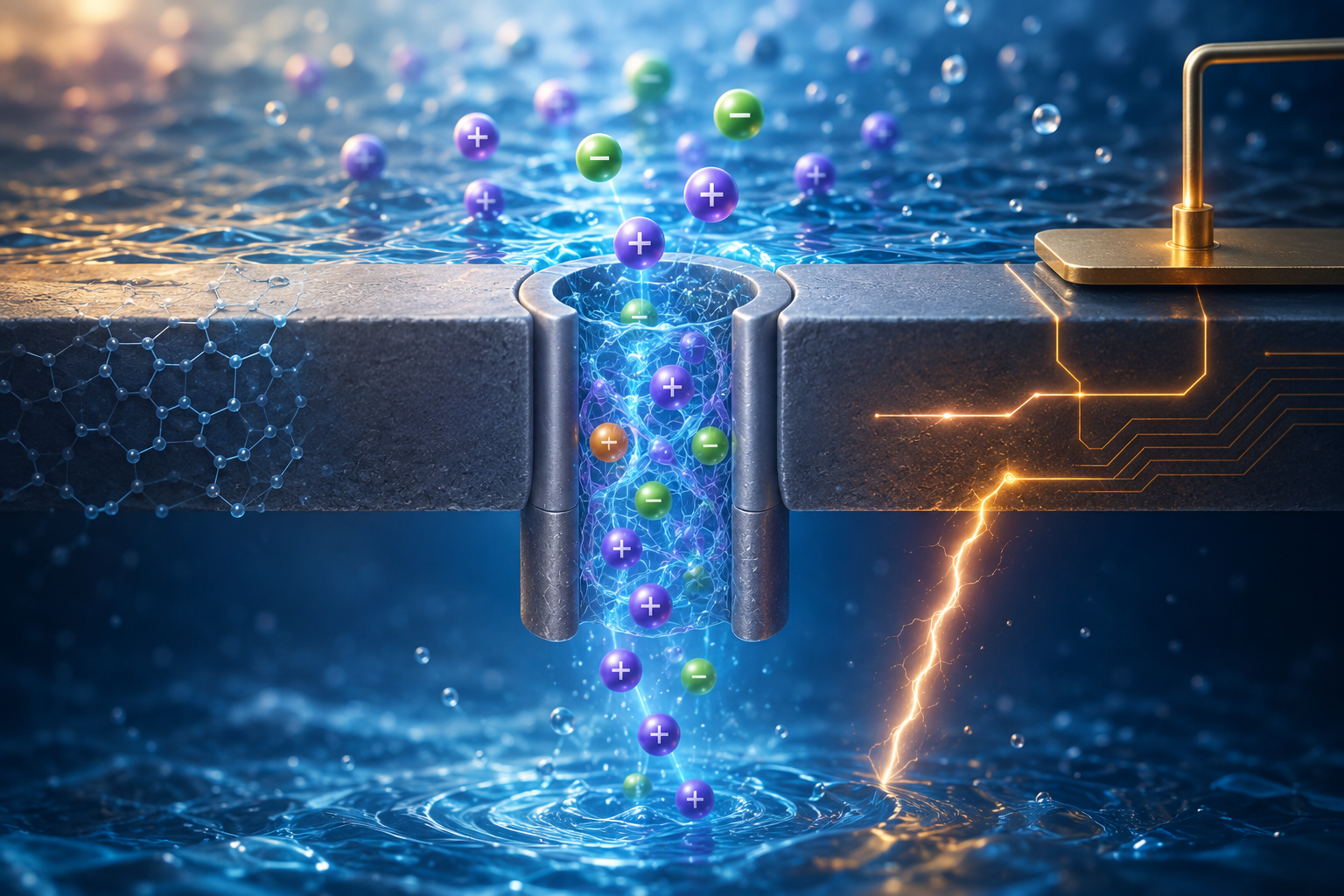
Paper: One-pore synthesis of ionic nanogel osmotic power generators. Image credit: AI-generated image created using ChatGPT/OpenAI
A recent study in the journal Communications Materials introduces a novel nanofabrication strategy for creating ultrathin ionic hydrogels inside individual solid-state nanopores. The resulting ionic nanogels exhibit tunable ion selectivity, exceptional ion permeability, and high pore-area-normalized osmotic power density. The technology offers a potentially scalable platform for next-generation nanofluidic devices, salinity-gradient energy harvesting systems, and ion-separation technologies, although membrane-scale performance still depends on pore spacing, active area, and concentration-polarization control.
Engineering Nanogels for Efficient Ion Transport
Selective ion transport underpins technologies such as water purification, desalination, chemical separations, and osmotic energy harvesting. In nanofluidic systems, charged nanopores can selectively transport certain ions while rejecting others. This capability enables the conversion of salinity gradients into electricity. However, achieving high ion selectivity without sacrificing ion transport remains a persistent challenge.
Conventional ion-exchange membranes face a fundamental trade-off between selectivity and permeability. Materials that selectively transport ions often restrict ionic flow, while highly permeable materials typically show weaker selectivity. Most hydrogel-based ion-selective membranes are micrometer- to submillimeter-scale thick, forcing ions to travel long distances and reducing transport efficiency.
To address this challenge, the researchers developed a strategy to form ionic hydrogels directly within nanoscale pores. The approach creates ultrathin ion-selective nanogels within lithographically fabricated silicon nitride nanopores. By minimizing transport distance, the design aims to improve ion permeability while preserving strong selectivity.
Voltage-Controlled Fabrication of Ionic Nanogels
The researchers fabricated nanopores ranging from tens of nanometers to micrometer-scale openings in diameter within thin silicon nitride membranes. They first coated the pore walls with chitosan, a positively charged polymer that anchored alginate molecules and modified the surface charge of the nanopores.
The team added a sodium alginate solution to one side of the membrane and a calcium chloride solution to the other. They initially applied a positive voltage to block calcium ions from entering the nanopore. Reversing the voltage drove calcium ions into the pore, where they crosslinked the alginate and formed an ionic hydrogel directly within the confined nanospace.
The researchers further tuned nanogel properties by adding phosphate-buffered saline to the alginate solution. This modification promoted the formation of calcium phosphate species within the gel network and altered its ion-transport properties. They also investigated alternative crosslinking ions, including aluminum, manganese, copper, and iron, to tailor nanogel behavior.
The team evaluated nanogel performance through electrical measurements of conductance, ion selectivity, and osmotic power generation under different salinity gradients. Scanning electron microscopy confirmed that gel formation remained confined to the nanopores, although the internal gel network and hydrated thickness could not be fully resolved after drying for microscopy. Additional experiments monitored local heat dissipation during gelation using integrated nanowire thermocouples. The researchers also employed gate-controlled nanopores to actively regulate ion transport with external electric fields.
Programmable Nanogels Deliver Exceptional Osmotic Power
The experiments showed that nanogel composition plays a central role in controlling ion transport. Calcium-crosslinked alginate nanogels without phosphate additives exhibited weak anion selectivity. In comparison, phosphate-containing nanogels showed strong cation selectivity because negatively charged calcium phosphate species were incorporated into the hydrogel network. Increasing phosphate concentration further enhanced cation selectivity and significantly boosted osmotic energy generation, but phosphate incorporation also reduced conductance, likely because embedded calcium-phosphate species partially obstructed ion flow and altered the polymer network.
The researchers also tuned ion transport behavior by varying the metal-ion crosslinker. Copper-crosslinked nanogels showed weak anion selectivity, whereas aluminum- and manganese-crosslinked systems favored cation transport. Iron-crosslinked nanogels exhibited more complex behavior, with ion selectivity varying under different salinity conditions due to competing iron oxidation states. These results demonstrate the versatility of one-pore synthesis for programming nanogel transport properties.
Microscopy confirmed that gel formation remained confined to individual nanopores, providing precise spatial control over gel formation. The ultrathin gels shortened ion transport pathways while maintaining strong selectivity. They combined high ion selectivity with exceptionally fast ion transport. As a result, ultrathin nanogels achieve areal conductance values exceeding 1000 S cm-², more than two orders of magnitude higher than those of conventional ion-exchange membranes.
Electrical measurements of the nanogels revealed pinched hysteresis loops arising from dynamic ion redistribution within the hydrogel network. This characteristic suggests potential applications in iontronic and neuromorphic nanofluidic devices. The highest pore-area-normalized performance was achieved using gate-controlled nanopores. Applying a negative gate voltage enhanced cation selectivity and increased osmotic power density by more than fourfold, reaching 213 kW m-² in a 70 nm gate-all-around nanopore.
Implications for Nanofluidic Energy Technologies
This study introduces a new approach for overcoming a longstanding limitation of ion-selective membranes. By confining hydrogel formation to individual nanopores, the researchers created ultrathin ion-transport pathways that combine high permeability with strong ion selectivity. The one-pore synthesis strategy effectively transforms nanopores into programmable nanofluidic reactors.
The results also highlight the versatility of ionic nanogels as functional nanomaterials. Their transport properties can be tailored through chemical additives, metal-ion crosslinkers, and external electric fields. This level of control enables the design of customized membranes for ion separation and energy conversion applications.
The nanogels exhibited memristive ion-transport behavior in addition to osmotic power generation, indicating potential applications in iontronic devices and neuromorphic computing. Their ability to dynamically regulate ion transport could support the development of adaptive nanofluidic circuits and bioinspired information-processing systems.
The study shows how precise nanoscale engineering can enable new functionalities in soft materials. The combination of voltage-controlled synthesis, programmable chemistry, and nanofluidic design provides a versatile platform for engineering advanced ionic materials. This approach could inform the development of renewable energy technologies, smart membranes, high-performance separation systems, and other next-generation nanofluidic technologies, provided that future designs address concentration polarization and improve membrane-scale performance.
Download your PDF copy by clicking here.
Disclaimer: The views expressed here are those of the author expressed in their private capacity and do not necessarily represent the views of AZoM.com Limited T/A AZoNetwork the owner and operator of this website. This disclaimer forms part of the Terms and conditions of use of this website.
Source:
- Tsutsui, M., Arima, A., et al. (2026). One-pore synthesis of ionic nanogel osmotic power generators. Communications Materials, Article in Press, unedited manuscript version. DOI: 10.1038/s43246-026-01242-6, https://www.nature.com/articles/s43246-026-01242-6