A cobalt-substituted magnetite nanozyme, wrapped in a CMC biopolymer and guided by anti-CD44 antibodies, targets one of glioblastoma’s toughest cellular targets through two complementary mechanisms.
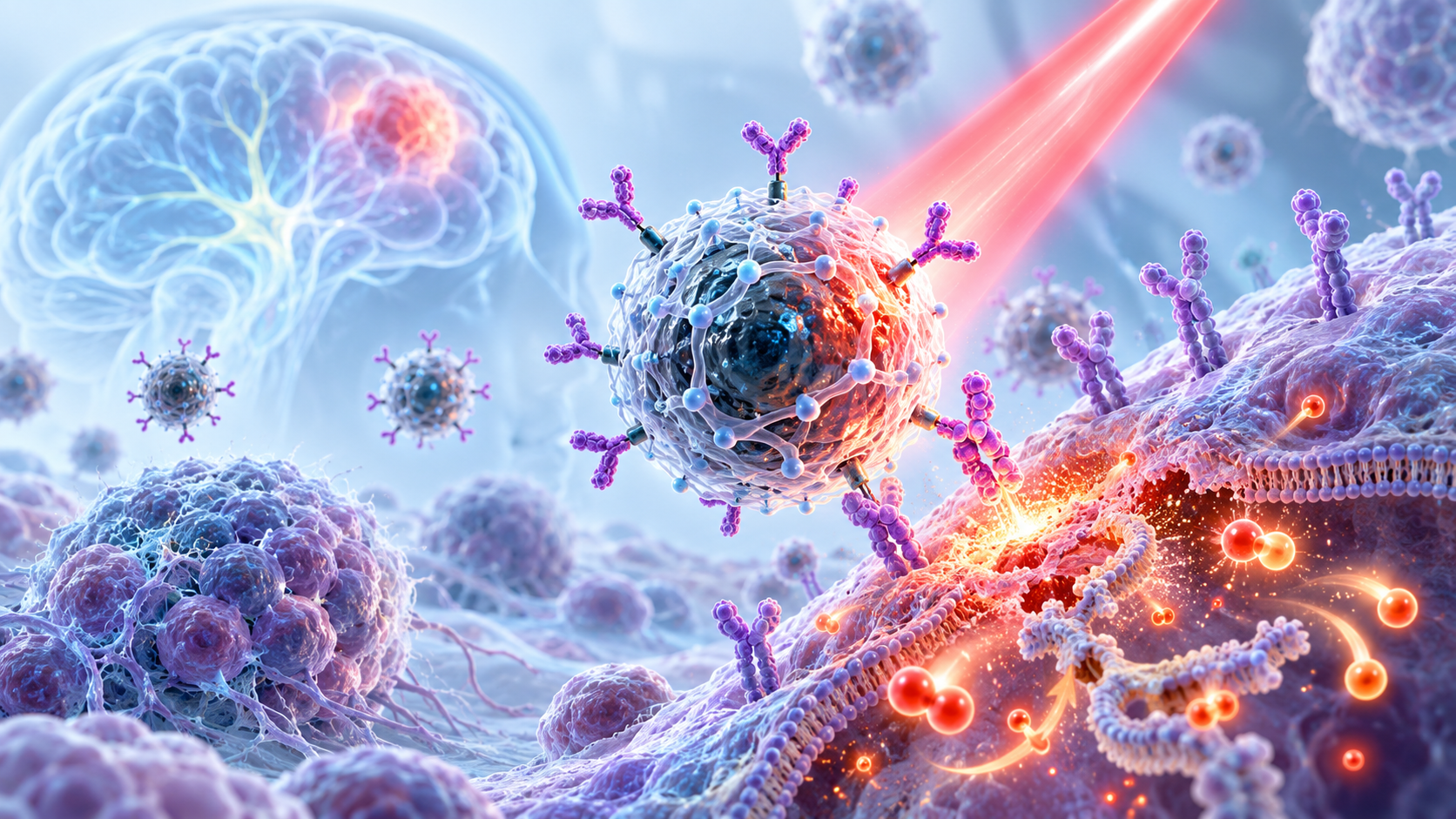
Paper: Bioengineered Carboxymethyl Cellulose-Based Immunoconjugates Templating Cobalt-Substituted Iron Oxide Nanoparticles for Targeted Enzyodynamic-Enabled Ferroptosis and Photothermal Therapy of Glioblastoma. AI-generated abstract conceptual image created using ChatGPT/OpenAI
A recent paper in the journal Polysaccharides reported a multifunctional immunonanosystem based on cobalt-substituted magnetite nanoparticles (Co0.4Fe2.6O4), stabilized with a carboxymethyl cellulose (CMC) biopolymer and functionalized with anti-CD44 antibodies for targeted, multimodal glioblastoma treatment.
Targeted Nanotheranostics for Glioblastoma Treatment
Glioblastoma multiforme (GBM) remains a virtually incurable and highly aggressive primary brain tumor despite major advances in oncology. The poor prognosis is largely linked to glioma stem-like cells (GSCs).
These GSCs are a treatment-resistant subpopulation that contributes to tumor recurrence. CD44 cell-surface receptors are highly expressed in GBM and GSCs. Targeted therapies that act through multiple anticancer mechanisms may help overcome these biological barriers.
In cancer nanotheranostics, nanozymes drive catalytic reactions in situ to eliminate cancer cells while limiting damage to healthy tissue by exploiting the tumor microenvironment's distinct biochemical features.
Enzyodynamic therapy (EDT) uses these nanozymes to generate cytotoxic levels of reactive oxygen species in the tumor. Ferroptosis is an iron-dependent form of regulated cell death that nanozyme-driven Fenton-like reactions and extensive lipid peroxidation can trigger.
EDT can be combined with photothermal therapy (PTT) to increase anticancer activity. Transition metal-doped iron-oxide nanoparticles combine both functions by acting as photothermal agents and ferroptosis-inducing nanocatalysts.
While doping magnetite with cobalt can increase nanosystem responsiveness and catalytic cell-killing activity, it raises systemic toxicity concerns, such as neurotoxicity from off-target leaching of Co²+ ions.
For that reason, hybrid supramolecular nanostructures may help shield the inorganic core and support active tumor targeting.
The Proposed Approach
In this work, researchers report the first combination of CMC, anti-CD44 antibodies, and cobalt-doped iron-oxide nanozymes in a single immunotheranostic system for GBM.
The inorganic-organic nanohybrids contained Co0.4Fe2.6O4, stabilized and templated by an anionic CMC polysaccharide, which researchers biofunctionalized with anti-CD44 antibodies to yield engineered biohybrids (Co0.4Fe2.6O4@CMC-abCD44).
CMC served as the template for nanoparticle nucleation and stabilization, while the Co0.4Fe2.6O4 core provided optical photothermal conversion and nanocatalytic activity mimicking peroxidase for anticancer therapy.
Anti-CD44 antibodies were coupled to CMC (CMC-abCD44) to biofunctionalize the inorganic-organic nanohybrids for immunotargeting GBM cells.
Study Methodology
Initially, Co0.4Fe2.6O4 was chemically stabilized and functionalized with CMC to form nanoconjugates, Co0.4Fe2.6O4@CMC, fabricated via aqueous co-precipitation.
To prepare the antibody-functionalized immunoconjugate, the researchers diluted the Co0.4Fe2.6O4@CMC suspension in phosphate-buffered saline (PBS) and activated CMC carboxyl groups with EDC and NHS-sulfo under stirring in an ice bath for 15 min.
Then, anti-CD44 antibody in PBS was added and incubated under moderate stirring at 26.0 ± 2 °C for 2 h. After incubation, they added ethanolamine hydrochloride and stirred for 10 min to quench the EDC-mediated crosslinking reaction.
During synthesis, the antibody-to-CMC polymer molar ratio was 1:100. Researchers prepared a blank sample as a reference by replacing the antibody with PBS (Co0.4Fe2.6O4@CMC-Blank).
The blank sample and Co0.4Fe2.6O4@CMC-abCD44 immunoconjugate were dialyzed against 2.5 L distilled water for 24 h at room temperature under moderate stirring.
Researchers then assessed long-term nanoconjugate stability and behavior in biological media; characterized the nanozyme, immunoconjugate, and biopolymer; and conducted laboratory studies covering catalytic activity, cell viability, CD44 targeting, ferroptosis markers, and combined EDT/PTT in two-dimensional cell cultures and three-dimensional gliomaspheres.
Findings of the Study
The results showed that colloidal nanoarchitectures consisted of polysaccharide-antibody bioconjugate layers surrounding inorganic Co-substituted magnetite nanoparticles (Co0.4Fe2.6O4; diameter: 5.7 nm; spherical morphology).
The resulting Co0.4Fe2.6O4@CMC-abCD44 immunoconjugates exhibited a zeta potential of −56 mV and a hydrodynamic diameter of 73 nm.
They induced preferential cytotoxicity toward CD44-expressing U-87 MG glioblastoma cells in two-dimensional culture and reduced cell viability in three-dimensional gliomaspheres through a multimodal mechanism involving biocatalytic enzyodynamic-enabled ferroptosis and PTT triggered by 660 nm laser irradiation.
In two-dimensional MTT assays, the antibody-functionalized nanozyme had an EC50 of 0.4 µg/mL based on Fe+Co content in U-87 MG cells, compared with 1.2 µg/mL in HEK 293T cells and 1.7 µg/mL in HepG2 cells. Blocking CD44 receptors with hyaluronic acid increased U-87 MG cell viability 2.7-fold at 4.0 µg/mL compared with cells without receptor blocking, supporting a CD44-mediated targeting effect.
Separate biochemical and inhibition experiments provided evidence for the proposed ferroptosis mechanism. The findings included increased reactive oxygen species, lipid peroxidation measured by malondialdehyde, changes in oxidized glutathione, and reduced cell killing with ferrostatin-1 or α-tocopherol. The authors state that further work is needed to map the full molecular mechanism.
Sodium CMC, a non-toxic, biocompatible polysaccharide, provided water solubility and controlled spatial organization of nanoconjugates in stable colloidal suspensions. CMC carboxylate groups also allowed antibody functionalization through EDC-NHS chemistry for active targeting.
A preliminary red-blood-cell assay placed hemolysis in the 2% to 5% range at concentrations up to 20 µg/mL, which the cited standard classifies as slightly hemolytic.
The polysaccharide responded to pH changes in the medium by maintaining sufficient negative charge for metal coordination during synthesis and by stabilizing the inorganic cores through electrostatic repulsion under mildly acidic to physiological conditions.
The researchers also tested treatment effects in three-dimensional gliomaspheres. In three-dimensional gliomaspheres treated with two 4.0 µg/mL doses, the immunoconjugate reduced spheroid size by 47%, compared with 28% for the material without anti-CD44 functionalization. Cell viability was 34% with the immunoconjugate and 65% with the non-targeted material.
In a separate combined-treatment experiment, the authors reported about 30% additional inhibition following 660 nm laser irradiation.
The findings come from cell culture experiments rather than animal studies or clinical trials. The experiments used U-87 MG cells and U-87 MG-derived gliomaspheres, not an isolated, verified GSC population, and the study did not quantify photothermal conversion efficiency. The differences seen among the tested cell lines also do not establish that normal brain tissue would be protected in a living organism.
In future work, the authors call for in vivo and preclinical testing of long-term safety and pharmacokinetics, studies of blood-brain barrier transport and delivery routes, and assessment of potential cobalt-related and photothermal risks to normal tissue.
The study provides proof of concept for a dual EDT/PTT strategy with CD44-directed targeting in GBM cell models, not a demonstrated treatment for patients.
Disclaimer: The views expressed here are those of the author expressed in their private capacity and do not necessarily represent the views of AZoM.com Limited T/A AZoNetwork the owner and operator of this website. This disclaimer forms part of the Terms and conditions of use of this website.
Source:
- Mansur, A. A., De Carvalho, S. M., Carvalho, I. C., & Mansur, H. S. (2026). Bioengineered Carboxymethyl Cellulose-Based Immunoconjugates Templating Cobalt-Substituted Iron Oxide Nanoparticles for Targeted Enzyodynamic-Enabled Ferroptosis and Photothermal Therapy of Glioblastoma. Polysaccharides, 7(4), 122. DOI: 10.3390/polysaccharides7040122, https://www.mdpi.com/2673-4176/7/4/122