A new review frames enzyme-mimicking nanomaterials as ecosystem-level tools that could help clean up pollutants, support green energy systems, and guide the development of safer environmental technologies.
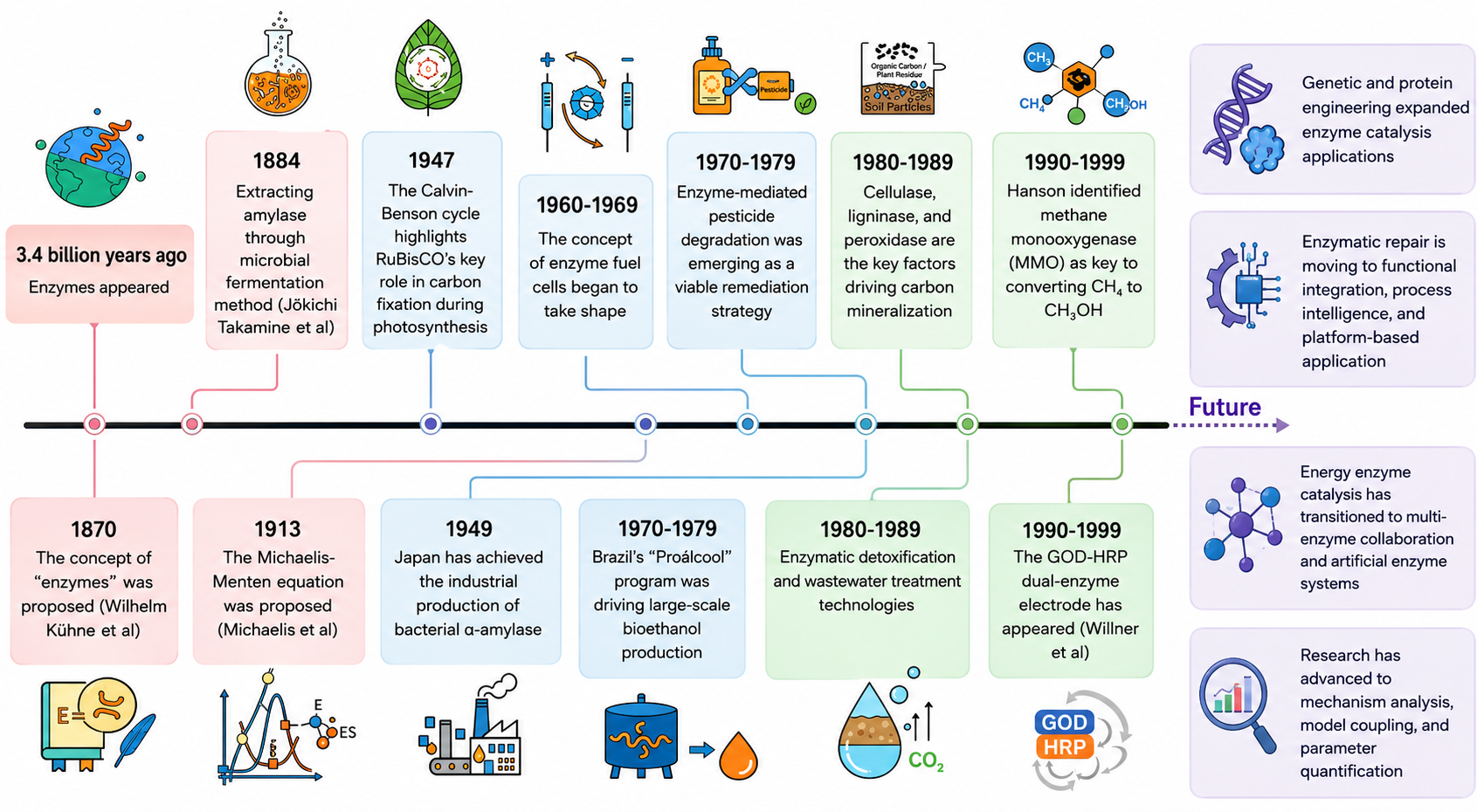
Historical trajectory of enzyme development in energy conversion and environmental remediation. Image Credit: Adapted from Shang L., Zhang Z., et al. (2026). Eco-Nanozymology: A Catalytic Paradigm Integrating Energy, Environment, and Ecology. Nano-Micro Letters using ChatGPT / OpenAI
In a recent review article published in the journal Nano-Micro Letters, researchers proposed the concept of eco-nanozymology, an interdisciplinary framework that integrates nanotechnology and enzymology principles to enhance energy conversion, environmental remediation, and ecosystem-level catalytic regulation.
Eco-Nanozymology Conceptual Framework
Eco-nanozymology is an emerging interdisciplinary field combining nanotechnology and enzymology to address challenges in energy conversion, environmental remediation, and ecosystem sustainability. Traditional enzymatic approaches, while critical in processes such as carbon fixation and pollutant degradation, suffer drawbacks including limited stability, narrow substrate specificity, limited operational lifespan, and high operational costs.
Nanozymes, nanomaterials that exhibit enzyme-like catalytic functions, offer a potential route to overcoming many limitations of natural enzymes through enhanced stability, tunable structures, and adaptable interfaces. Unlike conventional nanozyme research, which focuses on isolated reactions or material design, eco-nanozymology adopts an ecosystem-oriented framework that integrates catalytic activities into environmental transformation networks. Rather than treating nanozymes as isolated catalysts, the authors frame them as regulatory nodes in environmental systems.
This framework enables regulation of energy and matter cycling at the system level, improving the efficiency of processes such as nitrogen fixation, methane oxidation, and biomass valorization. The field emphasizes precise control of nanozyme interfacial microstructures, electronic distributions, multienzyme cascades, and carrier engineering to support greener technological pathways toward carbon neutrality and ecological balance.
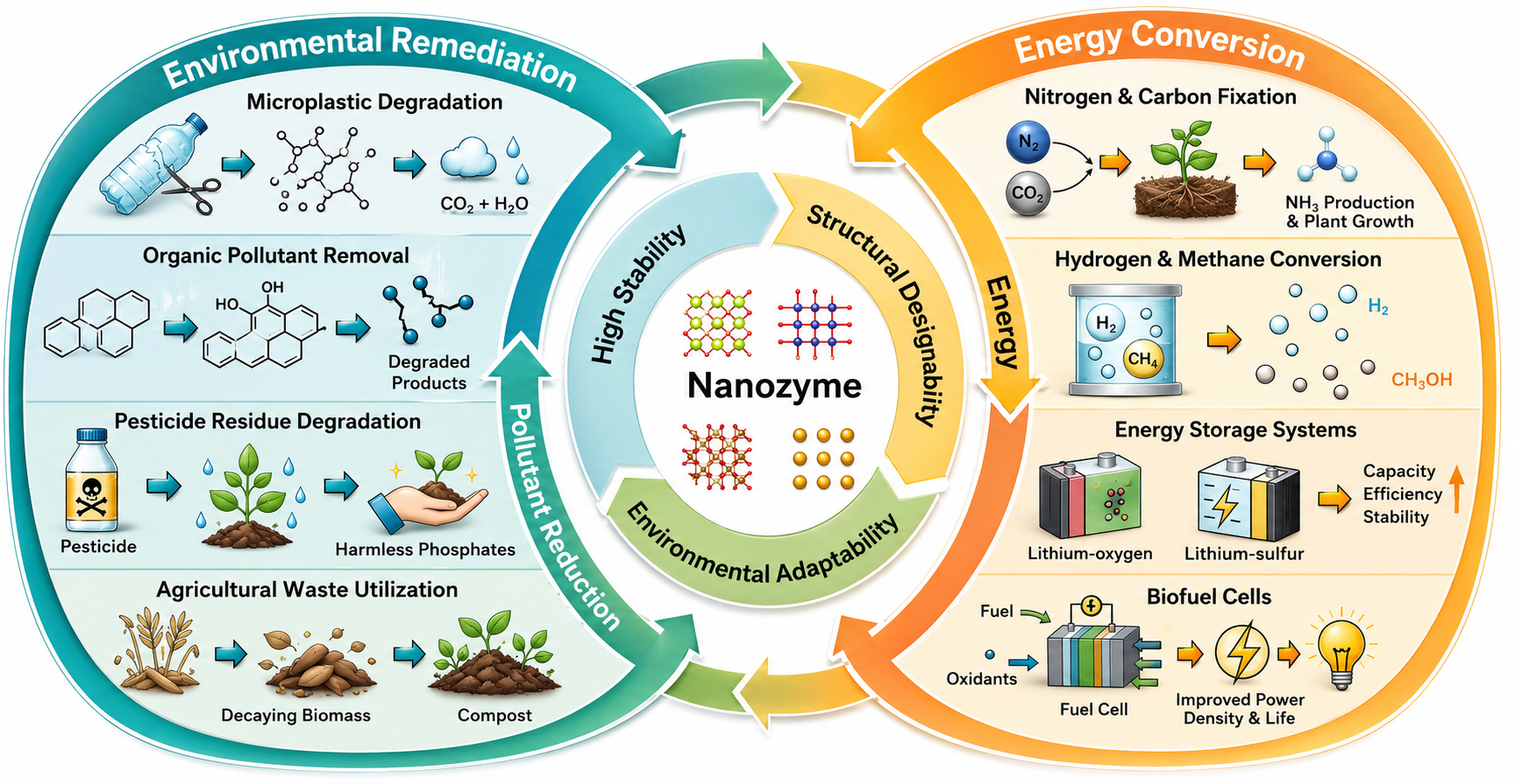
Research advances of eco-nanozyme in environmental remediation and energy conversion. Image Credit: Adapted from Shang L., Zhang Z., et al. (2026). Eco-Nanozymology: A Catalytic Paradigm Integrating Energy, Environment, and Ecology. Nano-Micro Letters using ChatGPT / OpenAI
Nanozyme Design and Modeling
The development of eco-nanozymology involves designing and engineering nanozymes to mimic or enhance the functions of natural enzymes in ecological contexts. Key strategies include molecular-level regulation of nanozyme active sites, optimization of interfacial microstructure, and electronic structure tuning to achieve high catalytic efficiency.
Multienzyme cascade systems and functionalized carrier substrates are employed to facilitate synergistic catalytic processes and improve substrate specificity and recyclability. Computational methods such as density functional theory (DFT) calculations, molecular dynamics simulations, and machine learning (ML) algorithms underpin the rational design of nanozyme systems by predicting structure-activity relationships and reaction mechanisms.
These theoretical tools enable screening of catalyst candidates and optimization of active site configurations considering environmental variables such as pH, ionic strength, and substrate composition. The review highlights experimental studies that employ biomimetic assembly techniques to create multilevel catalytic units that mimic natural enzymatic networks.
Such systems have been evaluated in previous studies for their catalytic performance in energy conversion reactions, such as nitrogen and carbon fixation, and in pollutant-degradation pathways under varied ecological conditions, assessing their stability, selectivity, and environmental compatibility.
The authors also discuss ecological stoichiometry and eco-enzymatic stoichiometry theories to align nanozyme function with ecosystem nutrient cycling requirements.
Catalytic Performance and Ecosystem Integration
The reviewed literature demonstrates important progress in designing eco-nanozymes that may improve catalytic efficiency, environmental robustness, and ecological compatibility, while overcoming selected limitations of natural enzymes, particularly stability, tunability, and recyclability.
In energy conversion, nanozymes mimicking the proton-coupled electron transfer (PCET) mechanisms of natural nitrogenases have been explored for nitrogen fixation under ambient conditions, aided by oxidase-like activity that regulates reactive oxygen species.
Carbon fixation is advanced by nanozyme-based artificial photosynthetic systems and carbon-fixation strategies that mimic or support key photosynthetic processes, with interfacial modulation allowing performance in diverse pH and ionic environments. Methane oxidation is promoted by nanozymes engineered to emulate methane monooxygenase, facilitating methane-to-methanol conversion while stabilizing intermediates.
In environmental remediation, oxidoreductase-like nanozymes show promising capabilities for degrading persistent organic pollutants, including organophosphate pesticides, phenolics, and microplastics. Structural biomimicry and surface engineering confer resistance to enzyme denaturation from salinity, temperature, and oxidative stress.
Functional differentiation between hydrolase- and oxidoreductase-like nanozymes enables synergistic degradation of pollutants across multiple chemical classes.
The incorporation of multienzyme cascade systems effectively simulates natural enzymatic pathways, fostering enhanced substrate selectivity and reaction rates through spatial confinement and optimized electron/proton transfer routes. Nanozyme-based platforms integrated with conductive carriers or magnetic substrates demonstrate recyclability and sustained catalytic function, critical for practical deployment.
Computational modeling and machine learning augment experimental findings by accelerating nanozyme discovery and optimization. Activity descriptors derived from DFT, combined with ML-based high-throughput screening, inform rational adjustments to active sites and surface chemistry that may improve performance and selectivity.
Environmental adaptability is a prominent theme, with emerging research on cold-adapted, or psychrophilic, nanozymes that retain activity under low temperatures by modifying electronic structures and defect sites, including oxygen vacancy engineering and Jahn-Teller distortions.
Photonic and ionic interfacial cues inspired by natural photosynthetic systems are explored to sustain catalytic activity across varying environmental gradients.
Sustainability and ecological safety considerations increasingly guide nanozyme design and application. Strategies to minimize ecological risks include controlling particle size, tuning degradability, and surface modifications to reduce toxicological impacts and bioavailability. A combined data-driven and experimental approach could support predictive ecological risk assessment, essential for responsible nanozyme deployment in complex environmental matrices. However, the review emphasizes that long-term ecological behavior, toxicity, mobility, degradation products, and regulatory standards remain insufficiently evaluated in real air, soil, and water systems.
Future Directions in Eco-Nanozymes
Future prospects for eco-nanozymology. Image Credit: Adapted from Shang L., Zhang Z., et al. (2026). Eco-Nanozymology: A Catalytic Paradigm Integrating Energy, Environment, and Ecology. Nano-Micro Letters using ChatGPT / OpenAI
Eco-nanozymology represents a proposed paradigm that integrates catalytic nanomaterials into ecological frameworks to enhance energy conversion, environmental remediation, and biogeochemical cycling. By combining biomimetic design, interfacial engineering, and advanced computational modeling, eco-nanozymes could help address key limitations of natural enzymes, achieving improved catalytic efficiency and environmental adaptability in selected applications.
Emphasizing ecological safety, stability, and material recyclability will foster practical deployment in real-world environmental matrices, provided that environmental fate, biosafety, and scalability challenges are resolved. Eco-nanozymology offers promising avenues for addressing global energy and environmental challenges through green and sustainable nanobiocatalysis.
Want to read later? Download your PDF copy by clicking here.