A new review shows how light-activated bismuth nanomaterials could help doctors see disease, destroy bacteria, and attack tumors, while highlighting the safety and engineering hurdles that still stand between the lab and the clinic.
Study: Light-driven bismuth-based biomedical nanoplatforms: opportunity and challenge
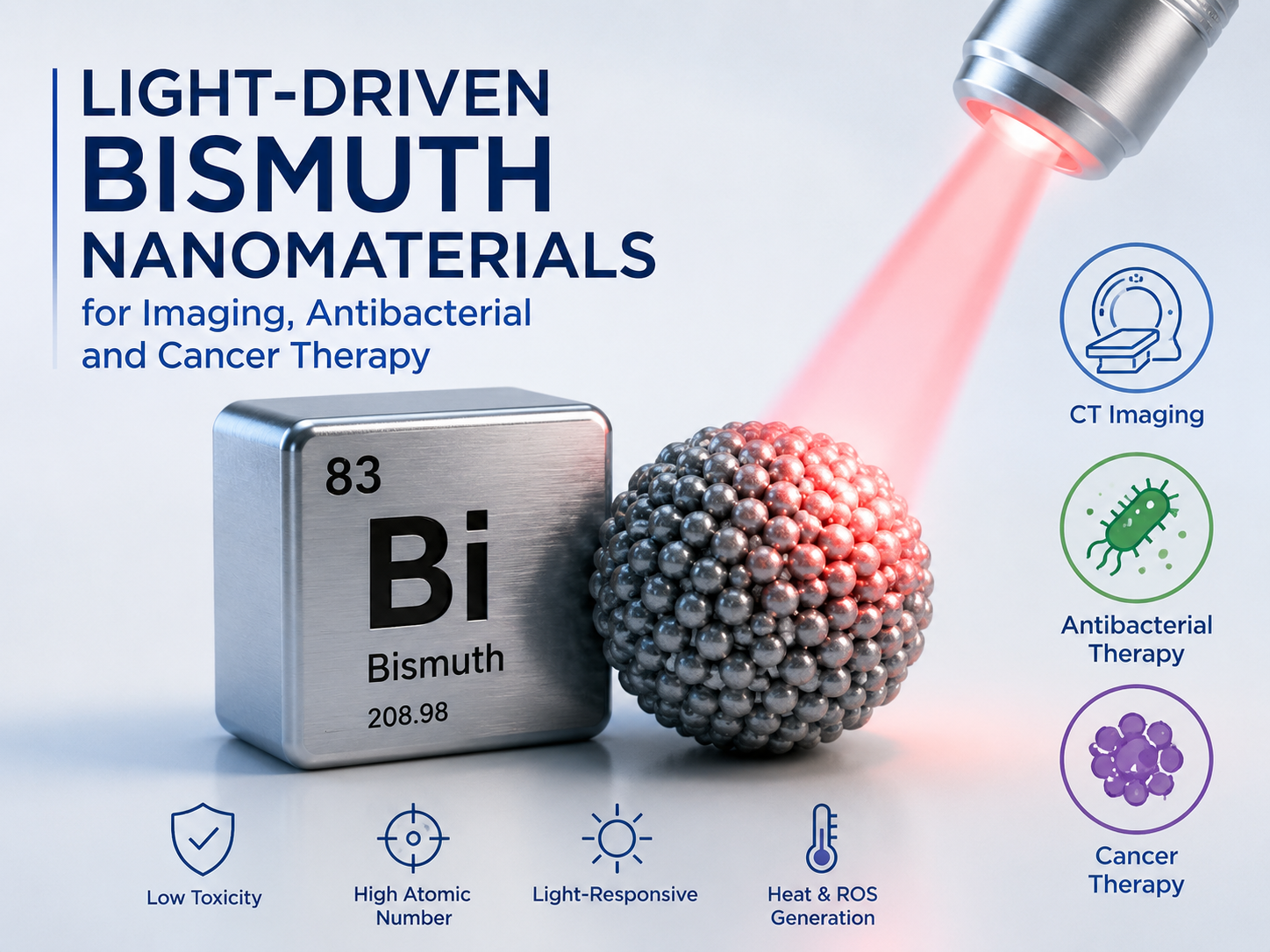
In a recent review article published in the journal Reviews in Inorganic Chemistry, researchers Zheng Han and Sihan Ma comprehensively examined the synthesis, optical properties, and biomedical applications of light-responsive bismuth-based nanomaterials, highlighting their emerging potential as experimental multifunctional nanoplatforms for imaging-guided antibacterial and anticancer theranostics.
Bismuth Nanomaterials in Biomedicine
The review examines the growing role of light-responsive bismuth-based nanomaterials in biomedical applications, particularly in imaging, antibacterial therapy, and cancer treatment. Bismuth-based nanoplatforms have attracted considerable attention because they combine low toxicity, relatively good biocompatibility, high atomic number, cost-effectiveness, and unique optical properties.
At the nanoscale, these materials exhibit strong interactions with light, enabling efficient conversion of light energy into heat or reactive oxygen species (ROS). Such properties make them suitable for photothermal therapy (PTT), photodynamic therapy (PDT), photocatalytic therapy (PCT), and biomedical imaging.
The authors emphasize that conventional diagnosis and treatment are often carried out separately, which can limit efficiency and precision. Bismuth-based nanomaterials offer an opportunity to integrate diagnosis and therapy into a single theranostic platform.
Their high atomic number enables strong X-ray attenuation for computed tomography (CT) imaging, while their tunable electronic structures support photoacoustic imaging and light-triggered therapeutic effects.
Advances in Bismuth Nanoplatforms
The review presents numerous examples demonstrating how nanoscale engineering enhances the biomedical performance of bismuth-based materials. It also compares major synthesis approaches, including hydrothermal and solvothermal synthesis, template methods, microwave-assisted synthesis, sol-gel routes, microemulsion, sonochemical, electrochemical, photochemical, and physical strategies, noting trade-offs in morphology control, purity, cost, safety, scalability, and yield.
In imaging applications, several nanoplatforms have been developed as CT contrast agents. Spirulina-bismuth biohybrid nanomaterials demonstrated strong CT contrast enhancement across multiple organs following intravenous administration, demonstrating the effectiveness of bismuth-containing nanostructures for in vivo imaging. Similarly, PEGylated Cu3BiS3 hollow nanospheres showed concentration-dependent CT signal enhancement in vitro, while uniform elemental bismuth nanoparticles exhibited excellent X-ray attenuation, allowing improved visualization of the gastrointestinal tract.
Photoacoustic imaging represents another important application highlighted in the review. Sulfur-deficient plasmonic Bi2S3−x-Au heterostructures were reported as efficient photoacoustic contrast agents owing to their strong near-infrared absorption and enhanced photothermal conversion capabilities.
Bi/Bi2O3−x nanostructures further demonstrated the ability to accumulate within tumors and generate strong photoacoustic signals, enabling imaging-guided therapeutic interventions in preclinical models.
In antibacterial therapy, the review highlights several nanosystems that exploit both photothermal and photocatalytic mechanisms. Oxygen-vacancy-rich BiO1−xI nanoparticles coated with glycol chitosan and polydopamine exhibited targeted antibacterial activity in diabetic wound models. Upon near-infrared irradiation, these nanomaterials generated heat and ROS simultaneously, leading to efficient bacterial eradication and accelerated wound healing.
Another notable example involved Bi2S3/Ag2WO4 heterostructures that employed an S-scheme charge transfer pathway to enhance photocatalytic ROS generation against bacterial pathogens. Interfacial engineering of Bi2S3/Ti3C2Tx MXene heterostructures further improved charge separation and photothermal effects, resulting in rapid bacterial membrane disruption and efficient elimination of tested Gram-positive and Gram-negative bacteria, including Staphylococcus aureus and Escherichia coli.
The review also discusses several nanoplatforms for cancer therapy. Plasmonic bismuth nanoparticles encapsulated within nitrogen-doped carbon matrices were designed for combined CT imaging, photothermal therapy, photodynamic therapy, and chemotherapy.
These multifunctional nanosystems generated ROS under near-infrared irradiation while simultaneously producing localized hyperthermia, resulting in enhanced tumor destruction in experimental tumor models. Ultrathin two-dimensional bismuthene nanosheets were highlighted for their strong optical absorption, efficient electron-hole separation, and strong light-responsive therapeutic performance.
Engineering Strategies and Challenges
A central theme of the review is that the biomedical performance of bismuth-based nanomaterials depends heavily on nanoscale structural design. Parameters such as particle size, morphology, crystal structure, surface chemistry, defect density, and heterostructure formation directly influence light absorption, charge transport, ROS generation, and thermal conversion efficiency.
The authors discuss several strategies for improving light-triggered therapeutic performance. One approach involves defect engineering, particularly the introduction of oxygen or iodine vacancies. These defects modify electronic band structures, facilitate charge carrier separation, and create additional active sites for ROS generation. For example, iodine-deficient BiOI nanosheets exhibited improved photocatalytic activity because vacancy formation altered the valence band position and enhanced carrier transport.
Another important strategy is heterojunction construction. By combining bismuth-based semiconductors with complementary materials, researchers can promote efficient separation of photogenerated electrons and holes, thereby reducing recombination losses. This leads to increased ROS production and stronger antibacterial or anticancer activity. The review presents several examples where heterostructure engineering substantially improved therapeutic outcomes.
Morphological control also plays a significant role. Nanostructures such as nanosheets, hollow spheres, nanorods, and ultrathin two-dimensional materials possess large surface areas and unique optical properties that facilitate enhanced light harvesting. Surface plasmon resonance effects, especially in elemental bismuth-containing nanostructures, further contribute to improved photothermal performance by increasing light absorption across broad spectral regions.
Future Directions and Prospects
The review concludes that light-responsive bismuth-based nanomaterials represent a highly promising class of theranostic nanoplatforms capable of integrating diagnosis and treatment within a single system. Their unique combination of strong X-ray attenuation, efficient photothermal conversion, ROS generation capability, and favorable biocompatibility enables applications ranging from CT and photoacoustic imaging to antibacterial therapy and cancer treatment.
However, the authors emphasize that clinical translation remains limited by incomplete understanding of morphology-function relationships, the need for stronger, broad-spectrum, and NIR-II optical performance, and the lack of systematic long-term biosafety data, including metabolism, cytotoxicity, hemolysis, and coagulation effects.
Continued research addressing these issues is expected to accelerate the development of next-generation bismuth-based nanomedicines and facilitate their transition from experimental systems to clinically relevant biomedical technologies.
Download your PDF copy by clicking here.