By pairing robust artificial enzymes with highly selective aptamers, nanozyme aptasensors could help detect disease biomarkers, pathogens, and contaminants faster, but the review shows that real-world deployment still depends on overcoming matrix interference, biofouling, and manufacturing challenges.

Study: Advancing nanozyme aptasensors status quo via strategies and key fabrication considerations. Image credit: AI-generated image created using ChatGPT/OpenAI
A recent review accepted as an 'Article in Press' in the journal npj Biosensing explored how synthetic enzyme-like nanomaterials, known as nanozymes, can be combined with highly selective deoxyribonucleic acid (DNA) or ribonucleic acid (RNA) oligonucleotide recognition elements called aptamers. These hybrid platforms, referred to as nanozyme aptasensors, combine the stability of nanozymes with aptamer-mediated molecular recognition to enable accurate target detection.
The review highlights selected nanozyme aptasensor examples that can detect specific targets at concentrations as low as 7.5 pg/mL, although comparisons with earlier systems, such as those with detection limits of 1 nM, should be interpreted cautiously because they involve different targets, units, and assay architectures. Their sensitivity, robustness, and potential scalability make them promising candidates for point-of-care diagnostics and environmental monitoring, where they could support the detection of trace contaminants and disease biomarkers in complex samples.
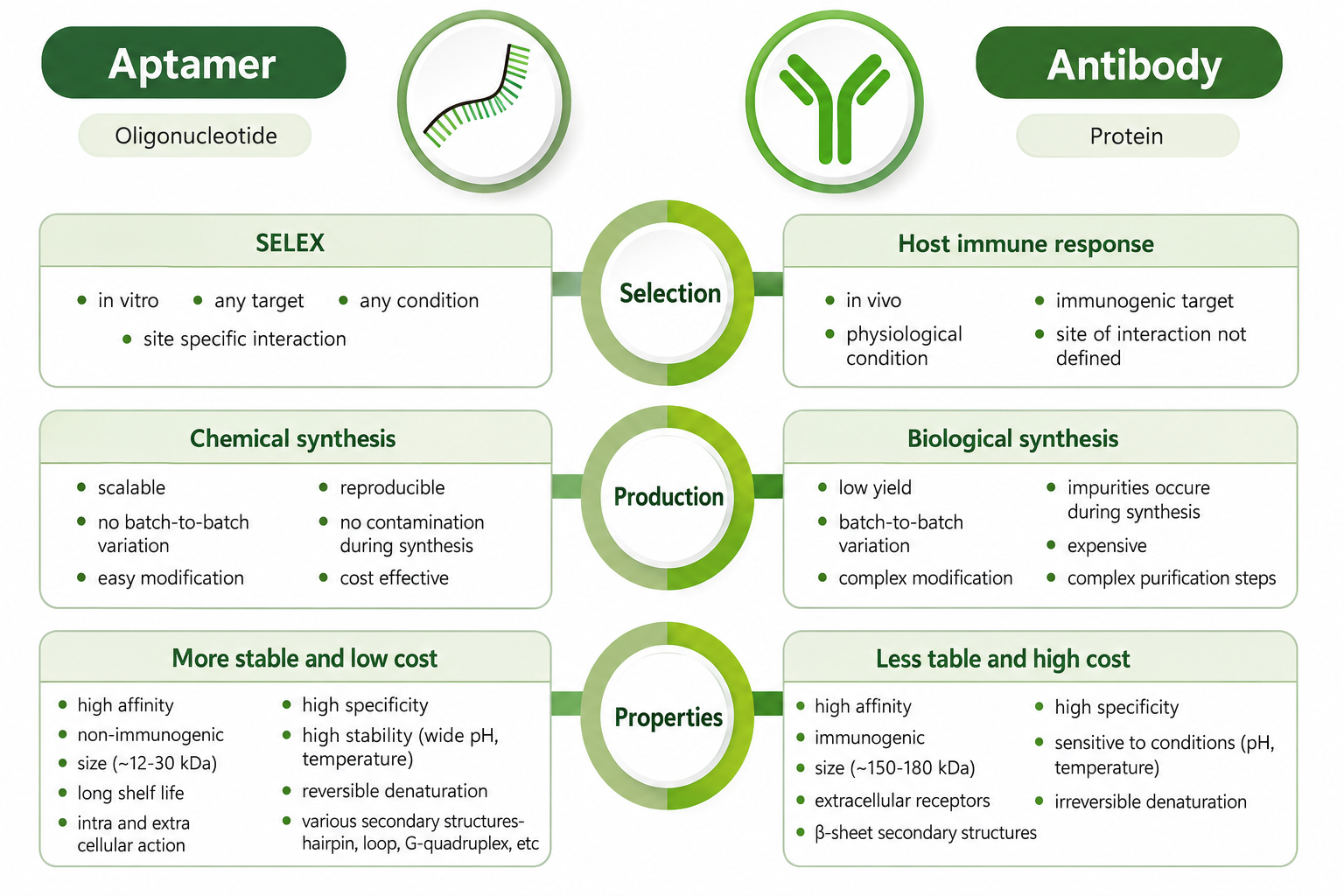
The comparison between aptamers and antibodies, two commonly used MREs or bioreceptors, during biosensor development. Image Credit: Adapted from Weerathunge, P., Bagree, G., Mahasivam, S., Amarasinghe, E., Ramanathan, R., & Bansal, V. (2026). Advancing nanozyme aptasensors status quo via strategies and key fabrication considerations. Npj Biosensing. DOI:10.1038/s44328-026-00110-0 using ChatGPT / Oen AI
Addressing the Shortcomings of Natural Enzymes
Traditional biosensors rely heavily on natural enzymes due to their high specificity and fast catalytic activity. However, these enzymes can be expensive to produce, require complex purification processes, and lose activity when exposed to heat or varying environmental conditions. Their limited stability complicates long-term storage and field use.
To address these challenges, researchers have developed nanozymes, synthetic nanomaterials that mimic the catalytic activity of natural enzymes. They can be composed of materials such as noble metals, metal oxides, carbon nanomaterials, and metal-organic frameworks. Compared to natural enzymes, nanozymes offer greater stability, longer shelf life, lower storage requirements, and more consistent large-scale production.
Diverse Architectures of Nanozyme Aptasensors
Nanozyme aptasensors can be constructed by attaching synthetic single-stranded DNA or RNA receptors to the surface of nanozymes. These aptamers are often selected through the Systematic Evolution of Ligands by Exponential Enrichment (SELEX) process, which identifies sequences that bind strongly and specifically to targets ranging from small molecules to whole cells. Because aptamers are chemically synthesized, they exhibit minimal batch-to-batch variation and are less expensive to produce than antibodies.
Researchers categorized nanozyme aptasensors into three main designs. The first is the nanozyme and aptamer-based immunosorbent assay (NAISA). In this format, a capture probe immobilized on a microtiter plate binds the target, while a second aptamer linked to a nanozyme generates the detection signal through a sandwich structure.
The second design is adsorption/desorption-based sensors, which are label-free approaches that rely on the reversible adsorption of aptamers onto the nanozyme surface. Upon target binding, the aptamer undergoes a conformational change or detaches from the surface, exposing or blocking the nanozyme's active sites and switching the catalytic signal.
The third format is amplification-based systems, which combine nanozymes with nucleic acid amplification methods to improve sensitivity. Techniques, including loop-mediated isothermal amplification (LAMP), catalytic hairpin assembly (CHA), hybridization chain reaction (HCR), and polymerase chain reaction (PCR), are integrated with nanozyme readouts to amplify nucleic acid recognition or signal output. This enables the detection of very low concentrations of target molecules. The review emphasizes that these formats involve trade-offs: NAISA offers high specificity, adsorption/desorption formats offer simpler, label-free operation, and amplification-based systems offer higher sensitivity at the cost of greater complexity.
Sensitivity and Performance Metrics
The review traces the evolution of nanozyme aptasensors over the past decade. Recent designs have significantly enhanced sensitivity, exemplified by a representative hybrid nanoprobe for cardiac troponin I that achieved a detection limit of 7.5 pg/mL with a linear range of 0.01-100 ng/mL. These advancements have been driven by improved control over sensor architecture, including the use of DNA nanotetrahedra that enhance target accessibility, although this cardiac troponin I system also involved horseradish peroxidase (HRP) and DNAzyme co-catalysis rather than a nanozyme-only readout.
Implications for Diagnostics and Environmental Monitoring
Nanozyme aptasensors have significant implications for clinical diagnostics, food safety, and environmental monitoring. Their high stability and straightforward operation make them promising for field testing, where conventional enzyme-based sensors often underperform, although practical deployment remains an active development challenge.
In food safety, paper-based sensors made from carbon nitride and copper oxide nanomaterials can detect Salmonella typhimurium in as little as six minutes. Other platforms identify foodborne pathogens, including Listeria monocytogenes, and detect pesticides such as acetamiprid and chlorpyrifos in samples such as water, milk, and fruit juice.
In clinical diagnostics, nanozyme aptasensors have been reported for detecting biomarkers such as cardiac troponin I and mucin 1, with potential relevance for earlier cardiovascular disease and cancer diagnostics. Reported environmental monitoring platforms have used these sensors to measure metal ions, such as Hg2+, and pesticide and antibiotic contaminants, including kanamycin.
Future Directions and Technological Integration
In summary, the next step for nanozyme aptasensors is to translate laboratory designs into practical point-of-care devices. Microfluidic systems, printable paper-based sensors, and label-free formats offer simple, low-cost platforms for field testing. However, widespread use will require better control of biofouling, matrix interference, and changes in nanozyme activity when testing complex clinical or environmental samples.
The review also highlights the growing prospective role of artificial intelligence (AI) and machine learning (ML) in sensor development. These tools could help predict aptamer-nanozyme interactions and optimize signal amplification strategies. Advancements in materials engineering, sensor design, and computational modeling could support the large-scale production of portable nanozyme aptasensors for healthcare, environmental monitoring, and food safety.
Disclaimer: The views expressed here are those of the author expressed in their private capacity and do not necessarily represent the views of AZoM.com Limited T/A AZoNetwork the owner and operator of this website. This disclaimer forms part of the Terms and conditions of use of this website.
Source:
- Weerathunge, P., Bagree, G., Mahasivam, S., Amarasinghe, E., Ramanathan, R., & Bansal, V. (2026). Advancing nanozyme aptasensors status quo via strategies and key fabrication considerations. npj Biosensing. DOI: 10.1038/s44328-026-00110-0, https://www.nature.com/articles/s44328-026-00110-0