A new University of Manchester study shows that the hidden core of polymer nanoparticles can tune ice growth, opening a more precise route to scalable synthetic materials for cryopreservation, frozen foods, and anti-icing technologies.
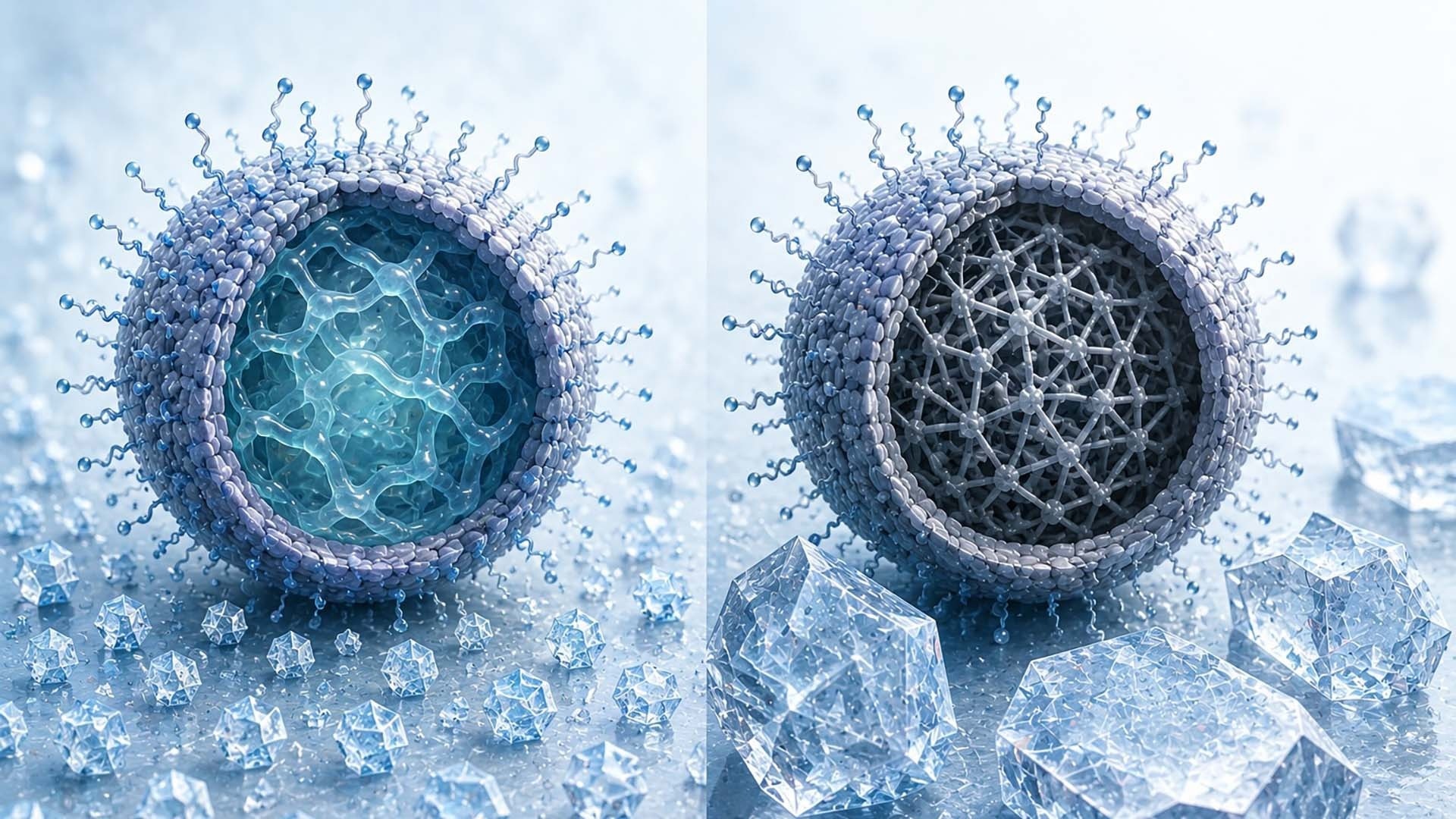
Study: Core-block engineering enables control of ice recrystallisation inhibition in polymer nanoparticles. Image Credit: University of Manchester
In a recent research article published in the journal Chemical Science, researchers demonstrated that the internal hydrophobic core of polymer nanoparticles synthesized via polymerization-induced self-assembly (PISA), rather than the hydrophilic corona alone, plays a dominant role in ice recrystallization inhibition (IRI) activity, revealing new design strategies for synthetic cryoprotectants.
Ice Recrystallization and Nanoparticles
Controlling ice formation and growth is vital for applications such as cryopreservation, food storage, and anti-icing, where ice-binding proteins (IBPs) naturally inhibit ice recrystallization (IRI) but are limited by cost and complexity. Synthetic analogs, including small molecules, polymers, peptides, and 2D materials, have shown IRI activity, yet typically with lower potency than IBPs.
Polymerization-induced self-assembly (PISA) offers a scalable route to the synthesis of block copolymer nanoparticles with controlled morphologies and chemistries. Remarkably, nanoparticles with non-IRI-active hydrophilic coronas exhibit enhanced ice growth inhibition compared to free polymer chains, suggesting emergent properties from nanoparticle formation.
Previous work focused primarily on the corona, assuming the hydrophobic core to be inert. This study challenges that assumption by systematically investigating the roles of both corona and core blocks, considering core chemistry, rigidity (glass transition temperature), and crosslinking in the IRI activity of PISA-derived polymer nanoparticles, with a particular focus on spherical systems.
PISA Nanoparticle Synthesis & Characterization
A broad library of PISA-derived block copolymer nanoparticles was synthesized using RAFT-mediated aqueous polymerization-induced self-assembly (PISA). Three different corona-forming precursor polymers were employed to span a range of surface chemistries: zwitterionic poly(2-(methacryloyloxy)ethyl phosphorylcholine) (PMPC), anionic poly(sodium 2-acrylamido-2-methyl-propanesulfonate) (PAMPS), and cationic poly[2-(methacryloyloxy)ethyl]trimethylammonium chloride (PMETAC).
These precursors were chain-extended with core-forming blocks of varying chemistry and length, including benzyl methacrylate (PBzMA), diacetone acrylamide (DAAM), benzyl acrylate (PBzA), or 2-hydroxyethyl methacrylate (PHEMA). These combinations produced different morphologies, including spheres, worms, and vesicles, depending on composition.
By varying the core block type and degree of polymerization (DP), the authors controlled the core rigidity and size. For instance, PBzMA cores have a higher glass transition temperature (Tg ~62 °C), rendering them relatively glassy and rigid at sub-zero temperatures, while PBzA cores are softer with Tg around 9 °C.
Nanoparticle sizes and morphologies were characterized using dynamic light scattering (DLS) and transmission electron microscopy (TEM), confirming that particles are mainly spherical across the core-comparison series, with sizes ranging from tens to several hundred nanometres, depending on composition and morphology. The authors also introduced core crosslinking by incorporating ethylene glycol dimethacrylate (EGDMA) comonomers during chain extension to chemically restrict the cores further.
The ice recrystallization inhibition (IRI) activity was assessed using a standardized “splat” assay. In this method, a thin wafer of ice (less than 10 microns thick) is formed and annealed at -8 °C to allow ice crystal growth. The mean grain size (MGS) of ice crystals after 30 minutes is measured relative to a 0.1 M NaCl control. IRI activity is reported as a percentage of MGS relative to control, with lower values indicating stronger inhibition.
Importantly, data were normalized based on the concentration of coronal polymer chains to enable fair comparisons across particles of different sizes and compositions, and control experiments confirmed that free polymers alone at equivalent concentrations exhibited minimal IRI activity.
Core Chemistry Governs IRI Activity
Spherical diblock copolymer nanoparticles with zwitterionic, anionic, or cationic coronas all exhibited enhanced ice recrystallization inhibition (IRI) compared to their free polymer chains, indicating emergent nanoparticle functionality with no clear dependence on corona charge alone. Larger nanoparticles generally showed stronger IRI than smaller ones, highlighting a size-dependent effect.
A key discovery was that core block properties profoundly influence IRI: nanoparticles with soft, low glass transition temperature (Tg) PBzA cores showed significantly greater IRI activity than those with hard, high Tg PBzMA cores, despite identical coronas and related particle architectures. For example, PMETAC123-PBzA2000 particles reduced ice grain size to ~10% of the control, whereas PBzMA analogs reduced it to ~50%.
The authors suggest this difference may reflect increased chain mobility in soft cores, potentially enabling amphiphilic copolymer chains or deformable nanoparticle interfaces to interfere with ice growth, although the precise mechanism remains unresolved. Increasing core length and particle size further enhanced IRI in a dose-dependent manner, suggesting interfacial presentation and aggregation may also contribute.
Crucially, core-crosslinking of soft PBzA nanoparticles using EGDMA chemically restricted the core and completely abolished IRI activity, despite only modest changes in Tg, confirming that core dynamics are strongly implicated in inhibition. These findings shift the focus from corona-only effects to include core engineering, opening new avenues for designing potent, tunable cryoprotectant nanoparticles via control of internal structure and mobility.
New Design Space for Cryoprotective Nanoparticles
This study reveals that the internal hydrophobic core can strongly influence ice recrystallization inhibition (IRI) in PISA-derived spherical polymer nanoparticles, refining the previous emphasis on surface chemistry. Soft, low Tg cores were more active than rigid, high Tg cores in this experimental system, although their activity remained lower than that of ice-binding proteins and higher than that of many small molecules and polymers reported in the literature. Crosslinking the soft cores, which reduces chain mobility and eliminates IRI activity, underscores the importance of core dynamics.
This work also prompts a broader investigation into how macromolecular assemblies influence phase transitions, such as ice crystallization. Expanding this approach to diverse nanoparticle structures could enable the development of advanced nanomaterials for biomedical, industrial, and environmental applications requiring effective ice growth suppression, although these applications remain prospective and were not directly tested in this study.
Want to read later? Download your PDF copy by clicking here.